

Article
Paul Stronski
{
  "authors": [
    "Paul Stronski"
  ],
  "type": "legacyinthemedia",
  "centerAffiliationAll": "dc",
  "centers": [
    "Carnegie Endowment for International Peace"
  ],
  "collections": [],
  "englishNewsletterAll": "ctw",
  "nonEnglishNewsletterAll": "",
  "primaryCenter": "Carnegie Endowment for International Peace",
  "programAffiliation": "russia",
  "programs": [
    "Russia and Eurasia"
  ],
  "projects": [],
  "regions": [
    "North America",
    "United States",
    "Russia"
  ],
  "topics": [
    "Security",
    "Foreign Policy"
  ]
}
Source: Getty
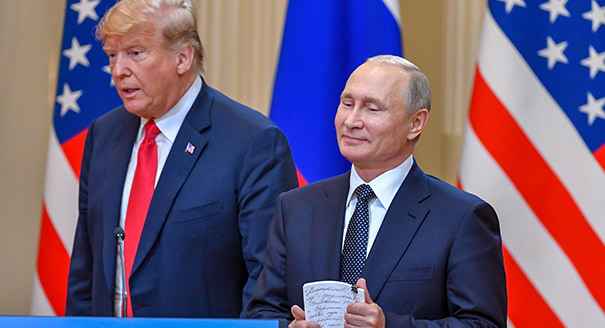
President Trump’s performance at his press conference with Russian President Vladimir Putin could scarcely have been more favorable to Putin or more threatening to the security of U.S. democracy.
Source: Axios
At President Trump’s press conference with Russian President Vladimir Putin on Monday, he assigned blame to the U.S. and complained about Robert Mueller's “witch hunt,” showing indifference to Russia’s meddling in both Ukraine and the 2016 U.S. election. His performance could scarcely have been more favorable to Putin or more threatening to the security of American democracy.
Why it matters: The press conference will create a lasting disconnect between the president and his national security team. It will now be much harder to continue assuring U.S. allies that they can ignore what Trump says.
Last week’s indictment of 12 Russian intelligence officers amplified what was already widely known: In 2016, Russian intelligence hacked into private U.S. email accounts and disseminated stolen information to damage Hillary Clinton’s campaign and tip the scales in Trump’s favor.
With the indictments weighing heavily on the summit, Trump, standing next to Putin, continued to deflect, deny and dismiss the findings of his own country’s intelligence community, at times citing a wandering list of grievances about Clinton and U.S. law enforcement.
Trump went so far as to contradict his own Director of National Intelligence, Dan Coats, giving equal weight to Coats’ assessment of Russian meddling and Putin’s denial of it. Trump's advisers, including U.S. Ambassador to Russia Jon Huntsman, appeared stunned by his comments.
The bottom line: The conference stands out as a uniquely submissive moment in the country’s recent history. It also fully fits Trump’s diplomatic worldview: He belittled and insulted longstanding friends and allies last week, and today appeased a major adversary — all of which redounds to Putin's benefit.
Former Senior Fellow, Russia and Eurasia Program
Paul Stronski was a senior fellow in Carnegie’s Russia and Eurasia Program, where his research focuses on the relationship between Russia and neighboring countries in Central Asia and the South Caucasus.
Recent Work
Paul Stronski
Paul Stronski
Carnegie does not take institutional positions on public policy issues; the views represented herein are those of the author(s) and do not necessarily reflect the views of Carnegie, its staff, or its trustees.

Are Germany’s economic, industrial, and political struggles becoming a liability for the EU’s ability to rise to the geopolitical moment?

Rym Momtaz, ed.

European Commission President Ursula von der Leyen is about to give her annual address on the state of the EU. Here’s what she won’t—but should—say.
Rym Momtaz

Radical-right parties are expected to do well in upcoming elections in four of the EU's biggest member states. If successful, they could prevent the union from addressing key challenges ahead.

Stefan Lehne

The aftermath of the Ceuta crisis shows Europe has drawn the wrong lessons. Rather than doubling down on failed migration policies, the EU needs to address the underlying roots of such episodes.

Richard Youngs

Canadian Prime Minister Mark Carney has twice inspired praise for standing up to U.S. President Donald Trump: at the 2026 World Economic Forum in Davos and on Canada-U.S. trade negotiations. Is Carney showing a third way better than the EU has in dealing with the Trump administration?
Rym Momtaz, ed.