

Commentary
The EU can impose sanctions but struggles to enforce them without the United States. With Washington increasingly disinterested in backing European interests, the bloc must now fend for itself.
Nicu Popescu, Tiago Antunes
{
  "authors": [
    "Andrew Miller",
    "Richard Sokolsky"
  ],
  "type": "legacyinthemedia",
  "centerAffiliationAll": "dc",
  "centers": [
    "Carnegie Endowment for International Peace",
    "Malcolm H. Kerr Carnegie Middle East Center"
  ],
  "collections": [],
  "englishNewsletterAll": "menaTransitions",
  "nonEnglishNewsletterAll": "",
  "primaryCenter": "Carnegie Endowment for International Peace",
  "programAffiliation": "MEP",
  "programs": [
    "Middle East"
  ],
  "projects": [],
  "regions": [
    "Middle East",
    "North Africa",
    "Egypt",
    "Jordan",
    "Qatar",
    "Saudi Arabia"
  ],
  "topics": [
    "Political Reform",
    "Foreign Policy"
  ]
}
Source: Getty
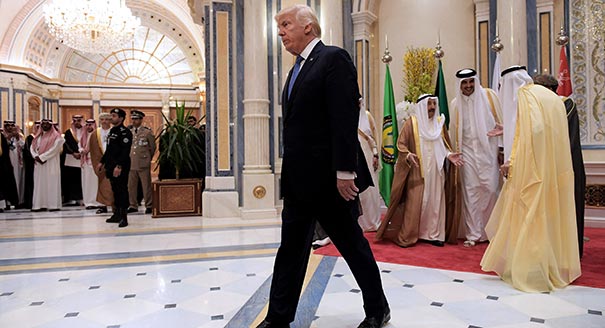
The Trump administration’s plan for an “Arab NATO,” aimed at countering Iran’s influence, poses serious risks for the region.
Source: Lobe Log
The Trump administration, in its preoccupation with containing and rolling back Iranian influence in the Middle East, is pursuing a hare-brained and potentially risky scheme: “a regional security alliance comprised of Egypt, Jordan, and six Gulf Arab states and informally known as the “Arab NATO.” Fortunately, the divisions and limitations of America’s traditional Arab partners will likely save all concerned from this loopy idea.
Dubbed the Middle East Strategic Alliance (MESA) by the administration, the new organization is supposed to “serve as a bulwark against Iranian aggression, terrorism, extremism, and will bring stability to the Middle East.” Details on MESA’s structure and the process through which it will be established are scant, but the Trump White House apparently hopes to discuss the alliance at a summit planned for October.
The Trump administration’s interest in a regional security organization is neither unprecedented nor in and of itself concerning. Indeed, the Obama administration also engaged with regional states on two separate proposals for a Middle East security organization—Saudi Arabia’s “Islamic Force” and Egypt’s “Arab Force.” It also made an ill-fated effort to build the capacity of the Arab League to engage in peacekeeping, stabilization, and humanitarian operations in the Middle East. For both Obama and Trump, part of the appeal of such a force is that it could potentially reduce the security burden borne by the United States in the Middle East, where Washington has expended and wasted blood and treasure over the last two decades.
What is problematic with the Trump White House’s proposal for a regional security alliance, however, is the mission envisioned for this force and the broader policy context in which it would operate. The Obama administration saw a new security organization in the Middle East as a way to encourage regional countries to participate in the enormous undertaking of stabilizing and reconstructing the conflict-torn Middle East. During the Obama administration, there was an understanding that the U.S. vision for such a regional security organization did not necessarily align with some of its regional sponsors, who were spoiling for a fight with Iran. As a result, the Obama team treated proposals for an Arab force with caution and, in the words of General Martin Dempsey, former chairman of the Joint Chiefs of Staff, “found that the enthusiasm would dissipate pretty quickly.”
By contrast, the Trump administration is fixated on an anti-Iran mission for a potential regional security alliance. In this context, what the Obama foreign policy team saw, with trepidation, as the unbridled enthusiasm of some countries for a confrontation with Iran is music to the ears of the Trump administration. For a president who seems to crave a confrontation with Iran but does not necessarily want to commit U.S. troops to such an endeavor, the prospect of an Arab alliance willing to take the initiative is something to be encouraged and abetted. Whereas the Obama administration largely tried to rein in the rash impulses of some Arab leaders, with Saudi action in Yemen being a notable exception, the Trump administration appears determined to unleash them.
Under these conditions and with this mandate, MESA is a recipe for disaster. By ceding the initiative to, and emboldening, regional leaders with a track record of reckless actions and often brutal repression, the United States is asking for trouble. For a taste of what to expect from MESA, one need only look at Yemen. Three years after Saudi Crown Prince Mohammed bin Salman’s ill-conceived intervention, Saudi Arabia has not only failed to subdue Iranian-backed rebels in Yemen, but arguably increased Iran’s influence in the country. Meanwhile, the United Nations has labeled Yemen the world’s worst humanitarian crisis, with the Saudi-led coalition responsible for most of the 16,000 civilian casualties caused by the conflict. With U.S. support, it is not hard to imagine Saudi Arabia and its regional partners bumbling into additional quagmires in Lebanon, Bahrain, or even Syria.
The U.S.-backed war in Yemen has been a strategic and humanitarian calamity, but it has yet to draw the U.S. military into a direct combat role. There is no guarantee, however, that the United States would be able to avoid escalating involvement in new conflicts initiated by its regional proxies. Indeed, this may be part of the appeal of MESA for regional countries, who see the security alliance as a means to commit the United States to coming to their rescue should their military adventures go awry, as is likely. This scenario could also appeal to Trump’s more hawkish advisors like Secretary of State Mike Pompeo and National Security Advisor John Bolton, who do not share the president’s reluctance to deploy additional U.S. troops to the Middle East.
Fortunately, MESA is unlikely to get off the ground, whatever the Trump administration’s intentions. Past efforts to organize a functioning regional security alliance foundered on intra-Arab tensions, and there is no reason to expect this time to be any different. Egypt and Saudi Arabia have previously refused to place their own forces under the other’s command, which is one reason for their dueling alliance proposals under the Obama administration. Even if Cairo and Riyadh can overcome this historical resistance, it is by no means clear that Egypt, Jordan, Oman, Qatar, and Kuwait are prepared to sign up for an anti-Iran mission. Moreover, several core members of MESA (including Saudi Arabia, Egypt, and the United Arab Emirates) are not even on speaking terms with another potential member (Qatar). And this does not begin to address the enormous challenge of integrating militaries with widely divergent capabilities and in some cases non-interoperable weaponry.
The dangers of the Trump administration’s proposal will likely be averted by its sheer improbability. Make no mistake: its vision for a regional security organization would not result in the Arab equivalent of NATO, an alliance of stable democratic governments that helped maintain the peace in Europe through the worst days of the Cold War. Instead, the United States would be left with something closer to the Arab version of the pre-World War I alliances that dragged Europe into a paroxysm of violence unlike anything seen before. In seeking to empower countries like Saudi Arabia or the UAE, the Trump administration is ultimately asking for more conflict and instability in a region that has seen enough of both.
Former Nonresident Scholar, Middle East Program
Andrew Miller was a nonresident scholar in Carnegie’s Middle East Program.

Nonresident Senior Fellow, Russia and Eurasia Program
Richard Sokolsky is a nonresident senior fellow in Carnegie’s Russia and Eurasia Program. His work focuses on U.S. policy toward Russia in the wake of the Ukraine crisis.
Carnegie does not take institutional positions on public policy issues; the views represented herein are those of the author(s) and do not necessarily reflect the views of Carnegie, its staff, or its trustees.

The EU can impose sanctions but struggles to enforce them without the United States. With Washington increasingly disinterested in backing European interests, the bloc must now fend for itself.


Nicu Popescu, Tiago Antunes

Russia is testing the waters of NATO’s mutual defense clause. What do strikes in Romanian territorial waters mean for the alliance’s posture toward Moscow?

Dimitar Bechev

With its public finances in shambles, the far right polling at 35 percent ahead of the 2027 presidential election, and a growing protest movement, is France’s crisis a threat to the EU’s geopolitical awakening?

Rym Momtaz, ed.

Ahead of a tough winter for Ukraine, Donald Trump’s swing back toward Russia bodes ill. But instead of panicking, Kyiv’s European allies are focusing on action.
Rym Momtaz

Funding Ukraine remains a priority for European leaders. As Russia’s war of aggression heads into another winter, two feasible options to mobilize support for Kyiv should be fast-tracked.


Vladyslav Rashkovan, Gregory P. Wilson