

Article
C. Raja Mohan, Darshana M. Baruah
{
  "authors": [
    "C. Raja Mohan"
  ],
  "type": "legacyinthemedia",
  "centerAffiliationAll": "",
  "centers": [
    "Carnegie Endowment for International Peace",
    "Carnegie India"
  ],
  "collections": [],
  "englishNewsletterAll": "",
  "nonEnglishNewsletterAll": "",
  "primaryCenter": "Carnegie India",
  "programAffiliation": "",
  "programs": [],
  "projects": [],
  "regions": [
    "United States",
    "South Asia",
    "India",
    "North America"
  ],
  "topics": [
    "Foreign Policy"
  ]
}
Source: Getty
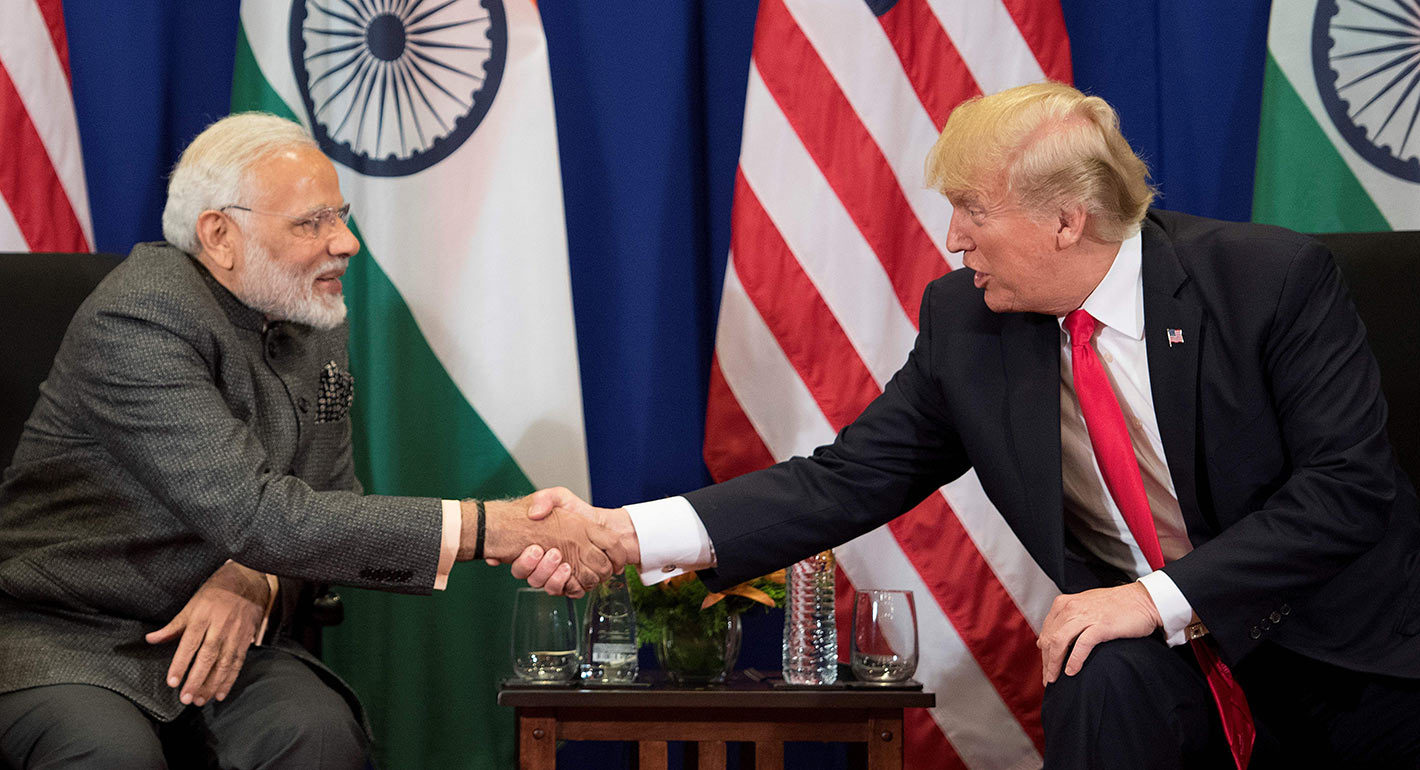
What creates the room for some bold thinking about the next steps in the bilateral relationship is the fit between U.S. President Trump’s effort to recalibrate America's international relations and India’s ambitions to play a larger global role.
Source: Indian Express
The idea that India-US relations are enveloped by a crisis has been a recurring theme for the last quarter of a century and more. Yet, since the end of the Cold War, the bilateral relationship has made a steady advance across a broad front. Despite the presumption or hope in many sections at home and abroad that something will surely trip up India and the US, their partnership has become stronger by the day. The lack of pace and the enduring sense of unrealised potential do, however, continue to dampen the enthusiasts in both capitals.
For India, ties with the US have emerged as the most comprehensive among all its major power relationships. In terms of breadth, it ranges from defence and high technology cooperation to a substantive people-to-people relationship. In terms of weight, it is the most important economic relationship — annual two-way trade in goods and services now stands at nearly $140 billion and mutual investments are on the way up.
Even more significant is the growing convergence of perspectives on regional and international affairs. Few other powers have been as positive as the US in addressing either India’s concerns about terrorism in the region or as supportive of its aspirations for a larger international role. Further, India has no territorial disputes with the US. Nor have Delhi’s armies ever had to confront Washington’s. It is quite easy to forget this amid the media focus on the minutiae of the bilateral relations.
The first ever “two-plus-two” meeting between Delhi and Washington — that brings together the foreign and defence ministers of India and the United States around one table — is at once the symbol of the progress made so far as well as the platform to address new issues in the relationship. The forum could also help set more ambitious goals for the future.
But first, to the latest bout of gloom and doom. Much of it flows from the claim that US President Donald Trump’s policies are derailing the relationship. Some of these arguments are about the breakdown of bipartisanship in Washington and the open confrontation between Trump and the traditional foreign policy establishment.
The ground reality, however, is quite different. Although many of America’s traditional partners have found themselves at the receiving end of Trump’s effort to reorient US foreign policy, the consequences for India have not been too severe to cope with. On the two primary areas of concern for India — Pakistan and China — Delhi, in fact, has no reason to complain about Trump’s policies.
On the sources of terror in Pakistan and its destabilisation of Afghanistan, Trump has mounted the kind of pressure on Rawalpindi that his predecessors were not willing to consider. Trump’s pushback against China’s assertive policies has already opened up new diplomatic space for Delhi in the Indo-Pacific, including with Beijing.
To be sure, the continuing escalation of tensions between Washington and Moscow has begun to pose new problems for the bilateral relationship. Since the end of the Cold War, India did not have to look over its shoulder in its engagement with either Russia or America. Delhi will now have to deal with this new situation. The new US law that mandates sanctions against countries that buy arms from Russia is at the centre of the current debate. For all the concern about India’s plans to buy the S-400 missiles from Russia and the consequences in the US, both Delhi and Washington have incentives to manage their differences.
Washington has no reason to wreck the growing military relationship with India — which has seen the US expand its share in arms sales to India at the expense of Russia — by making the S-400 as some kind of red line that can’t be crossed. India, on its part, needs to take full advantage of the strategic possibilities with the US for modernising India’s military as well as its defence industrial base. If Trump can find a way to provide a waiver for India, Prime Minister Narendra Modi has the means to make it worthwhile for Trump. How the issue might get finessed is a matter of diplomatic detail, if there is political will on both sides to find a way.
The Iran problem might be a lot easier to manage. It’s been done before amidst the continuing confrontation between Tehran and Washington. More than a decade ago, the UPA government refused to sacrifice India’s rising stakes in the US relationship for the sake of Iran. There is no reason why the NDA would do this now. Meanwhile, India’s interests are rapidly rising in the UAE and Saudi Arabia — two countries that are in a deepening conflict with Iran.
Far more significant is the problem on the trade front. Driven by powerful domestic political considerations, Trump has chosen to confront all of America’s major economic partners — from Canada to China and Mexico to Japan — on ending the trade imbalance. India is certainly on the list of countries with a trade surplus with the US. Like all other partners of Washington, Delhi, too, must find ways to limit the damage to its most important trade relationship through practical negotiations.
India and the United States have advanced their partnership over the last few years by sticking to two important principles. One is the political commitment not to let any one problem derail the broader partnership and the other is to continue to expand the areas of engagement that yield additional gains for both.
As they iron out the current wrinkles in the bilateral relationship, the four ministers have an opportunity to take a fresh look at the partnership. While small steps are possible and will be announced, the two sides must try and break from the frustrating tradition of incrementalism. What creates the room for some bold thinking about the next steps in the bilateral relationship is the fit between Trump’s effort to recalibrate America’s international relations and India’s ambitions to play a larger global role.
Trump wants to cut America’s offshore burdens and get allies and partners to do more. As a rising power, Delhi is eager to take more responsibility for promoting regional peace and prosperity in the Indo-Pacific. Translating this alignment of interests into concrete outcomes requires the development of a new framework for burden-sharing and strategic coordination.
This article was originally published in the Indian Express.
Former Nonresident Senior Fellow, Carnegie India
A leading analyst of India’s foreign policy, Mohan is also an expert on South Asian security, great-power relations in Asia, and arms control.
Recent Work

C. Raja Mohan, Darshana M. Baruah


Alexander Gabuev, Paul Haenle, C. Raja Mohan, …
Carnegie does not take institutional positions on public policy issues; the views represented herein are those of the author(s) and do not necessarily reflect the views of Carnegie, its staff, or its trustees.

The new U.S.–Denmark–Greenland agreement will help Washington exert political, economic, and financial dominance under the guise of security. Yet, it acknowledged Copenhagen’s and Nuuk’s sovereignty on the island.

Marc Pierini

A summer of escalation in the Black Sea has hurt Ukraine economically and is exacerbating world food security. A truce is needed—as is a broader reframing of Europe’s Ukraine strategy.

Thomas de Waal

Are Germany’s economic, industrial, and political struggles becoming a liability for the EU’s ability to rise to the geopolitical moment?

Rym Momtaz, ed.

European Commission President Ursula von der Leyen is about to give her annual address on the state of the EU. Here’s what she won’t—but should—say.
Rym Momtaz

Radical-right parties are expected to do well in upcoming elections in four of the EU's biggest member states. If successful, they could prevent the union from addressing key challenges ahead.

Stefan Lehne