

Commentary
Dmitri Trenin
{
  "authors": [
    "Dmitri Trenin"
  ],
  "type": "commentary",
  "centerAffiliationAll": "",
  "centers": [
    "Carnegie Endowment for International Peace",
    "Carnegie Russia Eurasia Center"
  ],
  "collections": [],
  "englishNewsletterAll": "",
  "nonEnglishNewsletterAll": "",
  "primaryCenter": "Carnegie Russia Eurasia Center",
  "programAffiliation": "",
  "programs": [],
  "projects": [],
  "regions": [],
  "topics": [
    "Economy"
  ]
}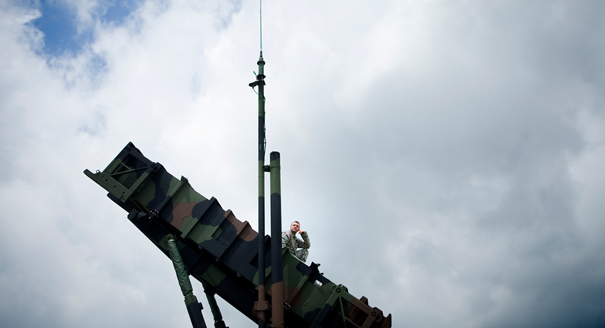
Source: Getty
Moscow needs to remain calm and hold back emotions. U.S. withdrawal from the INF Treaty won’t compromise Russia’s security, which rests on the pillars of nuclear deterrence and mutually assured destruction.
One could basically anticipate the Trump Administration’s decision to withdraw from the Intermediate-Range Nuclear Forces Treaty, or INF. It’s in line with the U.S. president’s general approach to foreign policy: he renounces agreements that he believes to be unfavorable to the United States. In this light, it’s unlikely that this recent decision by Donald Trump was conceived as a bargaining chip in negotiations with Moscow.
From the political standpoint, Trump’s coup de theatre on the eve of U.S. congressional elections deals a blow to his critics, who constantly rebuke the president for appeasing the Kremlin. By destroying one of the two remaining pillars of the U.S.-Russian arms control architecture (the New START Treaty is now the last one standing), Donald Trump comes across far more hawkish on Russia than Barack Obama and his fellow Democrats.
In a practical sense, scrapping the INF Treaty gives Washington free rein to threaten North Korea while also pressuring China, the country Trump deliberately alluded to when announcing the U.S. withdrawal from the treaty.
If the negotiations on the denuclearization of North Korea fail—and it’s hard to imagine that Pyongyang will completely abandon its nuclear long-range missile arsenal in exchange for verbal promises from Washington—the United States will go back to exerting pressure on North Korea and will probably deploy its intermediate-range nuclear missiles in Northeast Asia. The U.S. Pacific Command has long been backing this option.
Such a deployment would place China’s political decisionmaking and military command centers, as well as many of its important military installations, within the range of U.S. missiles, which would give Washington clear leverage in the unfolding rivalry between the United States and China.
U.S. intermediate-range missiles can also return to Europe, but this seems to be a less relevant issue for Trump, at least for the time being. Should this happen, however, it would lead to a steep escalation of the U.S.-Russian confrontation.
In and of itself, the U.S. withdrawal from the INF treaty doesn’t create any immediate problems for Russia. What’s more important is what steps the United States will take following this decision, and in which theaters of operations it will act.
Moscow’s reaction shouldn’t be impulsive. At this stage, it needs to focus on working with European governments and publics to prevent growing likelihood of a military conflict in Europe in case U.S. intermediate-range missiles are deployed in NATO countries.
In the event of a significant increase in the military threat for Russia, Moscow should proportionally increase the threat for the U.S. territory. It’s not in Russia’s best interest to respond to the United States by punishing its allies. Russia’s efforts shouldn’t strengthen NATO’s unity.
The U.S. decision to withdraw from the INF Treaty doesn’t necessarily spell the end for the New START Treaty. The New START is set to expire in 2021 and can be extended for five more years. Some in the United States have long considered withdrawing from the INF Treaty in conjunction with extending the New START as a possible dual move in Washington’s strategic relations with Moscow.
U.S. withdrawal from the INF Treaty frees Russia from its limitations, too. It will inevitably prompt the issue of Russia resuming its intermediate-range missile development program. However, Moscow doesn’t have to blindly follow the United States. Getting involved in another U.S.-imposed arms race and undermining its relations with third countries is not in Russia’s best interests.
Moscow needs to remain calm and hold back emotions. U.S. withdrawal from the INF Treaty won’t compromise Russia’s security, which rests on the pillars of nuclear deterrence and mutually assured destruction.
Former Director, Carnegie Moscow Center
Trenin was director of the Carnegie Moscow Center from 2008 to early 2022.
Recent Work
Dmitri Trenin
Dmitri Trenin
Carnegie does not take institutional positions on public policy issues; the views represented herein are those of the author(s) and do not necessarily reflect the views of Carnegie, its staff, or its trustees.
As geopolitical rivalry weaponizes global supply chains, the EU’s true vulnerability lies in emerging-risk imports. For these goods, suppliers are growing more concentrated, substitution more difficult, and political risk is looming.

Sinan Ülgen
The EU is putting together a new security strategy to meet today’s myriad challenges. But for any proposal to be effective, the union needs to grapple with its identity and ambitions.

Pierre Vimont
Between the United States’ market-driven approach and China's state-led industrial strategy, Europe is reckoning with how it can remain competitive in the global economy. But is Europe in danger of becoming a U.S. or China colony?


Noah Barkin, Anu Bradford
The U.S.-sponsored TRIPP deal is driving the Armenia-Azerbaijan peace process forward. But foreign and domestic hurdles remain before connectivity and economic interdependence can open up the South Caucasus.



Thomas de Waal, Areg Kochinyan, Zaur Shiriyev

Economic growth is at the heart of a dilemma between planetary and international security.

Olivia Lazard