

Article
Zaha Hassan
{
  "authors": [
    "Zaha Hassan"
  ],
  "type": "commentary",
  "centerAffiliationAll": "dc",
  "centers": [
    "Carnegie Endowment for International Peace",
    "Malcolm H. Kerr Carnegie Middle East Center"
  ],
  "collections": [],
  "englishNewsletterAll": "menaTransitions",
  "nonEnglishNewsletterAll": "",
  "primaryCenter": "Carnegie Endowment for International Peace",
  "programAffiliation": "MEP",
  "programs": [
    "Middle East"
  ],
  "projects": [],
  "regions": [
    "Middle East",
    "Israel",
    "Palestine",
    "Levant"
  ],
  "topics": [
    "Political Reform"
  ]
}
Source: Getty
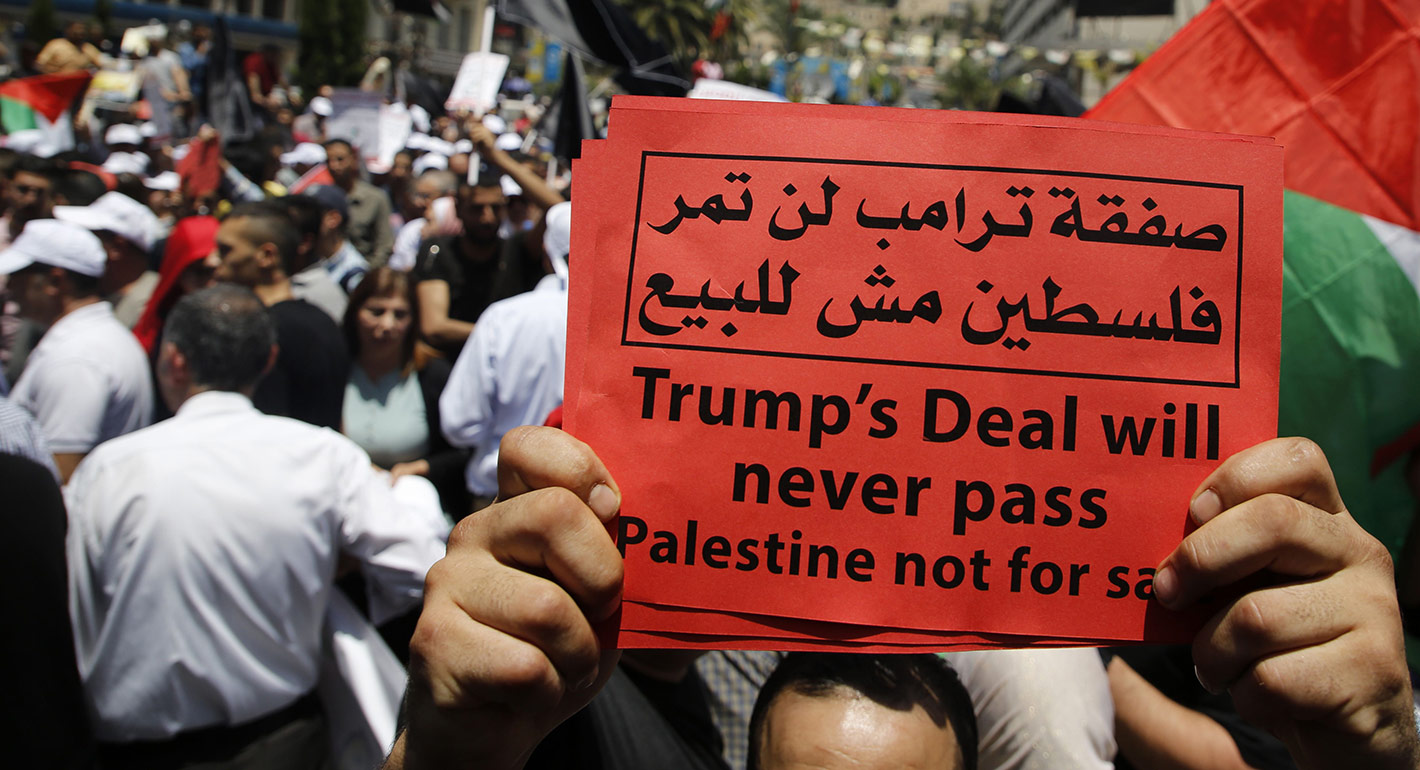
At a workshop in Bahrain last week, Jared Kushner gave a slick presentation of the economic portion of the White House’s new peace plan for Israelis and Palestinians. But beneath the glossy packaging were the same failed ideas.
Live-streamed coverage of the Bahrain “Peace to Prosperity” workshop, phase one in the Trump administration’s release of its peace plan for Israelis and Palestinians, brought to mind a dark, smoke-filled room from an earlier period where other powerful men, British and French, divvied up Arab land after World War I. This time, Arab governments and the U.S. co-hosted the dismemberment of the Palestinians’ national aspirations, while sitting in TED Talk-styled respectability. Just as before, ideas like human rights, self-determination and political and economic sovereignty were completely lost on the architects of this new effort.
The glitzy presentations and marketing materials largely repackage old, failed ideas about the potential for economic development, even while Israel keeps control over Palestinian land. There is no acknowledgment of the existence of an Israeli military occupation, no mention of the likely formal annexation of the West Bank following Israeli elections in September, nor of Israel’s intention to continue its twelve-year isolation and siege of Gaza. Instead, the plan assumes what ails Palestinians is not a lack of freedom and self-determination, but the poor management of their economy and a lack of knowledge about how to run basic municipal services.
Besides omitting a political solution, the administration’s economic plan cannot answer basic questions about implementation: who is going to fund the $50 billion dollar price tag; what government(s) will oversee the 179 projects identified; and where are the borders of the Palestinian land area where these projects will take place?
For funders, the likely suspects would be Saudi Arabia and the European Union (EU). However, Saudi Arabia has indicated that it will do nothing unless the Palestinian Authority gives the green light. It reiterated its commitment to the Arab Peace Initiative, which calls for Israeli withdrawal from the occupied territories before normalization of relations with Israel. Meanwhile, the EU has said it has no intention to pledge funds for the plan because it is already heavily invested in Palestinian state-building. In fact, over the many years of such funding, the EU has been regularly frustrated by the loss of its investments in schools and renewable energy projects in the occupied territories, which Israel destroys or pilfers and auctions.
Serious Palestinian businesspersons and investors, those responsible for creating 70 percent of the jobs in the occupied West Bank and Gaza, have said they will not be party to any plan that does not include an independent Palestinian state as a part of the political horizon—something not called for under Kushner’s plan.
On the question of what government(s) will oversee implementation of the projects, there is no mention of the Palestinian Authority, the governing body in the West Bank, or Hamas, the authority in Gaza. Both have no contact with the administration and have shunned its peace efforts. Instead, there are references to civil society actors and regional governments, in particular, Egypt, Jordan, Lebanon and Israel.
As for Egypt, where the U.S. administration hopes to construct an industrial zone for Palestinians in the Sinai, the Egyptian foreign minister Sameh Shoukry has said “not one grain of sand” from its territory will be relinquished, regardless of the $9 billion dollars it stands to receive under the plan. The unstated quid pro quo for Jordan’s inclusion as a recipient of the $7.5 billion in funding is that it should naturalize the approximately 2.2 million Palestinian refugees within the kingdom, something it will never do. For the same reason, Lebanon, which hosts half a million Palestinian refugees, refused to attend the workshop in Bahrain and will instead host another one with Palestinian officials present.
Even the location of the proposed projects ignores the political questions of sovereignty and territorial integrity. Conspicuously missing from the plan are any references to the June 4 1967 green line, which demarcates the border between Israel and the occupied Palestinian territories, including East Jerusalem. In fact, there is no mention of either a Palestinian state, or of Jerusalem, where more than 370,000 Palestinians live, representing 40 percent of the city’s residents.
The plan also does not call for evacuation of any Israeli settlements. How are Palestinians to “unleash” the potential of their economy, as the plan promises, if settlers’ businesses and industrial enterprises continue to enrich themselves from Palestinian minerals that the World Bank estimates to be worth almost $1 billion per year?
There is no one to pay for this plan, no one to oversee it, and nowhere to implement it. This administration’s Mideast peace efforts will be remembered for only two significant achievements. First, that it managed to find one Palestinian—a petty businessman whose excommunication from his family and Palestinian society predated the Bahrain workshop—willing to sit on stage to express support for the plan--but even he went off script to call for a Palestinian state. And second, that Palestinian leaders and the people are finally united in a way they have not been for a long time. That unity just might ignite serious reconciliation efforts between the authorities in the West Bank and Gaza, so that Palestinian national aspirations and rights can be preserved and protected. Both are things Kushner and his team surely did not bargain for.
Zaha Hassan (@ZahaHassan) is a human rights lawyer and visiting fellow at the Carnegie Endowment for International Peace.
Senior Fellow, Middle East Program
Zaha Hassan is a human rights lawyer and a senior fellow at the Carnegie Endowment for International Peace.
Recent Work
Zaha Hassan
Zaha Hassan, Charles H. Johnson
Carnegie does not take institutional positions on public policy issues; the views represented herein are those of the author(s) and do not necessarily reflect the views of Carnegie, its staff, or its trustees.

A notable degree of participative democracy has firmly arrived in Europe. But to have more far-reaching impact, democratic deliberation needs to move into a radically new phase.

Richard Youngs

Before the next wave of EU enlargement takes place, the union needs to grapple with thorny questions of how power is distributed among its members.


Emil Sondaj Hansen, Ditte Brasso Sørensen

As the EU confronts profound challenges, several leaders have called for fundamental reform to the union’s model—but only modest, superficial changes have resulted. What if Europe really could be reimagined from zero today: What should such a redesigned European order look like?
Richard Youngs, ed.

The EU’s new migration policy is not suited to today’s realities. With climate change increasingly becoming a driver of displacement, Europe needs to rethink its deterrence-focused approach.

Shana Tabak
Europe seems to have accepted its sidelining in the Middle East. The EU must reassert its support for the international rules-based order and step up engagement.

Rym Momtaz