

Article
Erik Brattberg, David Whineray
{
  "authors": [
    "David Whineray"
  ],
  "type": "legacyinthemedia",
  "centerAffiliationAll": "",
  "centers": [
    "Carnegie Endowment for International Peace"
  ],
  "collections": [],
  "englishNewsletterAll": "",
  "nonEnglishNewsletterAll": "",
  "primaryCenter": "Carnegie Endowment for International Peace",
  "programAffiliation": "",
  "programs": [],
  "projects": [],
  "regions": [
    "Western Europe",
    "United Kingdom"
  ],
  "topics": [
    "Foreign Policy"
  ]
}
Source: Getty
Against a geopolitical backdrop of transatlantic divisions, Britain’s ability to lead European foreign policy after Brexit will ultimately depend on the strategic posture it chooses to adopt between Europe and the United States.
Source: Hill
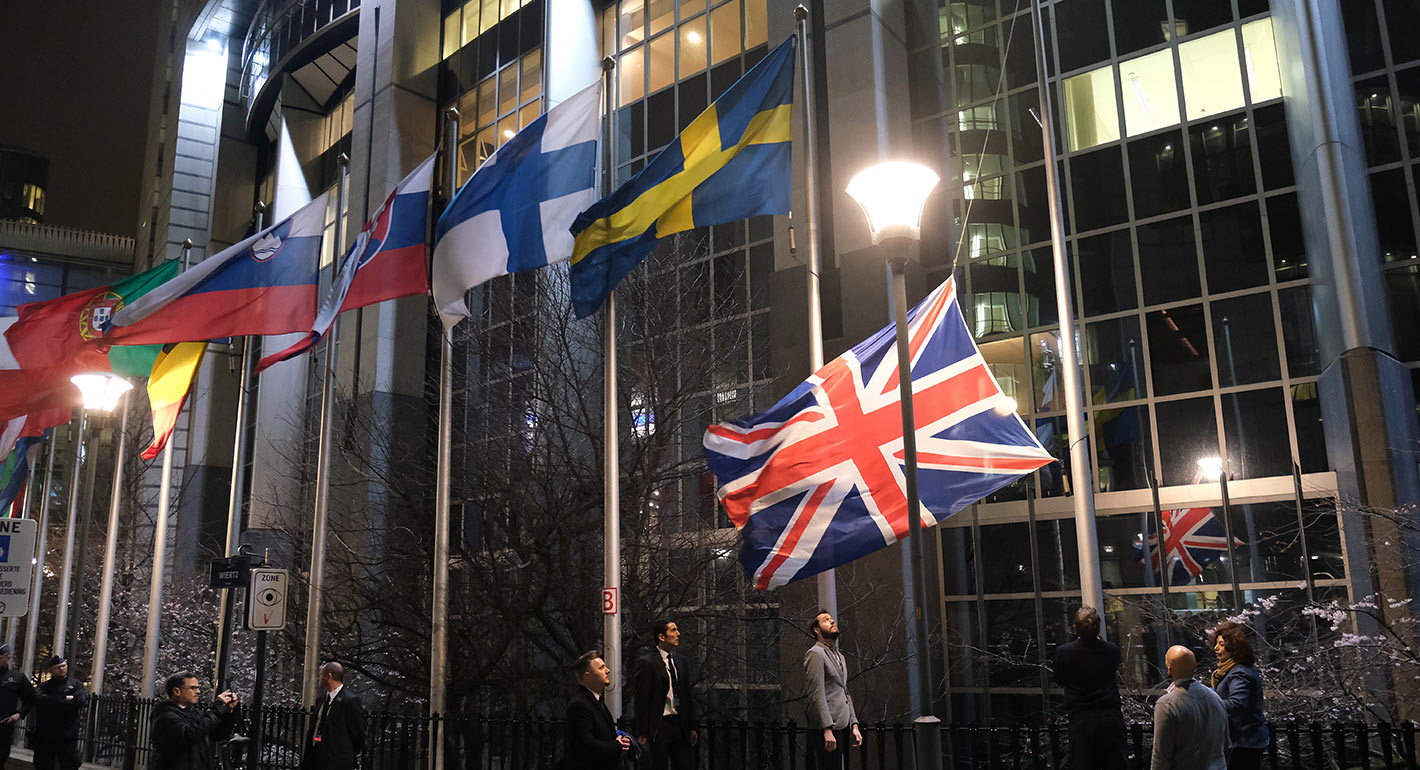
This week sees the biggest shift in British foreign policy in almost 50 years, as the United Kingdom leaves the European Union. As an EU member, the UK shaped Europe’s foreign policy, from EU sanctions on Russia to the Iran nuclear deal. The UK wants to stay an influential European foreign policy power. But how can it outside the EU?
When European foreign ministers discussed Iran this month the Brits were there; in future they won’t be. The UK can still play a leading role in shaping Europe’s foreign policy after Brexit — but it will need to engage with Europe differently.
Up to 2016, British foreign policy was based on three pillars. First, Atlanticism. London routinely aligned with Washington on international issues and acted as a transatlantic bridge, explaining European views to the United States and vice versa. Second is leadership in the EU — specifically, the EU’s Common Foreign and Security Policy (CFSP). Third, multilateralism. As a medium-sized power with global interests, an effective rules-based international order was central to advancing British interests.
Each of these pillars is now challenged. First, Brexit takes the UK out of the CFSP. Second, the rules-based international order is being undermined by Russia, China and, to an extent, the U.S. Third, Washington’s transatlantic outlook under the Trump administration has become more nationalistic, transactional and mercantile, with skepticism — sometimes even hostility — toward the EU and NATO.
The English Channel and the Atlantic have both widened since 2016. The UK’s traditional diplomatic handling of foreign policy crises — align with Washington and shape the EU response — no longer applies. So how can the UK lead European foreign policy after Brexit? Through four new steps.
First, by doing more bilaterally with European counties — especially France and Germany. New summits, dialogues and agreements could be launched.
Second, by using meetings of other international groupings to coordinate European foreign policy positions and actions. The so-called “E3” (Germany, France and the UK) works well on Iran — Angela Merkel, Emmanuel Macron and Boris Johnson issued a joint statement on Soleimani — and could be expanded to other issues. The Group of Seven (G7) could play a bigger foreign policy role too.
Third, as part of this year’s negotiations on the UK’s future trade and security relationship with the EU, London and Brussels could agree to close co-operation on foreign policy. Various new mechanisms are possible. French President Macron has suggested creating a European Security Council including the UK. Alternatively, the UK could occasionally be invited to attend meetings of EU foreign ministers, as John Kerry did as U.S. secretary of State. Joint UK-EU statements could even be considered if the UK and EU wanted to show a united stance – including to Moscow and Beijing – such as after a use of chemical weapons.
Fourth, by working closely with the EU in other international organizations, particularly the United Nations. This would also help bolster multilateralism, and show the UK remains globally orientated.
Europe should support these steps. In or out of the EU, the UK is a major European political and military power, and one of only two European nuclear states and permanent members of the U.N. Security Council. European views will pack more punch globally if the Brits are also on board. Growing transatlantic tensions also mean Brussels, Paris and Berlin should keep London within the European foreign policy orbit instead of seeing it adopt a more Trumpian outlook.
Against a geo-political backdrop of transatlantic divisions, Britain’s ability to lead European foreign policy after Brexit will ultimately depend on the strategic posture it chooses to adopt between Europe and the US. In short, will the UK align more with Washington on foreign policy after Brexit? Does the UK see its interests and values remaining European? Or will it adopt a policy of strategic equidistance?
Despite Brexit, since the 2016 referendum the UK has supported the EU, not the US, on major transatlantic disagreements — including Iran, trade, climate change and China. Brussels and Washington will look closely at whether this continues or changes. The UK wants trade deals with both.
Former Nonresident Fellow, Europe Program
David Whineray was a nonresident fellow in the Europe Program at the Carnegie Endowment for International Peace in Washington, DC.
Recent Work

Erik Brattberg, David Whineray
David Whineray
Carnegie does not take institutional positions on public policy issues; the views represented herein are those of the author(s) and do not necessarily reflect the views of Carnegie, its staff, or its trustees.

Ahead of a tough winter for Ukraine, Donald Trump’s swing back toward Russia bodes ill. But instead of panicking, Kyiv’s European allies are focusing on action.

Rym Momtaz

Funding Ukraine remains a priority for European leaders. As Russia’s war of aggression heads into another winter, two feasible options to mobilize support for Kyiv should be fast-tracked.


Vladyslav Rashkovan, Gregory P. Wilson

While the EU and European governments are embracing the much-lauded middle-power moment, this entails three difficult conundrums.

Richard Youngs

A notable degree of participative democracy has firmly arrived in Europe. But to have more far-reaching impact, democratic deliberation needs to move into a radically new phase.
Richard Youngs
Much has been said of the changes Brussels is trying to make to the EU enlargement process. Here’s why gradual integration might—or might not—be the answer.

Dimitar Bechev