

Research
- +5
Alper Coşkun, Fatih Ceylan, Tacan İldem, …
{
  "authors": [
    "Sinan Ülgen"
  ],
  "type": "legacyinthemedia",
  "centerAffiliationAll": "",
  "centers": [
    "Carnegie Endowment for International Peace",
    "Carnegie Europe"
  ],
  "collections": [
    "Turkey’s Transformation"
  ],
  "englishNewsletterAll": "",
  "nonEnglishNewsletterAll": "",
  "primaryCenter": "Carnegie Europe",
  "programAffiliation": "",
  "programs": [],
  "projects": [],
  "regions": [
    "Middle East",
    "Europe",
    "Türkiye",
    "Syria"
  ],
  "topics": [
    "EU",
    "Migration"
  ]
}
Source: Getty
It’s too late to defeat the Assad regime, but a humanitarian intervention by the EU and NATO could prevent countless deaths and another massive refugee crisis.
Source: Foreign Policy
In its latest convulsion, the war in Syria has produced its biggest humanitarian calamity yet. But the world’s attention is focused elsewhere. Syrian President Bashar al-Assad’s military operation targeting Idlib, in the northwest of the country, has uprooted more than 900,000 civilians—the majority of them women and children—according to United Nations figures.
These internally displaced persons have found temporary refuge near the Turkish border in makeshift camps under harsh winter conditions. The latest U.N. report showcases several examples of displaced civilians burning their few belongings to fight the cold. Already, many children have died.A humanitarian crisis of this scale should have already galvanized the international community to launch a coordinated campaign to end this suffering. But, so far, regional and global politics have stymied such efforts. And in the absence of any outside intervention, the conflict is likely to further aggravate the humanitarian consequences.
One reason is that the Syrian regime, with Russian backing, is pushing ahead to reconquer territory held by opposition forces. The Assad regime and Iranian-backed Shiite militias have used brutal tactics with the aim of depopulating Idlib so regime forces can more effectively control this territory with a predominantly Sunni population.
The international community has so far looked the other way, allowing the Assad regime’s progress because of the presence of myriad jihadis in Idlib, including al Qaeda-linked Hayat Tahrir al-Sham and the Suqour al-Sham Brigades. Idlib incidentally became a safe haven for many of these groups, which have been forced to relocate as they gradually lost territory in other parts of Syria to government forces.
In the absence of a clear policy related to the repatriation of these foreign fighters, most Western countries favor an outcome where these jihadis would end up being killed in Syria and never make it back to their original countries. This is also the argument espoused by Damascus and Moscow to justify the Idlib operation.
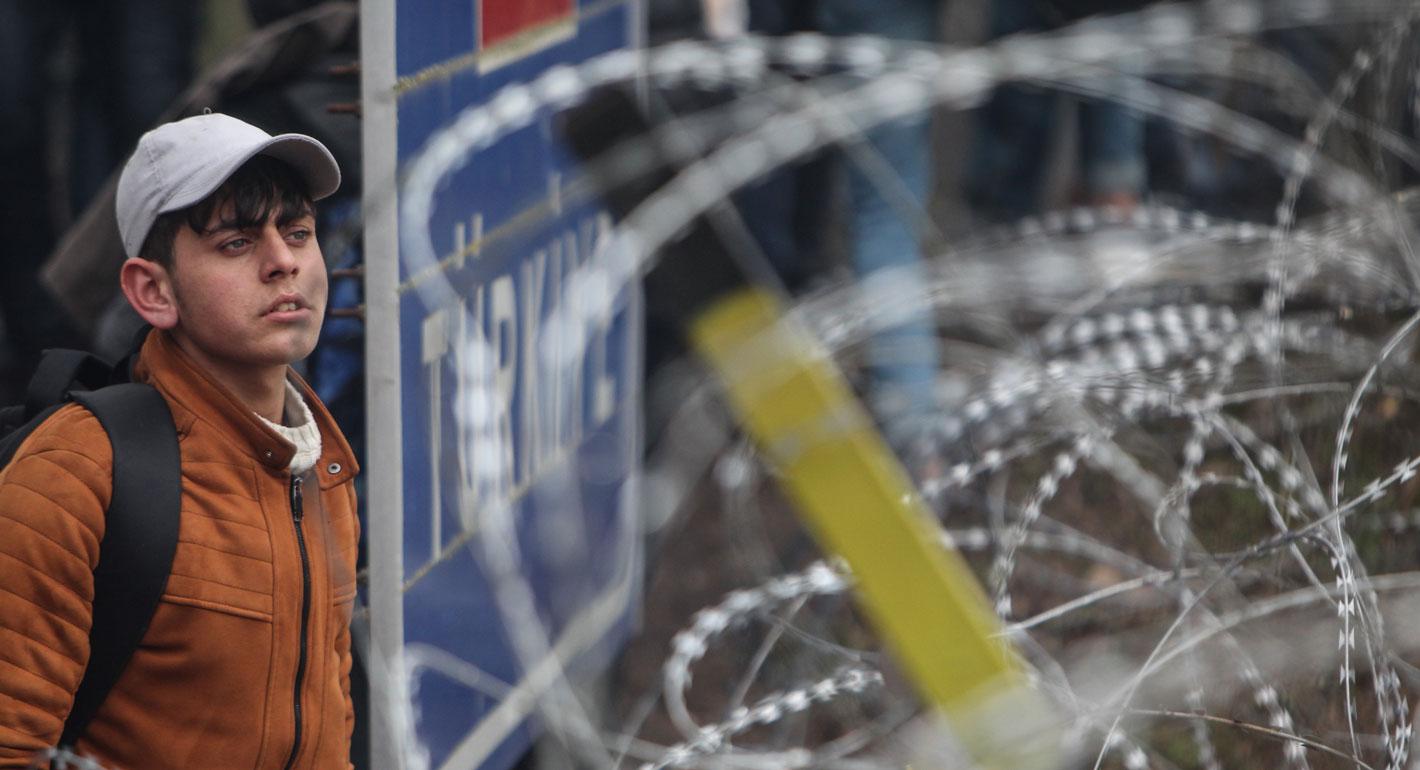
In this equation, the only country that remains directly exposed to the negative consequences of the Idlib operation is Turkey. Already host to more than 3.6 million Syrian refugees, Turkey justifiably fears another refugee wave that could force Turkish policymakers to open the country’s borders to yet another million people under duress.
That is also one reason why Ankara has amassed forces at the border, carried out several retaliatory strikes on Syrian forces after being targeted, and threatened the Syrian regime with further military action should the advance continue. Turkish President Recep Tayyip Erdogan gave an ultimatum to Damascus with a deadline of Feb. 29, seeking to force Syrian troops to relinquish part of the territory they acquired in Idlib. Erdogan is asking the regime forces to move back east of the strategically important M5 highway linking Damascus to Aleppo. Such a move would lessen the pressure on the refugees.
Many observers believe that with Russian mediation Ankara and Damascus will reach a temporary truce, consolidating their current positions on the ground. But talks have not produced an agreement yet, and the situation remains precarious with no guarantee of a negotiated outcome. In addition, even if the Syrian regime buckles under Turkish pressure and agrees to suspend its current campaign, it could easily resume it in coming weeks and months.
Having acknowledged the scale of the humanitarian tragedy, the U.N. did try in December 2019 to increase its humanitarian aid mission in Idlib. But the opening of new routes for the delivery of aid was blocked in the Security Council by Russia and China. Their concern was that the increased U.N. assistance would help the armed opposition and jihadi groups. There is no reason to think therefore that the U.N. could, in the imminent future, overcome this political obstacle and be an active player on the ground to address the unfolding humanitarian catastrophe.
In the early days of the Syria crisis, talk of an international intervention was scrapped due to Russia’s opposition. The consequence of Western inaction then has been a decade-long war and untold human suffering in Syria—as well as a refugee crisis that has strained Turkey and caused political upheaval across Europe. The window of opportunity for regime change in Syria is now closed. But the West could and should still act on humanitarian grounds in Idlib despite Russian resistance.
The consequence of Western inaction then has been a decade-long war and untold human suffering in Syria—as well as a refugee crisis that has strained Turkey and caused political upheaval across Europe.
Idlib is a textbook case of the sort of situation in which international humanitarian intervention is warranted. But a broken system of international governance that ensures U.N. inaction means that the only option therefore is for Western nations to lead in the establishment of a “coalition of the willing” outside the U.N. umbrella.
The aim would be to bring in large-scale humanitarian assistance to the displaced population of Idlib. A joint European Union-NATO humanitarian mission would allow the EU civilian mission to rely on NATO protection. The NATO-backed military component would be necessary to protect the zone from Syrian aggression.
After its strategic failure in Syria, the West should at least strive to protect civilians caught in Idlib—moving beyond a superficial interest in their fate and relying on Turkey to open its borders. The proposed formula for Western action would require the U.S. government to accept NATO to serve a primarily civilian mission to be led by the EU in northwestern Syria. It would also compel Turkey to give up its political objective of retaining control in Idlib and abetting its motley crew of proxy groups.
Most importantly, it would test whether Europe is indeed ready to speak the language of power as claimed by its new leadership. The emergence of a humanitarian crisis near Europe’s borders unrivaled in its severity since the Yugoslav wars should convince Western nations to reassess the risks of nonintervention.

Senior Fellow, Carnegie Europe
Sinan Ülgen is a senior fellow at Carnegie Europe in Brussels, where his research focuses on Turkish foreign policy, transatlantic relations, international trade, economic security, and digital policy.
Recent Work

Alper Coşkun, Fatih Ceylan, Tacan İldem, …

Funding Ukraine remains a priority for European leaders. As Russia’s war of aggression heads into another winter, two feasible options to mobilize support for Kyiv should be fast-tracked.


Vladyslav Rashkovan, Gregory P. Wilson

While the EU and European governments are embracing the much-lauded middle-power moment, this entails three difficult conundrums.

Richard Youngs

Europe is facing rising populism internally as well as external pressures from Russia, China, Turkey, and the United States.

Dimitar Bechev

A notable degree of participative democracy has firmly arrived in Europe. But to have more far-reaching impact, democratic deliberation needs to move into a radically new phase.
Richard Youngs

Much has been said of the changes Brussels is trying to make to the EU enlargement process. Here’s why gradual integration might—or might not—be the answer.
Dimitar Bechev