

Commentary
- +3
Marwan Muasher, Amr Hamzawy, Rain Ji, …
{
  "authors": [
    "Yasmine Farouk"
  ],
  "type": "commentary",
  "centerAffiliationAll": "dc",
  "centers": [
    "Carnegie Endowment for International Peace"
  ],
  "collections": [
    "Coronavirus"
  ],
  "englishNewsletterAll": "menaTransitions",
  "nonEnglishNewsletterAll": "",
  "primaryCenter": "Carnegie Endowment for International Peace",
  "programAffiliation": "MEP",
  "programs": [
    "Middle East"
  ],
  "projects": [],
  "regions": [
    "Middle East",
    "Saudi Arabia"
  ],
  "topics": [
    "Political Reform"
  ]
}
Source: Getty
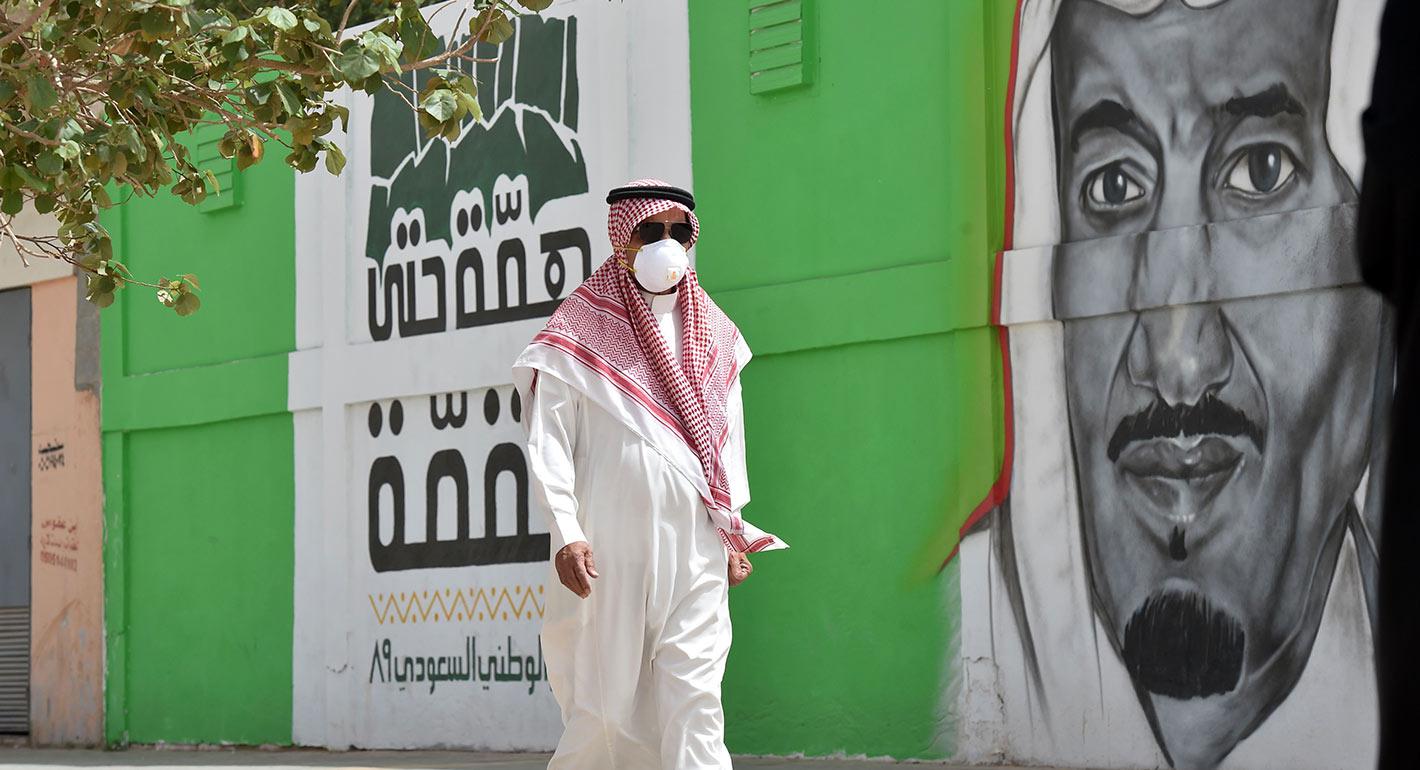
In the face of the global health crisis, the kingdom is bringing back traditional policy approaches that the crown prince had brushed aside in his “new Saudi Arabia.”
The spread of the new coronavirus presents serious risks in Saudi Arabia, which has reported 2,385 cases and 34 deaths as of April 5. The kingdom is a hub for tens of millions of foreign laborers and pilgrims from across the globe. Especially in light of potential shortages of doctors and hospital beds, maintaining public support will be critical to the state’s response.
To respond to the crisis, King Salman Bin Abdulaziz Al Saud and Crown Prince Mohammed bin Salman (known as MBS) have acted quickly, using a mix of long-standing and newly devised Saudi statecraft.
The dual qualities of firmness and determination have been the motto of the crown prince’s reign. In this spirit, the government acted decisively as the coronavirus spread to implement comprehensive and unprecedented precautionary measures that were largely applauded. The kingdom started by quarantining an entire city and later imposed local lockdowns and a nationwide curfew that includes the two holy cities of Mecca and Medina. Alleged rumor spreaders, religion mongers, curfew violators, and opportunist suppliers have been prosecuted. Violators of these measures have been denounced as citizens rally behind the slogan “We are all responsible.”
Although MBS has cut back on public appearances, officials and supporters are actively praising him for the firm response. Yet a new wave of political arrests offered a reminder of the association between “firmness and determination” and repression.
Riyadh is also crafting a nationalist narrative to encourage citizens’ adherence to government measures. This framing has resulted in calls on individuals and the private sector to assist the state response and civil society. Allegations of disloyalty and noncompliance spread quickly. Such allegations especially affected Shia citizens who had failed to come forward about recent travel to Iran and who made up the kingdom’s first cases. But state policies to restrain sectarianism, such as pardons for citizens who disclose their visits to Iran and controls on information from the quarantined Shia city of Qatif, have tamped down some of the accusations.
However, an official statement accused Iran of “direct responsibility” for the spread of the virus, while commentators in the media and online also accused Saudi Arabia’s foes, Qatar and Turkey, of deliberately mismanaging the crisis.
Since the launching of Vision 2030 in 2016, the former rentier state model has been condemned by the new state elite as an obstacle to socioeconomic progress. Yet, in addition to almost daily economic decisions, exceptional actions taken to mitigate the pandemic’s impact on Saudi citizens—from facilitating repatriation of those stuck abroad to providing free healthcare, covering 60 percent of private-sector salaries, and expanding digital services—have mobilized public support. These policies are a reminder to citizens that being Saudi means having a state that looks after its sons and daughters, not only a state that provides “human rights to citizens.” A flurry of stories have positively compared Saudi Arabia’s crisis management to that of the Western democracies that criticize its human rights record while failing to save their citizens’ lives.
The king’s March 19 speech embodied this new paternalistic approach while harkening back to the era of former king Abdullah bin Abdulaziz. The paternalistic and humane framing of the current king’s decisions treats the millions of foreigners living in the country as part of Saudi society and pushes back against a growing hostility toward expatriates and naturalized citizens living in the kingdom. While the crisis is furthering the Saudi labor market’s naturalization, the kingdom needs the compliance of its more than 10 million foreigners—especially the foreign majority of its doctors—to control the pandemic.
The kingdom’s first swift decisions to manage the crisis of COVID-19, the disease caused by the new coronavirus, came in its religious sphere, which has witnessed sweeping changes in the last two years. As a result of the spreading virus, the kingdom temporarily closed the two holiest mosques of Islam, suspended year-round pilgrimages (the Umrah) and asked Muslims across the globe to delay plans for their annual pilgrimage (the Hajj) coming up in July. Other limits on congregational worship and related activities were also implemented, arousing the emotions of a highly religious society that believes in destiny and divinely ordained decree. The religious establishment’s systematic support for these restrictions was essential not only to encourage obedience, but also to counter arguments that the crisis is God’s response to the excesses of social liberalization led by the crown prince. Even the largely tamed religious police reemerged with its own campaign to support state decisions. However, a prominent pro-MBS imam who called for the release of prisoners amid a COVID-10 outbreak was suspended, providing a reality check for the establishment.
Building on its unique expertise in managing the annual pilgrimage, Saudi Arabia’s COVID-19 strategy has reassured the Saudi public and the World Health Organization (WHO). Riyadh has jumped at this chance to repair its international image. It is showing off the growth of its public health expertise since its mismanagement of the MERS coronavirus outbreak in 2012. It donated $10 million to the WHO, delivered humanitarian aid to China, and is preparing potential aid to Palestinians. As current president of the G20, Saudi Arabia organized a virtual summit on March 20 to coordinate on the pandemic. But the kingdom’s campaign to promote its efforts should be moderated so as not to discredit the real value of its efforts in the eyes of both the international community and the domestic public.
Much is also at stake for Saudi Arabia’s domestic politics. The economic impact of the pandemic is compounding a self-inflicted drop in oil revenues, lost revenue from suspended pilgrimages, and uncertainty within the royal family. Managing heightened public expectations of the leadership will be crucial in maintaining public support for MBS when the pandemic subsides. The crisis is also a test for the progress made on Saudi Vision 2030, especially its programs to transform public services, reduce unemployment, and diversify the economy away from oil.
However, global economic and political risks might impede the crown prince’s capacity to focus on the fight against the coronavirus. Worry about the impact of Saudi oil policy on U.S. shale production is spreading among U.S. energy companies and within Trump’s Republican party. Trump is now considering options to assuage those concerns; consequently, Saudi Arabia put out a statement that it will “respond to his requests.” Meanwhile, the Houthis in Yemen have intensified military operations over the last month, targeting the Saudi capital of Riyadh on March 28. Furthermore, Iranian-backed militias in Iraq are escalating regional tensions with the United States.
The kingdom’s management of the crisis has not been flawless, but it has shown that the country can be a responsible member of the international community when it wants to and has rebuilt bridges with citizens who felt left out by recent waves of socioeconomic and political change.

Former Nonresident Scholar, Middle East Program
Yasmine Farouk was a nonresident scholar in the Middle East Program at the Carnegie Endowment for International Peace.
Recent Work


Marwan Muasher, Amr Hamzawy, Rain Ji, …
Yasmine Farouk
Carnegie does not take institutional positions on public policy issues; the views represented herein are those of the author(s) and do not necessarily reflect the views of Carnegie, its staff, or its trustees.

A notable degree of participative democracy has firmly arrived in Europe. But to have more far-reaching impact, democratic deliberation needs to move into a radically new phase.

Richard Youngs

Before the next wave of EU enlargement takes place, the union needs to grapple with thorny questions of how power is distributed among its members.


Emil Sondaj Hansen, Ditte Brasso Sørensen

As the EU confronts profound challenges, several leaders have called for fundamental reform to the union’s model—but only modest, superficial changes have resulted. What if Europe really could be reimagined from zero today: What should such a redesigned European order look like?
Richard Youngs, ed.

The EU’s new migration policy is not suited to today’s realities. With climate change increasingly becoming a driver of displacement, Europe needs to rethink its deterrence-focused approach.

Shana Tabak
Europe seems to have accepted its sidelining in the Middle East. The EU must reassert its support for the international rules-based order and step up engagement.

Rym Momtaz