

Commentary
Andrei Kolesnikov
{
  "authors": [
    "Andrei Kolesnikov"
  ],
  "type": "legacyinthemedia",
  "centerAffiliationAll": "",
  "centers": [
    "Carnegie Endowment for International Peace",
    "Carnegie Russia Eurasia Center"
  ],
  "collections": [],
  "englishNewsletterAll": "",
  "nonEnglishNewsletterAll": "",
  "primaryCenter": "Carnegie Endowment for International Peace",
  "programAffiliation": "",
  "programs": [],
  "projects": [],
  "regions": [
    "Russia"
  ],
  "topics": [
    "Political Reform"
  ]
}
Source: Getty
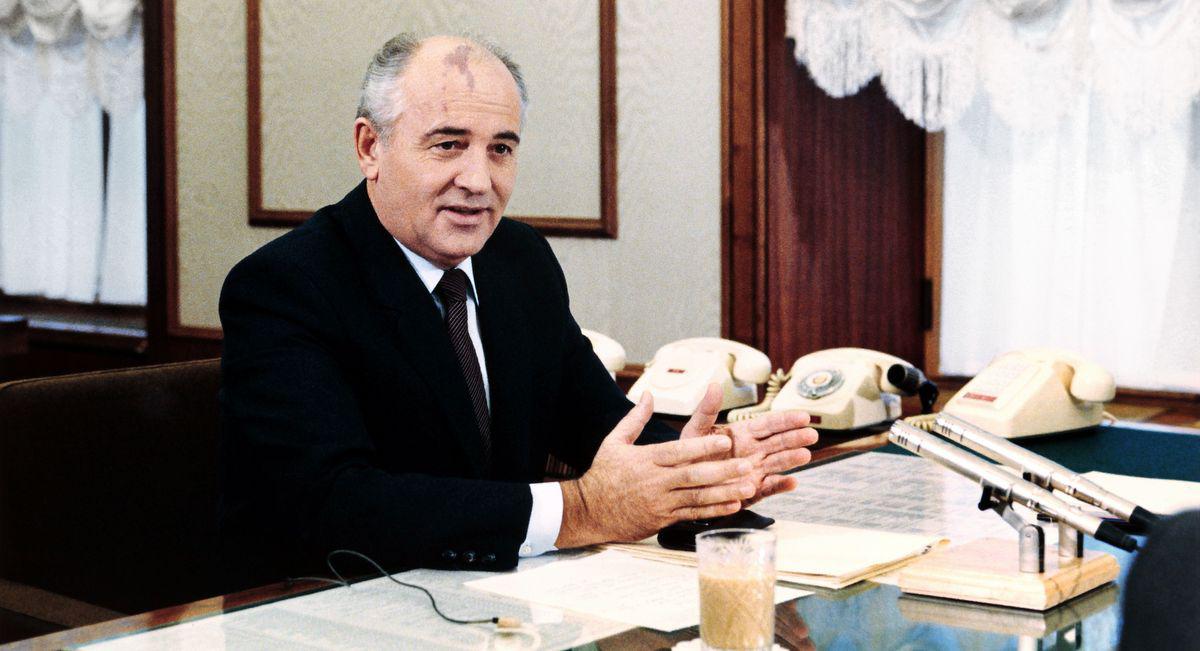
Whereas Mikhail Gorbachev granted his people freedom and suffered a crushing personal defeat, Vladimir Putin is doing exactly the opposite. But, in the end, it is Putin's legacy that will suffer, and Gorbachev who will be redeemed.
Source: Project Syndicate
Thirty-five years ago, Mikhail Gorbachev was named General Secretary of the Communist Party of the Soviet Union. “They expect a lot of Gorbachev,” Anatoly Chernyaev – a Communist Party bureaucrat and intellectual who would later become a leading adviser to Gorbachev – wrote in his journal at the time. The USSR needed “nothing less” than a “revolution from the top,” he noted. “Does Mikhail Sergeyevich understand this?”
To be sure, Gorbachev’s policies of perestroika (political and economic restructuring) and glasnost (transparency and openness) brought a revolution of expectations. After 20 years of stagnation overseen by an ailing gerontocracy – three leaders died in less than three years (a “hearse race,” Russians bleakly joked) – people sought change. Gorbachev, they believed, could deliver it.
Gorbachev’s first overtures to the West fueled what was called at the time “Gorbymania” – and not only in Western Europe and the United States, but also at home. This charismatic new leader would provide a better quality of life – comparable to East Germany, Hungary, or, better yet, Western Europe.
But that did not mean that Soviet citizens were about to embrace Western European-style governments or economies. On the contrary, they wanted to continue aimlessly drinking tea in offices, enjoying a lot of social security with little responsibility. They simply wanted their shops to be better stocked.
The architects of perestroika, by contrast, did understand that they were engineering a revolution. Gorbachev’s 1987 report marking the 70th anniversary of the Bolshevik Revolution was called “October and Perestroika: The Revolution Continues.” But even Gorbachev and his allies did not understand the extent of the task.
Gorbachev believed that if Leninism was merely purged of its association with Stalin, socialism would be reinvigorated and renewed in a more democratic, market-oriented form. What he did not realize was that these objectives were fundamentally incompatible. Far from restoring Leninism, his revolution would lead to the loss of socialism – and of the Soviet empire.
The tension between socialism and perestroika meant that Gorbachev’s leadership was marred by profound inconsistencies. Consider the institutionalization of elections, aimed at shoring up political leadership with democratic legitimacy. While the public and the perestroika-era elite applauded this shift, the sclerotic Soviet bureaucracy opposed it, and Gorbachev did not show the commitment to it one might expect.
In 1990, with the Communist Party’s monopoly on power coming under growing pressure, particularly from independence movements in the Baltic republics, Gorbachev decided to become president of the USSR. But rather than holding a national election, he was selected by the Congress of People’s Deputies – essentially an electoral college.
Similarly, after the Baltic republics broke away, Gorbachev tried to restore order by force – an approach that flew in the face of his declared effort to build a more humane, open state. The political costs of Gorbachev’s inconsistency rose after the secret protocols of the 1939 Molotov-Ribbentrop Pact (the treaty of non-aggression between Nazi Germany and the USSR that enabled them to divide Poland) and the Katyn massacre (the mass execution of Polish military officers) were revealed.
Gorbachev ran ahead of the political avalanche, pretending that he was leading what he was actually desperate to avoid. But he could outrun the inevitable for only so long, before being crushed. To conservatives, he soon became a villain – a destructive leader who had lost control of an empire – while radicals viewed him as a conservative pretending to be a reformer. By this point, not even his success in ending the Soviet-Afghan War in 1989 enabled him to maintain a modicum of popularity.
Nonetheless, by the time Boris Yeltsin took over in 1991, it was too late. Gorbachev’s reforms had already put the Soviet Union on the path toward dissolution. This earned him much praise in the West, where he is widely regarded as the Soviet leader who freed Eastern Europe, dismantled the Iron Curtain, ended the Cold War, and eliminated the specter of nuclear war. So transformative was Gorbachev’s revolution – including his embrace of many democratic values – that, looking back, it is little wonder that in 1989 Francis Fukuyama famously declared the “end of history.”
In Russia, however, the end of the Cold War is broadly viewed as a defeat. A public that had wanted simple quality-of-life improvements had to work hard to adapt to the new conditions brought about by Gorbachev’s reforms. Many never forgave Gorbachev for that, just like they did not forgive Yeltsin for failing to fulfill his promise of abundance and stability by the end of 1992, or Yegor Gaidar (the acting prime minister that year) for his role in designing market-oriented economic reforms.
To this day, most Russians view the collapse of the Soviet empire, morally and economically bankrupt as it was, as President Vladimir Putin does: “a major geopolitical disaster of the century.” In March 2019, a Levada Center poll found that 48% of Russians would prefer if everything had stayed as it was before perestroika.
This works for Putin, whose greatest fear is pressure to pursue a “perestroika 2.0.” Gorbachev granted his people freedom and suffered a crushing personal defeat. Putin – who has been busy setting himself up to remain president until 2036 – is doing exactly the opposite.
But rejecting perestroika’s legacy will deal Putin a hidden defeat. The current coronavirus crisis is demonstrating the extreme inefficiency of a non-democratic and bureaucratic capitalist state, and has revealed that society is not united by conservative and nationalistic values. Russians are much more pragmatic: they want a state that can reliably provide basic services. In this sense, Putin’s authoritarianism is failing, and the legacy of Gorbachev, who willingly or unwillingly gave Russia freedom, will be redeemed in the long run.
Former Senior Fellow, Carnegie Russia Eurasia Center
Kolesnikov was a senior fellow at the Carnegie Russia Eurasia Center.
Recent Work
Andrei Kolesnikov
Andrei Kolesnikov
Carnegie does not take institutional positions on public policy issues; the views represented herein are those of the author(s) and do not necessarily reflect the views of Carnegie, its staff, or its trustees.

Europe is facing rising populism internally as well as external pressures from Russia, China, Turkey, and the United States.

Dimitar Bechev

A notable degree of participative democracy has firmly arrived in Europe. But to have more far-reaching impact, democratic deliberation needs to move into a radically new phase.

Richard Youngs

Before the next wave of EU enlargement takes place, the union needs to grapple with thorny questions of how power is distributed among its members.


Emil Sondaj Hansen, Ditte Brasso Sørensen

A summer of escalation in the Black Sea has hurt Ukraine economically and is exacerbating world food security. A truce is needed—as is a broader reframing of Europe’s Ukraine strategy.

Thomas de Waal

European Commission President Ursula von der Leyen is about to give her annual address on the state of the EU. Here’s what she won’t—but should—say.

Rym Momtaz