

Commentary
Vita Spivak
{
  "authors": [
    "Vita Spivak"
  ],
  "type": "commentary",
  "centerAffiliationAll": "",
  "centers": [
    "Carnegie Endowment for International Peace",
    "Carnegie Russia Eurasia Center"
  ],
  "collections": [
    "Pax Sinica"
  ],
  "englishNewsletterAll": "",
  "nonEnglishNewsletterAll": "",
  "primaryCenter": "Carnegie Russia Eurasia Center",
  "programAffiliation": "",
  "programs": [],
  "projects": [],
  "regions": [
    "East Asia",
    "China",
    "Russia"
  ],
  "topics": []
}
Source: Getty
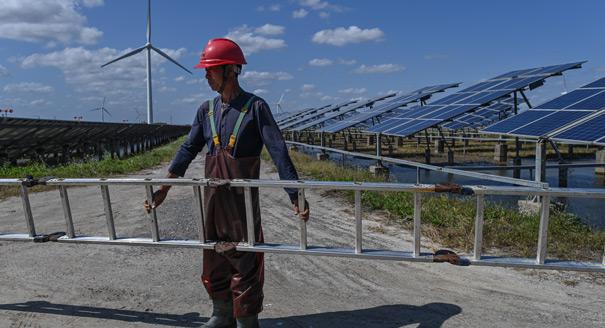
As Russia becomes increasingly pulled into China’s tech orbit, the Rubicon will be the Kremlin’s final decision on whether to use Chinese or Western technology to develop 5G networks in Russia—and currently Chinese companies look like the favorites.
China recently unveiled its fourteenth five-year development plan, covering the period 2021–2025. In the next five years, Beijing plans to pave the way for attaining two strategic goals: doubling GDP by 2035 (compared with 2020), and achieving the status of a high-income economy.
In addition, by 2027–2028, there is every chance that China will overtake the United States and become the world’s biggest economy in terms of nominal GDP. While the rest of the world is still reeling from the impact of the new coronavirus pandemic and lockdowns, the Chinese economy is growing. For Russia, the priorities outlined in the next five-year plan open up new opportunities on the one hand, while increasing the risks of an asymmetrical dependence on China on the other.
It’s likely that Russia will be able to sell more gas to China, though as far as pipeline gas is concerned, the Chinese market is increasingly becoming a buyer’s market: Gazprom and its Power of Siberia pipeline (and its planned second line) will have to fight off competition from pipelines from Central Asia and Myanmar.
Suppliers of liquefied natural gas (LNG) to China, including Russia’s Novatek, are in a better position, since they can quickly diversify their deliveries in the event of fluctuations in demand from China.
The future also looks bright for suppliers of oil to China. According to forecasts by the Oxford Institute for Energy Studies, as the Chinese economy bounces back from the effects of the pandemic, the country will move to ensure its energy security by buying more oil, especially while prices are low.
In the long term, however, there are factors that will negatively impact on oil demand in China, such as the proliferation of electric and hybrid vehicles as part of Beijing’s program to create new infrastructure and become carbon-neutral by 2060. By 2025, the proportion of what the Chinese government refers to as “new energy vehicles” among new car sales in China is expected to reach 25 percent.
The fourteenth five-year plan is good news for Russian agriculture, in addition to the usual Russian exports to China such as hydrocarbons, metals, and fertilizers. Growth in Chinese consumption over the next five years could help the Russian food industry to find new customers on the Chinese market. Russian agricultural exports to China have been growing rapidly for several years now, from an estimated total value of $1.2 billion in 2015 to $3.1 billion in 2019, despite fluctuations in the ruble exchange rate.
It’s important for Russian businesses to understand that the Chinese population is going to get richer over the next five years, and its consumer choices will become increasingly important on the global market. The multimillion-strong middle class in Chinese metropolises is adopting an ever-more serious attitude to food quality, and could be interested in buying Russian produce, which is often perceived by Chinese consumers as eco-friendly.
However, success on the Chinese market is highly dependent on the quality of transport infrastructure and logistics networks. To win over Chinese consumers, Russian food producers will have to overcome multiple tariff and nontariff barriers, as well as carefully devise a sales and marketing strategy for the Chinese market.
The technology part of China’s latest five-year plan is also extremely important for Russia. At a time when the two biggest and most technologically advanced economies in the world—the United States and China—have entered into a fight for leadership, interconnected production chains on both sides of the Pacific Ocean would serve as a guarantee that globalization will continue in technology, and that the whole world will operate according to roughly the same technological standards while having access to solutions from various producers. But the outlines of China’s national policy on technology discernible in the new plan indicate that Beijing intends to stake everything on technological nationalism, and reduce its dependence on the United States as far as possible.
Washington has chosen the same approach: President Joe Biden has signed an executive order on gradually returning critically important high-tech production chains to U.S. territory and that of its allies. This means that the world will see the formation of two competing technology centers in China and the United States, though it’s possible that they will both work to the same (International Organization for Standardization) standards.
Given its escalating confrontation with the West, Russia will become increasingly integrated into China’s tech orbit. The Rubicon in this respect will be the Kremlin’s final decision on whether to use Chinese or Western technology to develop 5G networks in Russia. Currently, Chinese companies look like the favorites: Huawei and ZTE are more willing to localize their technology in Russia in partnership with local companies than Siemens or Nokia.
For Russia, it will be crucial to not only be able to choose missing elements from Chinese platforms, but also use its own technology elsewhere, or have access to alternative solutions other than Chinese products. It will also be important to have its own tech products that are of interest to China.
Until now, the most important field in this respect has been military technology, but Chinese interest is now fading, not least due to China’s own successful military-industrial policy, which will be continued in the next five-year plan.
If back in the middle of the last decade China was still ready to buy the latest Russian military hardware like Su-35 fighter jets and S-400 missile systems, now Moscow is having to share more strategic technologies, such as helping Beijing to establish a missile launch detection system.
Moscow is not yet prepared to sell its very latest weapons, Vladimir Putin told Russian parliamentarians in 2018. Russian experts believe that the best way to ensure that Russia remains a major supplier of arms to China is to focus on the joint development of weapons, just as Russia and India cooperated to manufacture BrahMos missiles.
The problem is that joint efforts in even the far less sensitive field of civil engineering are plagued with difficulties. A joint Chinese-Russian project to develop a wide-body aircraft, for example, has so far resulted in nothing worth boasting about. Nor has much progress been made in the joint development of a heavy-lift helicopter. Whether the two countries could fare better on military projects remains to be seen.


Former Nonresident Scholar
Vita Spivak was a nonresident scholar at the Carnegie Russia Eurasia Center.
Recent Work
Vita Spivak
Vita Spivak

European states control several Overseas Countries and Territories around the world that carry strategic, economic, and environmental weight. As great powers challenge the rules-based order, defending them is a geopolitical imperative for Europe.

Marc Pierini

In supporting Europe’s far-right, MAGA and Russia both want the same thing: a weaker EU. Europe must defend itself without abandoning the openness these forces exploit.

Armida van Rij

As we close out another season of Strategic Europe, it is worth taking stock of the deep shifts underway.

Rym Momtaz

The hybrid warfare landscape is evolving rapidly, leaving policymakers without clear strategies. To better inform their work in addressing emerging challenges, governments must dig deeper into the underlying dynamics at play.


Raluca Csernatoni, Alicia Wanless
The EU had to compromise to adopt a twenty-first sanctions package against Russia, exposing growing cracks in the union’s resolve. Is this latest, weaker round worth it to keep pressure on Moscow?
Rym Momtaz, ed.