

Commentary
Andrei Kolesnikov
{
  "authors": [
    "Andrei Kolesnikov"
  ],
  "type": "commentary",
  "centerAffiliationAll": "",
  "centers": [
    "Carnegie Endowment for International Peace",
    "Carnegie Russia Eurasia Center"
  ],
  "collections": [],
  "englishNewsletterAll": "",
  "nonEnglishNewsletterAll": "",
  "primaryCenter": "Carnegie Endowment for International Peace",
  "programAffiliation": "",
  "programs": [],
  "projects": [],
  "regions": [
    "Russia"
  ],
  "topics": []
}
Source: Getty
Navalny is pushing ordinary Russians out of their comfort zone. The mass conformism endemic in authoritarian regimes is working against him.
The opposition politician Alexei Navalny’s near-deadly poisoning, his return to Russia, and his subsequent imprisonment have only increased the Russian public’s distrust and disapproval of him, according to a recent poll. The explanation couldn’t be more banal: it’s a case of shooting the messenger.
With his investigations into senior officials and the film about “Putin’s palace,” Navalny has presented new proof of the corruption and moral bankruptcy of the country’s leadership. But the passive majority doesn’t want to know, and would prefer to block out unfavorable and compromising information about their country.
This was also the case with the Malaysia Airlines passenger jet shot down over Ukraine in 2014 (just 2 percent of Russians polled believed that Russia was responsible), and the 2018 poisoning of the Skripals (only 3 percent blamed Russian intelligence agencies). Now it’s repeating itself with Navalny: 55 percent of those polled were not inclined to believe that he had been deliberately poisoned. The average Russian doesn’t want to believe the worst of the authorities, shrugs off suspicion, and tries not to think about it. And those who keep presenting new evidence are therefore increasingly irritating, which is reflected in their approval ratings.
Navalny paid an unbelievably high price to boost his trust rating by just 1 percent—taking it to 5 percent—before it slid back to 4 percent again.
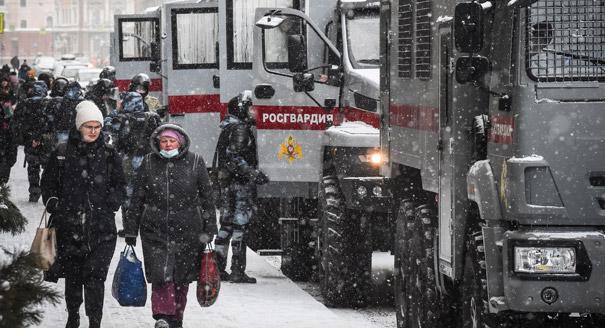
Mass conformism is one of the safeguards of Putin’s system, like any authoritarian regime. Anyone who doesn’t show demonstrative unity is marginalized—or, following the protests earlier this year, even criminalized.
Federal elections in Russia are really more of a referendum testing the degree of conformity of the apathetic majority. A good Russian should go to the polls and vote for an irremovable president, the ruling party, and regime-backed candidates: it’s a ritual that has been honed over the years until it’s automatic.
It would be strange to expect these “good” Russians to change their behavior over a film about “Putin’s palace,” or proof that the opposition leader had been poisoned, or indeed the return of that opposition leader to Russia, his arrest, and ensuing mass protests and civil resistance.
A third of those polled who had either watched Navalny’s film about “Putin’s palace” or had heard about it are sure the content of the film is untrue, while 38 percent chose the option “the content seems true, but it is difficult to assess the credibility of the accusations.” Just 17 percent were sure that the content of the film was true. That’s the entire outcome of the film ratcheting up millions of views.
The number of people who believe that protesters took to the streets because they were paid to was up 16 percentage points from 2017 to 28 percent. It’s important for conformists to convince themselves that nothing ever just happens: there must always be someone offstage, plotting to harm the fatherland. The level of distrust is particularly high with regard to protests in Russia’s biggest cities (especially Moscow and St. Petersburg), and even more so of those connected to Navalny: the protests and demonstrations in Khabarovsk last year over the arrest of the region’s governor elicited far more sympathy among ordinary Russians than the protests in support of Navalny in January and February this year.
This is an important point: protests without a leader—or at least those not associated with the name of a specific opposition leader—attract more sympathy in the average Russian than protests with a clear political label, like those in support of Navalny. In January 2021, a negative attitude (39 percent) and indifference (37 percent) toward protesters prevailed, while a positive attitude was only expressed by 22 percent of respondents. For comparison, 47 percent of people had a positive attitude toward protesters in Khabarovsk, and 16 percent had a negative attitude.
The protests of 2021 are, by their nature, a continuation of the 2011–2012 protests—a civil movement for the modernization of state and society—but at the same time, they differ greatly. In 2011–2012, there was a feeling of euphoria following the short-lived thaw of Dmitry Medvedev’s presidency, expectation of a dialogue with the authorities, and certainty that liberalization and democratization were inevitable. Until May 2012, given the lack of repression by the police or legal system thus far, there was no fear of such repression.
In 2021, there are no illusions or euphoria. There is, however, a clear understanding that repression is inevitable, and that the authorities are not prepared to enter into dialogue or to compromise.
There are also major differences with the perestroika era. Back then, there was a clear and simple idea—“Down With Communism”—and illusions of a democratic future with a bountiful market economy. But crucially, the push for democratization and permission for it came from the very top. A few years later, a leader appeared who symbolized that movement toward democracy: Boris Yeltsin.
Given Navalny’s monopoly on the political opposition, and now a significant part of civil society, he is in some ways reminiscent of Yeltsin. But Yeltsin was part of the elite, and his activity was not considered unlawful. Navalny has been excluded from the legal political process, including elections. Civil resistance is not just not permitted; it has been criminalized by the state.
The simple idea of “Down With Putin!” isn’t nearly enough to cover the whole of Russia. The average Russian, even one who is unhappy with the current state of affairs, still isn’t prepared to support the opposition, or even to join the ranks of those set on modernization.
The fact is that Russians have gotten used to the circumstances and rules of an authoritarian political regime. When actually faced with liberalization, they could discover quite quickly that they are perfectly capable of making use of democratic instruments. But for that to happen, the initiative needs to come from above, like under Mikhail Gorbachev.
For now, public opinion is mainly that of a distrustful observer. Navalny is pushing the conformists out of their comfort zone, and since they are completely unprepared to join civil society, they don’t like that.
Still, since 2018 (including at the height of the pandemic), the approval ratings of a symbol of comfort, President Vladimir Putin, have fallen. Something has driven the conformists to express their displeasure with the authorities, even if it’s not always very noticeable.
What precisely is changing the mood among the passive majority, and whether the generational gap in political views and values will come into play, will be the subject of two upcoming commentaries.
Former Senior Fellow, Carnegie Russia Eurasia Center
Kolesnikov was a senior fellow at the Carnegie Russia Eurasia Center.
Recent Work
Andrei Kolesnikov
Andrei Kolesnikov
Carnegie does not take institutional positions on public policy issues; the views represented herein are those of the author(s) and do not necessarily reflect the views of Carnegie, its staff, or its trustees.

The EU can impose sanctions but struggles to enforce them without the United States. With Washington increasingly disinterested in backing European interests, the bloc must now fend for itself.


Nicu Popescu, Tiago Antunes

Russia is testing the waters of NATO’s mutual defense clause. What do strikes in Romanian territorial waters mean for the alliance’s posture toward Moscow?

Dimitar Bechev

Europe is facing rising populism internally as well as external pressures from Russia, China, Turkey, and the United States.
Dimitar Bechev

A summer of escalation in the Black Sea has hurt Ukraine economically and is exacerbating world food security. A truce is needed—as is a broader reframing of Europe’s Ukraine strategy.

Thomas de Waal

European Commission President Ursula von der Leyen is about to give her annual address on the state of the EU. Here’s what she won’t—but should—say.

Rym Momtaz