

Commentary
The EU can impose sanctions but struggles to enforce them without the United States. With Washington increasingly disinterested in backing European interests, the bloc must now fend for itself.
Nicu Popescu, Tiago Antunes
{
  "authors": [
    "Eugene Rumer",
    "Richard Sokolsky"
  ],
  "type": "commentary",
  "centerAffiliationAll": "dc",
  "centers": [
    "Carnegie Endowment for International Peace"
  ],
  "collections": [],
  "englishNewsletterAll": "ctw",
  "nonEnglishNewsletterAll": "",
  "primaryCenter": "Carnegie Endowment for International Peace",
  "programAffiliation": "russia",
  "programs": [
    "Russia and Eurasia"
  ],
  "projects": [],
  "regions": [
    "North America",
    "United States",
    "East Asia",
    "China",
    "Russia"
  ],
  "topics": [
    "Security"
  ]
}
Source: Getty
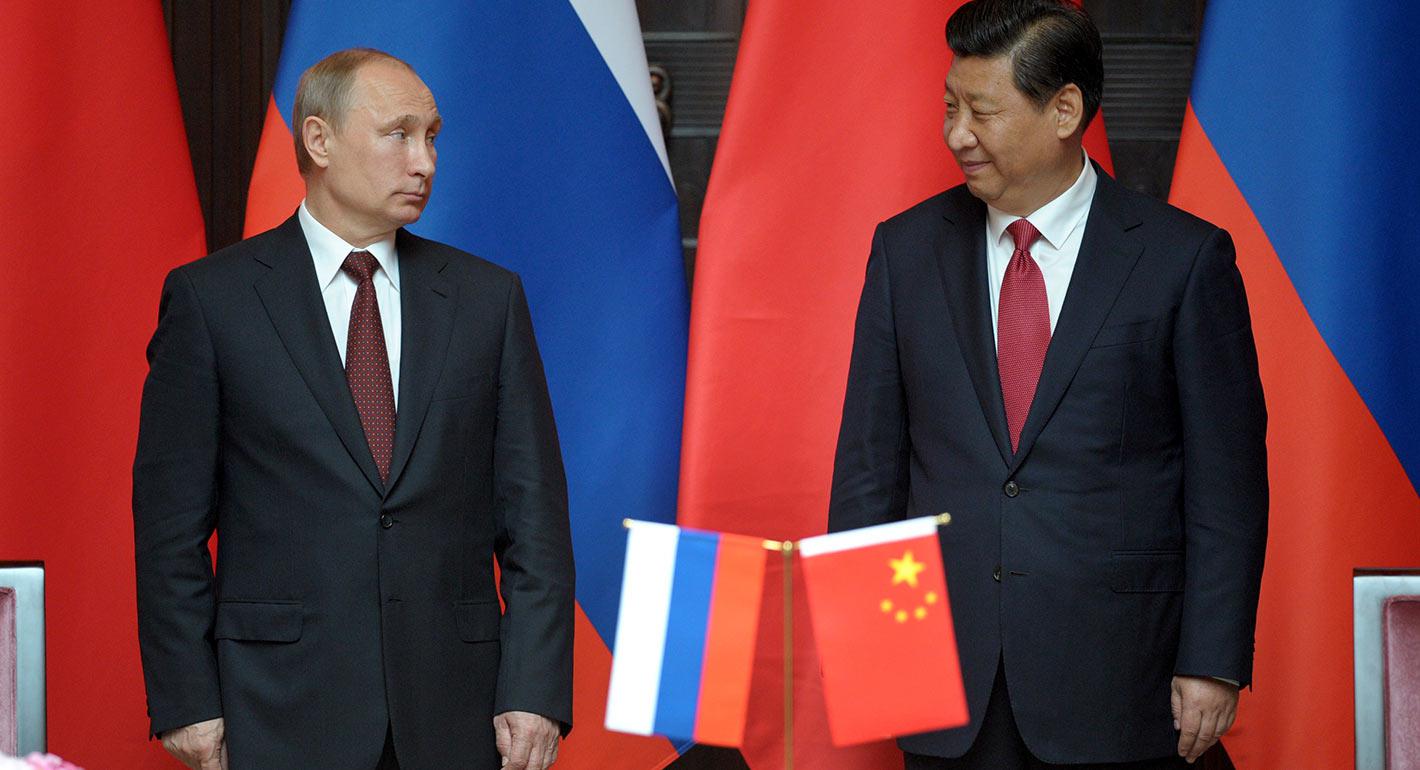
Two superpowers in league against the United States is an alarming prospect. But military cooperation between Moscow and Beijing is more about show than substance.
The specter of a defense alliance between Russia and China is haunting U.S. discussions about great power competition and even made it onto the transatlantic security agenda during President Biden’s recent European trip. Relations between Moscow and Beijing are indeed at an all-time high, and the two neighbors are pursuing some high-profile cooperative defense ventures. But the relationship falls well short of an alliance and is not heading that way. Chinese-Russian defense cooperation is more notable for the message it sends to the world—and especially to Washington—than for its practical operational benefits.
The biggest benefit Russia and China gain from their partnership in the defense sphere is intangible: it frees both countries from the necessity of vast military deployments on their 4,000- kilometer border. During the confrontation with China during much of the Cold War, the Soviet Union deployed as many as fifty divisions and faced an even greater number of Chinese divisions—fifty-nine, according to a declassified CIA estimate—on the other side of the border. The disappearance of that requirement frees up Russia to face NATO in Europe and allows China to face the United States and its allies in the Asia-Pacific. It is impossible to overestimate the value of this post–Cold War strategic realignment for both countries.
The debate in the United States about partnering with Russia to counter China has raised the former’s geopolitical stature. Beijing for its part also benefits from Washington’s preoccupation with Moscow’s malfeasance, as a distraction from the U.S.-China standoff. High-profile Chinese-Russian military moves, like the countries’ December 2020 joint bomber patrol over the Pacific, are of marginal military operational significance. Yet such moves inevitably raise questions in Washington about Russia’s role in a potential crisis between the United States and China in East Asia.
Some observers have raised concerns about the increasing frequency of Chinese-Russian military exercises. But it’s the quality of exercises that matters. These exercises are typically conducted in parallel rather than jointly and do not involve tactical or operational coordination to improve the countries’ interoperability or joint warfighting skills.
China has reportedly benefited from the exercises, learning from Russian command-and-control systems and recent combat experience. Even so, the limited scale and scope of these exercises suggest that their utility beyond geopolitical posturing is limited at best. Chinese-Russian joint naval drills have been limited in size—conducted in theaters where both countries’ navies are likely to struggle to sustain a significant presence—and are apparently designed for geopolitical signaling rather than meaningful operational purposes.
Following the normalization of Chinese-Russian relations at the end of the Cold War, Russia emerged as an important supplier of weapons and technology to China. That relationship was a financial lifeline for the Russian defense industry at a time when domestic procurement orders had dried up. But Russian sales to China have since tapered off as China’s own defense industry has matured, thanks to a significant degree to technology transfer and theft from Russia. China now competes with Russia in arms markets. Presently, Russia’s arms sales to China account for just 3 percent of the countries’ total annual two-way trade of more than $100 billion. With access to Western technology cut off by sanctions, Russia’s defense industry has been looking to China as an alternative source of innovation that it cannot develop indigenously. This trend is likely to continue, with Russia becoming more reliant on Chinese technology for its weapons development as long as Beijing is willing to sell it.
It is telling that all of the Kremlin’s touted defense cooperation with China has done little to alleviate the major deficiencies in Russia’s military posture, which include unmanned aerial vehicles, electronic warfare, and conventional precision strike capabilities. Chinese-Russian defense cooperation has generated significantly greater gains for China than it has for Russia. Over time, Moscow is poised to grow more dependent on Beijing as long as its standoff with NATO continues.
Russia’s and China’s adversarial relations with the United States could prompt them to undertake closer geopolitical coordination in different theaters. But their partnership has its limits. China has not recognized Russia’s annexation of Crimea. Russia is highly unlikely to risk an outright conflict with the United States in the event of a major crisis between Washington and Beijing in the Asia-Pacific. But Russia could engage in provocative posturing in Europe or the Middle East, or even in the Pacific, as a demonstration of its geopolitical stature.
The partnership with China is an incalculable force multiplier for Russia—more so than it is for China. Defense cooperation is an important element of the partnership but not the most important one. This is not an alliance, Chinese diplomats routinely stress in conversations about relations with Russia, and Chinese academics openly question the value of the partnership. The utility of defense cooperation with Russia will probably diminish for China as Russia is likely to have less to offer over time as a function of its modest technological capabilities. However, for the same reasons, the alignment with China is likely to remain important for Russia as Moscow seeks to retain its position as a global actor and to modernize its military and domestic security apparatus.

Director and Senior Fellow, Russia and Eurasia Program
Rumer, a former national intelligence officer for Russia and Eurasia at the U.S. National Intelligence Council, is a senior fellow and the director of Carnegie’s Russia and Eurasia Program.

Nonresident Senior Fellow, Russia and Eurasia Program
Richard Sokolsky is a nonresident senior fellow in Carnegie’s Russia and Eurasia Program. His work focuses on U.S. policy toward Russia in the wake of the Ukraine crisis.
Carnegie does not take institutional positions on public policy issues; the views represented herein are those of the author(s) and do not necessarily reflect the views of Carnegie, its staff, or its trustees.

The EU can impose sanctions but struggles to enforce them without the United States. With Washington increasingly disinterested in backing European interests, the bloc must now fend for itself.


Nicu Popescu, Tiago Antunes

Russia is testing the waters of NATO’s mutual defense clause. What do strikes in Romanian territorial waters mean for the alliance’s posture toward Moscow?

Dimitar Bechev

With its public finances in shambles, the far right polling at 35 percent ahead of the 2027 presidential election, and a growing protest movement, is France’s crisis a threat to the EU’s geopolitical awakening?

Rym Momtaz, ed.

Ahead of a tough winter for Ukraine, Donald Trump’s swing back toward Russia bodes ill. But instead of panicking, Kyiv’s European allies are focusing on action.
Rym Momtaz

While the EU and European governments are embracing the much-lauded middle-power moment, this entails three difficult conundrums.

Richard Youngs