

Book
Europe is facing rising populism internally as well as external pressures from Russia, China, Turkey, and the United States.
Dimitar Bechev
{
  "authors": [
    "Fyodor Tertitskiy"
  ],
  "type": "commentary",
  "centerAffiliationAll": "",
  "centers": [
    "Carnegie Endowment for International Peace",
    "Carnegie Russia Eurasia Center"
  ],
  "collections": [],
  "englishNewsletterAll": "",
  "nonEnglishNewsletterAll": "",
  "primaryCenter": "Carnegie Endowment for International Peace",
  "programAffiliation": "",
  "programs": [],
  "projects": [],
  "regions": [
    "East Asia",
    "South Korea",
    "Russia"
  ],
  "topics": [
    "Economy"
  ]
}
Source: Getty
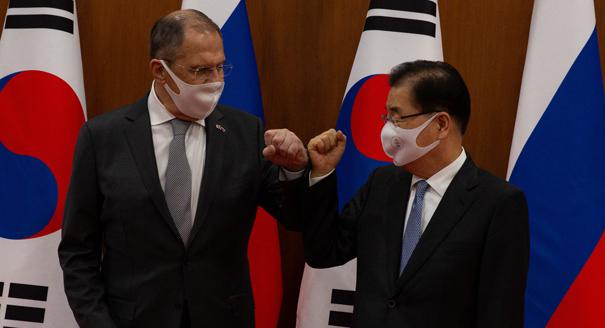
The U.S.-Russia standoff has escalated so much in recent years that other countries find it almost impossible to maintain good relations with both Washington and Moscow. Those who manage to tread that line successfully include South Korea.
In the three decades since Russia and South Korea established diplomatic relations, their friendship has survived all of the political changes in both countries, despite Seoul’s close military alliance with Washington.
South Korea’s partnership with the United States is fundamental to its foreign policy. Nevertheless, Seoul adroitly fulfills its obligations to Washington without undermining its relations with Moscow.
South Korea has taken a softer position vis-à-vis Russia on a number of issues. Following Georgia’s bombardment of its breakaway republic of South Ossetia in August 2008, South Korea was one of the few countries to denounce Georgian aggression and support Moscow, which backs the self-proclaimed republic. Following the Ukraine crisis, South Korea was also the only U.S. ally not to revoke its visa-free regime with Russia (currently suspended due to the coronavirus pandemic). Nor did Seoul impose its own sanctions against Moscow in response to the annexation of Crimea, although it does comply with the sanctions of the United States and its other allies, and does not recognize Crimea as part of Russia.
There are several reasons for this successful balance. First of all, Russia and South Korea don’t have major trigger points for conflict: Moscow focuses above all on the post-Soviet space, while Seoul is most concerned with developments in East Asia. Second, there are no major historical or ideological irritants in their bilateral relations, such as those both Moscow and Seoul separately have with Tokyo. Third, the two countries maintain a positive image of each other.
This doesn’t mean that relations between Russia and South Korea are completely trouble-free. For example, the issue of North Korea’s nuclear program both unites and divides Moscow and Seoul, and South Korea’s investments in Russia fuel not only amicability but also frustration over inflated expectations. However, there is no public demand for bilateral confrontation in either country.
For Russia, the key aspects of its relationship with South Korea are tourism and trade. The lack of visa requirements makes South Korea a very attractive destination for tourists from the Russian Far East.
Trade is conducted almost exclusively by sea. Hence the interest in one of the oldest yet still unfulfilled projects: the construction of the Trans-Korean Railway, which would cross North Korea and terminate in South Korea. There were also plans to build a gas pipeline along the same route, which would substantially increase the volume of trade between Russia and South Korea, with North Korea receiving transit fees.
The project should be attractive to all parties, but plans have been at a standstill for decades, and are unlikely to move forward unless there is a change of regime in Pyongyang. The two main stumbling blocks are the harsh sanctions against North Korea, which cannot be lifted without U.S. agreement, and Pyongyang’s unreliable reputation as a business partner: far too often it has nationalized projects that became profitable, and there is no guarantee that a railway and pipeline would not suffer the same fate.
For the time being, Russia is South Korea’s twelfth biggest trading partner, while South Korea is Russia’s sixth in terms of imports, and eighth in terms of exports.
For Seoul, in addition to tourism and trade, relations with Moscow include a diplomatic aspiration: Seoul hopes that Moscow can apply pressure on Pyongyang to set it on a path toward nuclear disarmament. For Moscow, too, participating in resolving the North Korean crisis presents an important opportunity to try to reduce the potential for conflict, curb the expansion of U.S. military infrastructure in the region, and increase its own international prestige.
Objectively speaking, Moscow has very little influence over Pyongyang: de facto, the Kremlin recognizes North Korea as being within China’s sphere of interest, and it has few levers of control outside of its geographic proximity, modest trade, and veto power in the UN Security Council.
Why, then, does Seoul still believe that Moscow can sway Pyongyang? There are several reasons. The first is persistence of perception: after all, North Korea was once a Soviet satellite. Second, the Kremlin has successfully sustained its image as an influential country that can pressure North Korea if needed. In particular, by securing a seat in the Six-Party Talks on North Korea’s nuclear program in the mid-2000s, Moscow set a precedent for playing a role in all conferences and events relating to North Korea. Even U.S. President Joe Biden has acknowledged that Russia and the United States need to work together on North Korea: after all, Russia’s vote is necessary to impose international sanctions via the UN Security Council.
Thus, Moscow and Seoul have many reasons to work together and no major grounds for conflict. At the same time, South Korea is an ally of the United States, and Washington currently has troubled relations with Moscow. How does that affect relations between Moscow and Seoul?
The short answer is: most likely it doesn’t. Russia and South Korea aren’t high on each other’s diplomatic lists of priorities. And the U.S. Embassy in Seoul has other worries, starting with fixing the soured relationship between Seoul and Tokyo, and watching over the activities of the main U.S. rival, China.
The Kremlin does occasionally voice symbolic criticism of South Korea for its lack of independence in relations with the United States: for example, over the deployment of the THAAD missile defense system in South Korea. However, such criticism does not affect the overall positive tenor of relations between Moscow and Seoul.
Moscow usually engages in confrontations with U.S. allies because of crises in bilateral relations, not simply because of U.S. pressure. There are no such crises on the horizon in Moscow’s relations with Seoul. While there are no reasons to expect relations to become significantly closer, substantive deterioration also seems improbable.
South Korea conducts an even-keeled foreign policy, so it is difficult to imagine Seoul making any rash steps that would upset Moscow. Russia is likewise unlikely to take anti–South Korea actions.
The only scenario in which a deterioration of Russia-South Korea relations seems at all likely is an escalation of the standoff between Moscow and Washington to a state in which the fight against the Kremlin becomes the number one priority for the White House. In that case, Seoul really would be forced to show solidarity with Washington, and the Russia-South Korea friendship would become a thing of the past.
However, the most likely forecast is for the continuation of the status quo: relatively passive, but cooperative and pragmatic relations in the years to come. Such relations suit the interests of the elites and the general populations of both countries.
This article was published as part of the “Relaunching U.S.-Russia Dialogue on Global Challenges: The Role of the Next Generation” project, implemented in cooperation with the U.S. Embassy to Russia. The opinions, findings, and conclusions stated herein are those of the author and do not necessarily reflect those of the U.S. Embassy to Russia.

Fyodor Tertitskiy
Carnegie does not take institutional positions on public policy issues; the views represented herein are those of the author(s) and do not necessarily reflect the views of Carnegie, its staff, or its trustees.

Europe is facing rising populism internally as well as external pressures from Russia, China, Turkey, and the United States.

Dimitar Bechev

The European Commissioner for Trade is headed to China. But after President Xi’s bridge-building visit to Washington, can a more isolated EU overcome Beijing’s stranglehold on critical raw materials? Who will blink first?

Rym Momtaz, ed.

The domestic impacts of how long it is taking to end the war in Ukraine have pushed the French electorate to the political extremes and compromised the country’s diplomatic capacity.
Rym Momtaz

A summer of escalation in the Black Sea has hurt Ukraine economically and is exacerbating world food security. A truce is needed—as is a broader reframing of Europe’s Ukraine strategy.

Thomas de Waal

European Commission President Ursula von der Leyen is about to give her annual address on the state of the EU. Here’s what she won’t—but should—say.
Rym Momtaz