

Paper
Christopher S. Chivvis, Rohan Mukherjee, Milan Vaishnav
{
  "authors": [
    "Christopher S. Chivvis"
  ],
  "type": "commentary",
  "centerAffiliationAll": "dc",
  "centers": [
    "Carnegie Endowment for International Peace"
  ],
  "collections": [],
  "englishNewsletterAll": "americanStatecraft",
  "nonEnglishNewsletterAll": "",
  "primaryCenter": "Carnegie Endowment for International Peace",
  "programAffiliation": "ASP",
  "programs": [
    "American Statecraft"
  ],
  "projects": [],
  "regions": [
    "North America",
    "United States",
    "Russia",
    "Eastern Europe",
    "Ukraine"
  ],
  "topics": []
}
Source: Getty
Russia’s invasion of Ukraine calls for more caution, not less.
Mock attacks by Russian bombers in the middle of the night. Mysterious mini-submarines appearing in the waters outside Stockholm. A small private island in the southern Gulf of Bothnia bristling with satellite antennae and a heliport.
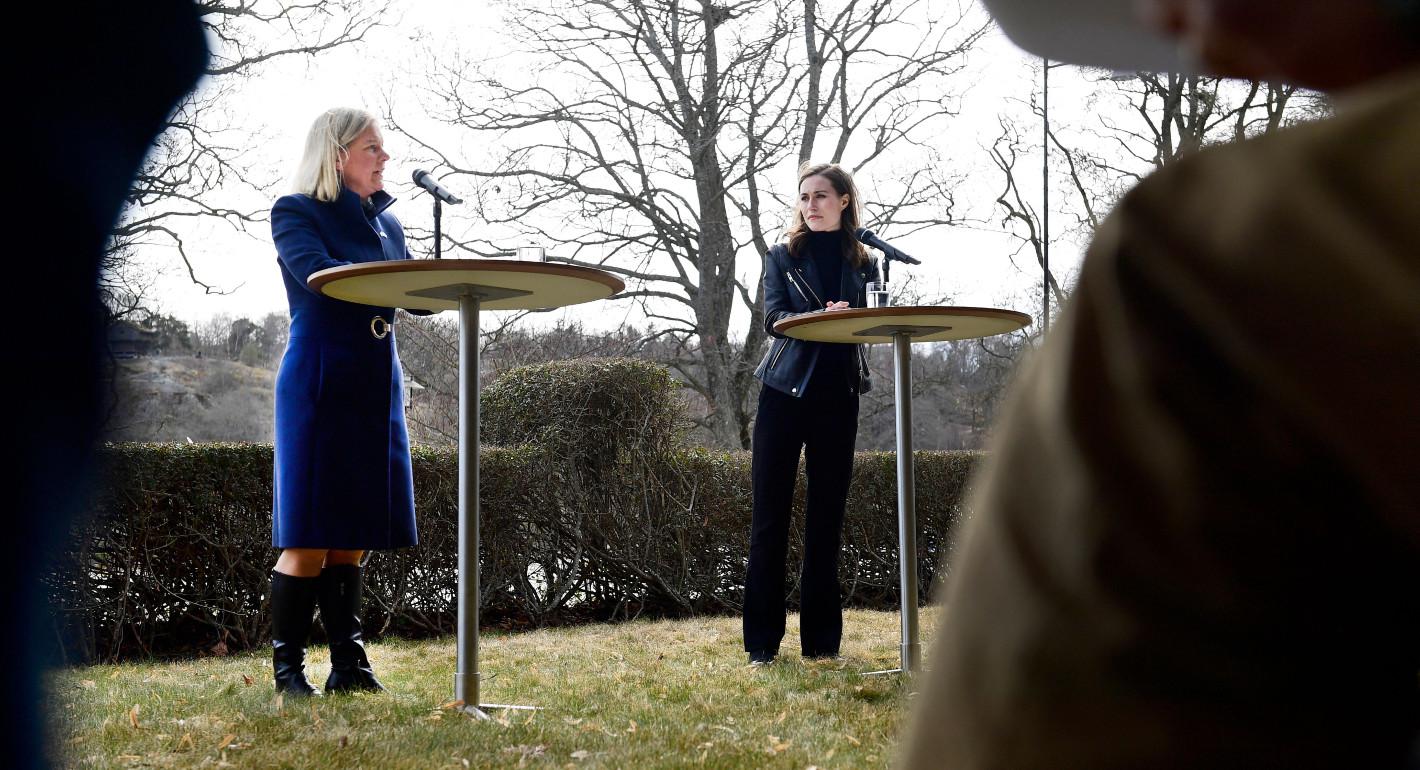
For years, once-neutral Sweden and Finland have leaned toward NATO after provocations like these from Russia, but their larger eastern neighbor’s war on Ukraine turbo-boosted their drive to join the alliance. Finnish president Sauli Niinistö visited the United States only a week after Russia’s invasion, presumably to discuss the possibility. Public opinion in both countries looks more and more favorable to NATO membership, and NATO’s secretary general recently said the two countries would be welcomed with open arms. The NATO summit planned for June would be the natural moment to launch the process, although it might happen even sooner.
This Nordic pair has a much stronger case for NATO membership than Ukraine did. Sweden and Finland are already wealthy members of the European Union, with long-established democratic regimes. If they were attacked by Russia, the economic and geopolitical consequences for the United States and Europe would be much greater than in Ukraine’s case.
But their likely applications for membership pose an inherent conundrum. On the one hand, Russian hostility is the cause of their interest. On the other, it creates a real chance the alliance would have to defend them against a Russian attack if they join. And if Sweden and Finland aren’t secure enough with their own armies, then bringing them in might create a major new vulnerability for the alliance just as the chances of conflict with Russia are rising.
Both countries have small, though advanced, militaries. Finland has a limited but high-end national defense force and a very large reserve army ready to mobilize on short notice to defend against a Russian attack. Sweden’s military was once among the largest in Europe but dwindled rapidly after the Cold War, when defense spending dropped to among the lowest levels in Europe. Both Sweden and Finland have greatly increased their defense spending in response to the war. As countries with high levels of per capita income, they could make a net contribution to NATO’s military capabilities over time.
Moreover, both countries are genuinely concerned about more than just their own borders. They rightly see the security of their whole neighborhood as key to their economic prosperity. It makes sense that they might take on a leading role in defending the whole Baltic region, for example, by adding enhanced air and missile defenses; making contributions to NATO ground forces currently in Estonia, Latvia, and Lithuania; and building better regional cyber and electronic warfare defenses. There’s even a possibility that bringing them into NATO would force Russia to be more cautious in future conflicts. At a minimum the Kremlin would need to figure out what to do about its 850-mile border with Finland.
But that same border is also a potential headache for NATO, which would have to develop and resource a credible plan to defend it against Russia. And herein lies the rub. It’s unrealistic and would be unwise to expect the United States to shoulder any major part of such a new commitment, given America’s domestic politics, other global defense priorities, and the fact that European allies should be capable of carrying the lion’s share of the burden on their own.
Washington needs to press pause and avoid rushing headlong into commitments that it might later regret. It should conduct a serious study of the conventional and unconventional requirements for the defense of Finland’s border, and it needs strong commitments from both countries—not only to fund the defense of their own territories but also to make real contributions to defending weaker allies along NATO’s eastern flank. It should also recognize that neither country will add anything meaningful to U.S. security policy in Asia, at least as long as that policy focuses on competition with China. Sweden was one of the first European countries to heed U.S. warnings about the risks posed by Chinese telecoms firms Huawei and ZTE, but its powerful business community remains laser focused on the Chinese market. Volvo Cars, a Swedish firm, is owned by the Chinese conglomerate Geely. Although recently critical of Beijing, Helsinki also has a long history of warm relations with China.
Some experts will no doubt urge haste to bring both countries into NATO, lest their neutrality invite an opportunistic Russian attack. But as long as Russia’s military is tied up in an escalating war in Ukraine, this is an unlikely scenario.
Others may see an opportunity to use NATO enlargement to punish Russia for its war on Ukraine, but that also doesn’t make much sense. Russian President Vladimir Putin is not a schoolchild ready to learn lessons from NATO. If anything, he will see another round of enlargement as further justification for his war on Ukraine.
Again, Finland and Sweden are not Ukraine. Bringing them into the alliance could offer real advantages that increase security in Europe if handled correctly. But first, Washington needs to be sure that the Finns and Swedes are truly ready to share the burdens and make the sacrifices that NATO membership entails—not just enjoy the benefits it brings.

Senior Fellow and Director, American Statecraft Program
Christopher S. Chivvis is the director of the American Statecraft Program at the Carnegie Endowment for International Peace.
Recent Work


Christopher S. Chivvis, Rohan Mukherjee, Milan Vaishnav

Christopher S. Chivvis, Senkai Hsia
Carnegie does not take institutional positions on public policy issues; the views represented herein are those of the author(s) and do not necessarily reflect the views of Carnegie, its staff, or its trustees.

The EU can impose sanctions but struggles to enforce them without the United States. With Washington increasingly disinterested in backing European interests, the bloc must now fend for itself.


Nicu Popescu, Tiago Antunes

Russia is testing the waters of NATO’s mutual defense clause. What do strikes in Romanian territorial waters mean for the alliance’s posture toward Moscow?

Dimitar Bechev

Ahead of a tough winter for Ukraine, Donald Trump’s swing back toward Russia bodes ill. But instead of panicking, Kyiv’s European allies are focusing on action.

Rym Momtaz

Funding Ukraine remains a priority for European leaders. As Russia’s war of aggression heads into another winter, two feasible options to mobilize support for Kyiv should be fast-tracked.


Vladyslav Rashkovan, Gregory P. Wilson

While the EU and European governments are embracing the much-lauded middle-power moment, this entails three difficult conundrums.

Richard Youngs