

Commentary
Rym Momtaz, ed.
{
  "authors": [
    "Rym Momtaz"
  ],
  "type": "commentary",
  "blog": "Strategic Europe",
  "centerAffiliationAll": "",
  "centers": [
    "Carnegie Endowment for International Peace",
    "Carnegie Europe"
  ],
  "englishNewsletterAll": "",
  "nonEnglishNewsletterAll": "",
  "primaryCenter": "Carnegie Europe",
  "programAffiliation": "",
  "regions": [
    "Europe",
    "United States"
  ],
  "topics": [
    "EU",
    "Foreign Policy",
    "NATO",
    "Trade"
  ]
}
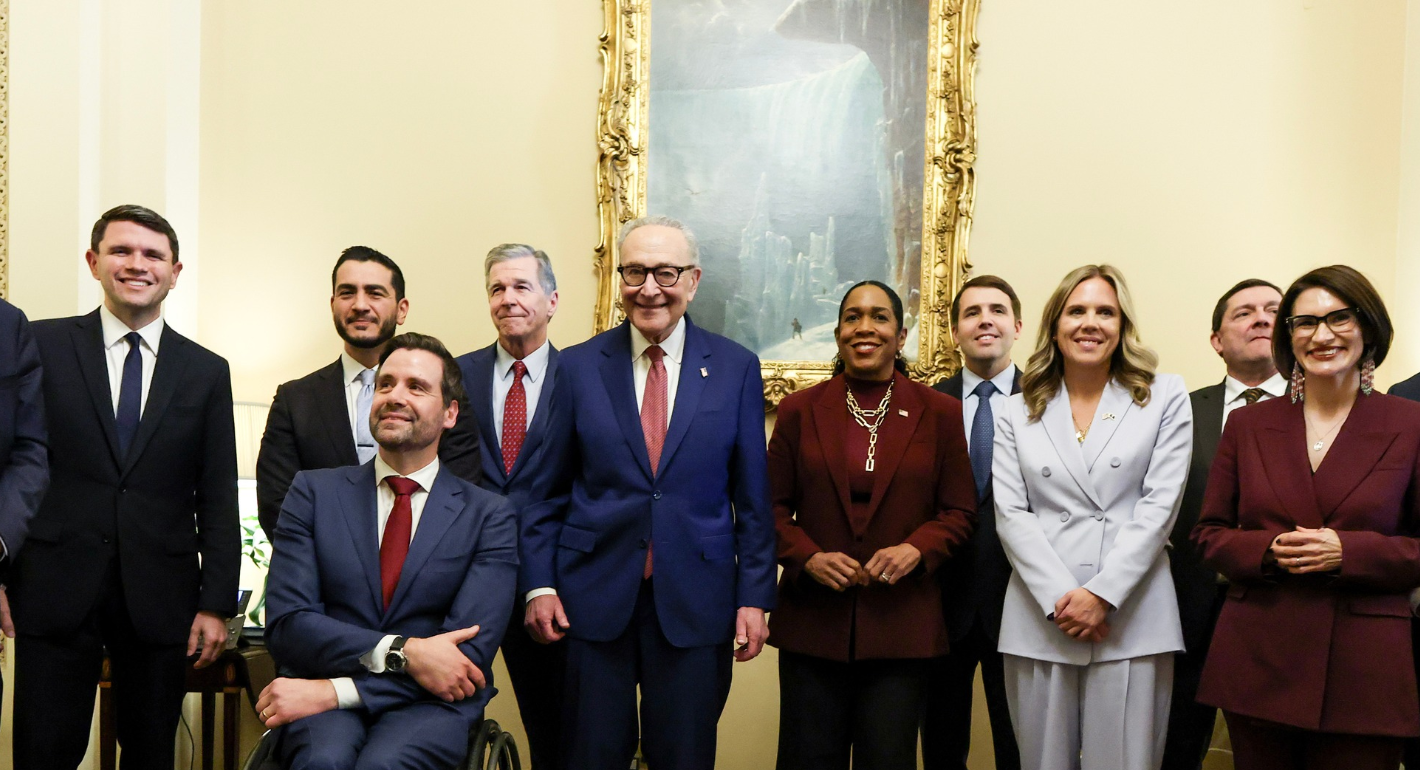
Source: Getty
A blue wave has swept over the U.S. midterms, with Democrats regaining control of both houses of Congress. But Europeans hoping for a return to business as usual should think again.
It’s that time again, when too many European allies are tempted to rejoice and let their guard down after an election in the United States. They shouldn’t.
The Democrats’ sweeping victory in the midterms will not translate into an equally dramatic reversal of the increasingly divergent U.S. and European interests on core strategic challenges.
There is bipartisan consensus in the United States on the need to renegotiate, redefine, and recalibrate the transatlantic relationship—even if policymakers on both sides of the aisle use different terminology and emphasize different aspects.
The fundamentals will remain unchanged, even if Democrats win the White House in 2028. Europeans have to assume primary responsibility for their conventional security, the United States will continue to use economic warfare to shore up its working and middle classes—as well as its industries—at the expense of its allies if need be, and parts of the American and European strategic threat assessments will continue to diverge.
The last Democratic administration’s own record under president Joe Biden—the Inflation Reduction Act, the AUKUS security partnership with Australia and the UK, and taking an increasingly conservative approach to military aid to Ukraine—should have inoculated the Europeans against this wishful thinking. And yet, some can’t help but put on their star-spangled-banner goggles and dream of a return to when they were warmly ensconced in the American cocoon, not recognizing that it was an aberration of history.
As the 2024 presidential election and the 2026 midterms have made abundantly clear, both Republicans and Democrats are bound by one overwhelming factor: the way the American people feel about the cost of living. That has direct and immovable repercussions for Europe on defense, on trade, and on tech. The era of unlimited American security and unfettered free trade is gone. U.S. President Donald Trump calls it “America First,” and the Biden administration called it “a foreign policy for the American people.”
While the new Democrat-dominated Congress is likely to be more positively inclined toward support for Ukraine than before, that support will not be game-changing. The incoming class of Democrats also includes a sizeable contingent that is singularly focused on improving the economic conditions of their constituents and is no more inclined than MAGA Republicans toward continuing massive defense spending on Europe or rolling back tariffs.
What Europeans can reasonably expect is for Democrats, and Republicans willing to break with Trump, to push through a new package of security assistance for Ukraine in the upcoming National Defense Authorization Act. This would include weapons through NATO’s Prioritized Ukraine Requirements List, which Europeans largely pay for, and intelligence sharing, as well as reversing Trump’s waivers on Russian diesel.
But they cannot create interceptor stocks faster than the laws of physics, and implementation and enforcement will remain a challenge. The uncomfortable reality for those who have an unextinguishable belief in the checks and balances of the U.S. system is that when an administration does not want to implement a bill or a law, Congress has very little recourse. The Trump administration has given a masterclass in this.
So, forcing the U.S. Department of Defense to stop undermining Ukraine on intelligence sharing, or on access to the Starshield satellite defense system, is likely to prove less straightforward.
The 2023 statutory requirement prohibiting a U.S. president from unilaterally withdrawing from NATO is a good case study to keep in mind. It introduced a real curb on any such move, had Donald Trump truly planned on withdrawing from the alliance. But Trump retains a vast ability to undermine NATO through his statements and decisions, should he choose to.
As Secretary of State and National Security Advisor Marco Rubio has said, “who is the president will largely … determine the direction your country goes with regard to foreign policy. And that’s the way it’s historically been in American history; that’s the way the Constitution is set up. So again, look, Congress has a role to play in our foreign policy, particularly in what it funds and in its oversight function, but the number one factor in determining the foreign policy of the United States has always been and will remain the president of the United States.”
As a result, Europeans have to stay the course. Over the past two years they have proven, to themselves as much as the rest of the world, that where there is a will, there is a way. They fund the overwhelming majority of both military and reconstruction aid to Ukraine. The upcoming funding shortfalls will be a challenge, but one that they have no choice but to overcome because the security stakes demand it. Within NATO, they are providing the lion’s share of military assets to police the air and sea on the alliance’s Eastern flank from increasing Russian probes, with undeniable crucial U.S. strategic enablers.
Building on this progress, Europeans would be well served to approaching the new congressional leadership with a concrete and decisive plan to continue this transatlantic rebalancing—including when it comes to the U.S. force posture review. To be successful, they have to build an intra-European consensus on how to wield and leverage the EU’s trading power, how much coproduction to pursue with U.S. weapons manufacturers, and how to address Big Tech. The good news is that even with the Trump administration and its potential heirs, and all the more so with the emerging Democrat coalition, the equation is not as zero-sum as has been presented. The global strategic upheaval is so profound that there are paths to benefit the working and middle classes on both sides of the Atlantic at the same time.
Subscribe to Strategic Europe, delivered every Tuesday and Thursday!

Editor in Chief, Strategic Europe
Rym Momtaz is the editor in chief of Carnegie Europe’s blog Strategic Europe. A multiple Emmy award-winning journalist-turned-analyst, she specializes in Europe and the Middle East and the interplay between those two spaces.
Recent Work
Rym Momtaz, ed.
Rym Momtaz, ed.
Carnegie does not take institutional positions on public policy issues; the views represented herein are those of the author(s) and do not necessarily reflect the views of Carnegie, its staff, or its trustees.

In Germany, competing perceptions of Russia are highlighting a tension between public opinion and government policy. In the country’s east, where division is widespread, populist parties are taking advantage.

Gwendolyn Sasse

The European Commission is preparing the EU for its next enlargement. But member states need to make it a project that European citizens can understand, shape, and support.

Iliriana Gjoni
Resetting relations with the EU is a central plank of the UK’s current foreign policy. Is Andy Burnham being bold enough or is he falling into the same trap as his predecessors, misreading the power dynamic?
Rym Momtaz, ed.

Excitement is in the air following Aleksandar Vučić’s defeat in Serbia. To build a truly democratic state, the movement that unseated the former president must learn from the mistakes of the past.

Ivan Vejvoda
The EU can impose sanctions but struggles to enforce them without the United States. With Washington increasingly disinterested in backing European interests, the bloc must now fend for itself.


Nicu Popescu, Tiago Antunes