

Commentary
Saskia Brechenmacher, Shreya Joshi
{
  "authors": [
    "Saskia Brechenmacher"
  ],
  "type": "commentary",
  "centerAffiliationAll": "dc",
  "centers": [
    "Carnegie Endowment for International Peace"
  ],
  "collections": [
    "Gender"
  ],
  "englishNewsletterAll": "democracy",
  "nonEnglishNewsletterAll": "",
  "primaryCenter": "Carnegie Endowment for International Peace",
  "programAffiliation": "DCG",
  "programs": [
    "Democracy, Conflict, and Governance"
  ],
  "projects": [],
  "regions": [
    "South Asia",
    "India"
  ],
  "topics": [
    "Democracy",
    "Civil Society"
  ]
}
Source: Getty
Bringing more women into national and state politics could be a significant step for women’s representation, but several factors may threaten progress.
Last week, India’s legislature passed a landmark bill requiring the lower house of parliament (known as the Lok Sabha), the Delhi Legislative Assembly, and state legislative assemblies across the country to set aside one-third of their seats for women. The reform represents a significant change in a country that currently ranks 141 out of 185 countries globally with respect to women’s political representation, opening the door for many more women to enter national politics.
Efforts to pass a national gender quota in India are not new: versions of the same reform had been sitting in Parliament since 1996. Six previous attempts to pass the measure had failed, often due to the opposition of smaller regional parties, many of which insisted that the gender quota include a subquota for women representing historically disadvantaged castes. This time around, the bill was celebrated by parties across the political spectrum, as well as many women’s rights advocates. But several hurdles and trends—including delayed implementation and democratic backsliding—threaten to cloud the quotas’ numerous benefits.
The new law will not come into force before next year’s elections. It stipulates that the gender quotas will only begin after delimitation (redistricting, in Indian parlance) has been completed, based on numbers from the first census after the passage of the act. India’s decadal census was to be implemented in 2021 but has been delayed indefinitely, so the gender reservation may not come into effect until the 2029 general elections.
Once it is implemented, the reservation will ensure a significant increase in women’s political representation. As of 2023, women hold only 15.2 percent of seats in the Lok Sabha and 13.9 percent in the upper house, known as the Rajya Sabha—though the latter is not covered by the new law. Representation across all but two state legislative assemblies is even lower. For instance, in the Himachal Pradesh state assembly, only one out of sixty-eight members is a woman. Globally, the share of women in parliamentary office stands at 26.5 percent.
Part of the problem is that few Indian women run for office. In 2019, under 10 percent of candidates were women. Barriers include traditional gender norms that limit women’s roles, mobility, and influence outside of the home; lower levels of political knowledge; concerns about safety; and sexism and discrimination within political parties. Although Indians generally support women’s political leadership, women often struggle to advance in political parties without the patronage of powerful male leaders.
Some critics argue that gender quotas—especially those that reserve parliamentary seats for women—only result in women’s tokenistic inclusion, with male party leaders selecting candidates that they can control from behind the scenes. Although quota reforms are rarely sufficient to transform patriarchal norms and hierarchies, evidence from India’s local governments suggests that they can deliver tangible governance improvements and benefits for women citizens. Since the early 1990s, India has reserved one-third of village council leadership positions for women (and the reserved seats rotate each election). Research shows that this policy has brought more women into politics and has helped to change citizen attitudes about women in leadership positions, improved government responsiveness to female citizens, increased girls’ aspirations and educational attainment, fueled rising investments in public goods favored by women, and increased reporting of crimes against women.
These findings mirror global patterns. To date, 137 countries have implemented some form of gender quota in legislative bodies. These reforms have spurred increases in health spending, prompted new legislation on women’s rights, and increased legislators’ responsiveness to female constituents. However, in some cases, quotas have also generated backlash. In India, local female leaders have been more likely to enforce gender-equalizing property inheritance laws. One result has been an uptick in male resistance, with brothers often opposing their sisters’ land claims and pressuring them to renounce their rights.
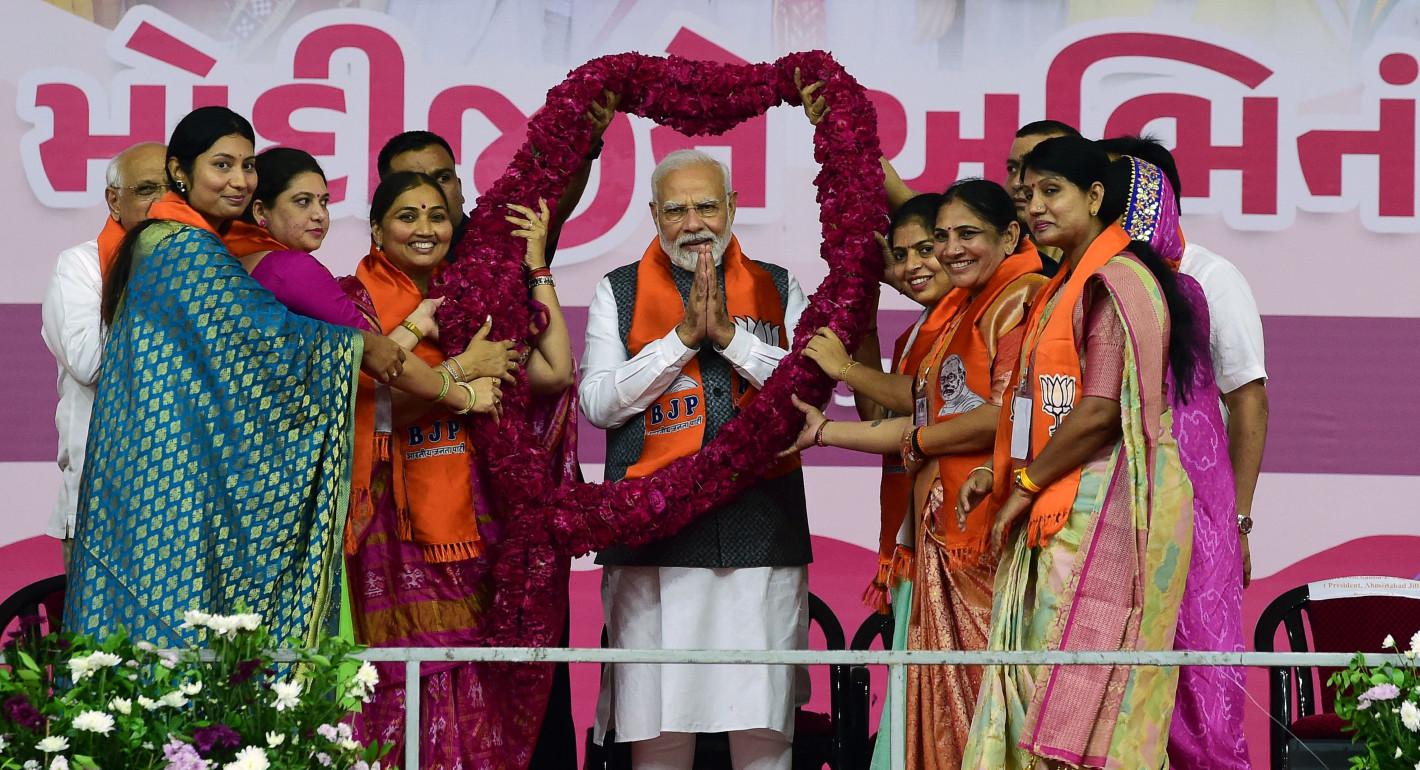
The timing of the new gender reservation bill is not coincidental. Ahead of India’s critical 2024 elections, Prime Minister Narendra Modi and the ruling Bharatiya Janata Party (BJP) have an interest in appealing to women, who in 2019 turned out to vote in equal numbers to men for the very first time.
India’s upcoming elections are taking place amid a democratic erosion. Over the past several years, Modi has increasingly used the BJP’s electoral dominance to weaken checks on executive power; sideline the political opposition; and crack down on dissent in civil society, academia, and independent media. Undergirding these antidemocratic tendencies is the BJP’s Hindu nationalist rhetoric and agenda, which has fueled attacks on minority rights and a rise in extralegal violence.
But Modi remains a very popular leader, including among many women. Throughout his tenure, he has regularly focused on women’s empowerment to bolster his legitimacy, discussing women’s issues at public rallies and casting himself as a masculine protector figure. In 2019, the BJP fielded more female candidates than any other party, intensified its outreach to rural and poorer women, and became the party with the highest number of female voters. The party has also promoted social welfare schemes that primarily benefit women, such as distributing subsidized household gas cylinders. These efforts are not unusual. Around the world, autocratizing leaders often use women’s rights to bolster their domestic legitimacy while projecting a modernizing image to the world.
Observing rising political illiberalism, some feminist activists have critiqued the government for advancing a narrow and paternalistic vision of women’s empowerment rooted in conservative religious and gender norms. Muslim women and women from other marginalized groups have been at the front lines of nonviolent, anti-government protests, speaking out against some of the government’s illiberal policies and facing detention, police intimidation, harassment, and threats.
Together, these trends cast a shadow over the newly adopted quota reform. Bringing more women into national and state politics could be a significant step for women’s representation, making governance more responsive to women’s interests and needs. Yet ongoing efforts to concentrate power in the executive branch and close space for dissent will inevitably weaken these representational gains. After all, civil society is another critical space for women to articulate their demands, hold legislators accountable, and claim political power.

Senior Fellow, Democracy, Conflict, and Governance Program
Saskia Brechenmacher is a senior fellow in Carnegie’s Democracy, Conflict, and Governance Program, where her research focuses on democratic erosion, gender, and civic activism in the United States and globally. She also serves on the board of the International Center for Not-for-Profit Law.
Recent Work
Saskia Brechenmacher, Shreya Joshi

Saskia Brechenmacher, Frances Z. Brown
Carnegie does not take institutional positions on public policy issues; the views represented herein are those of the author(s) and do not necessarily reflect the views of Carnegie, its staff, or its trustees.

A notable degree of participative democracy has firmly arrived in Europe. But to have more far-reaching impact, democratic deliberation needs to move into a radically new phase.

Richard Youngs

The domestic impacts of how long it is taking to end the war in Ukraine have pushed the French electorate to the political extremes and compromised the country’s diplomatic capacity.

Rym Momtaz

Before the next wave of EU enlargement takes place, the union needs to grapple with thorny questions of how power is distributed among its members.


Emil Sondaj Hansen, Ditte Brasso Sørensen

Radical-right parties are expected to do well in upcoming elections in four of the EU's biggest member states. If successful, they could prevent the union from addressing key challenges ahead.

Stefan Lehne

An overwhelming victory by a far-right-wing party in a small state in eastern Germany will have major repercussions for Chancellor Friedrich Merz’s coalition.

Judy Dempsey