

Paper
Catherine Fieschi
{
  "authors": [
    "Catherine Fieschi"
  ],
  "type": "commentary",
  "blog": "Strategic Europe",
  "centerAffiliationAll": "",
  "centers": [
    "Carnegie Endowment for International Peace",
    "Carnegie Europe"
  ],
  "englishNewsletterAll": "",
  "nonEnglishNewsletterAll": "",
  "primaryCenter": "Carnegie Europe",
  "programAffiliation": "",
  "regions": [
    "Europe",
    "France"
  ],
  "topics": [
    "EU",
    "Democracy"
  ]
}
Source: Getty
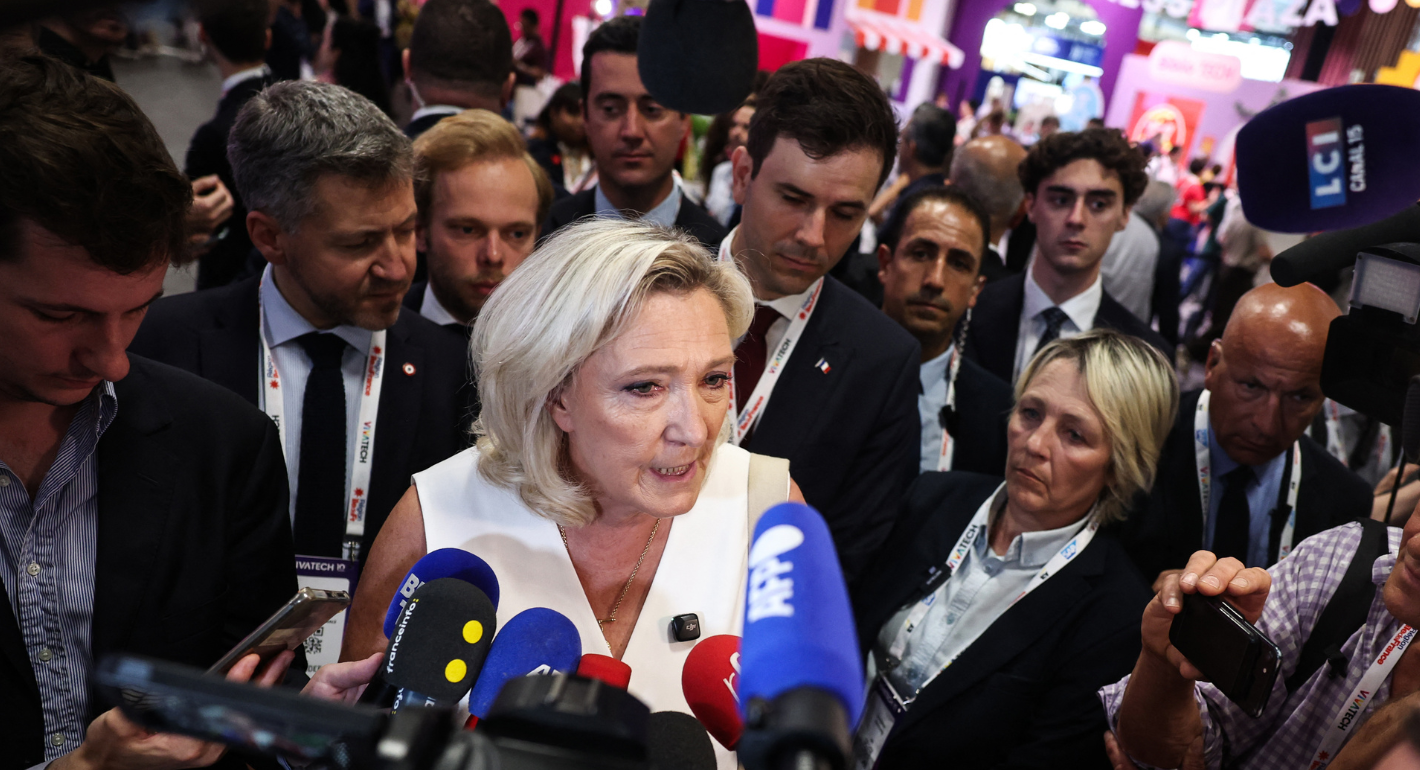
Far-right leader Marine Le Pen can—and will—run in France’s next presidential election. What does the outcome of her appeal against a 2025 embezzlement conviction mean for the country’s political future?
For months, the French political debate has organized itself around one single question: Would National Rally (RN) leader Marine Le Pen be barred from the 2027 presidential race, or would the court adjudicating the appeal of her 2025 conviction for embezzlement overturn enough of the ruling to allow her to stand? Instead, she was given a choice no one had quite expected: legally possible, politically costly, and potentially ethically compromising.
The appeals court produced a subtle verdict. It upheld her conviction for the systematic misuse of European Parliament funds and retained a substantial sentence: three years’ imprisonment, one of them to be served wearing an electronic tag under house arrest, and a fine of €100,000 ($114,000). But it reduced her ban from public office from five years to forty-five months, thirty of them suspended. The remaining (effective) fifteen months were deemed to have been served. Le Pen therefore emerged neither acquitted nor simply reprieved—she remained a convicted politician, sentenced to a real custodial constraint, but nevertheless eligible to seek the presidency.
Le Pen then faced a major dilemma: allow her young protégé Jordan Bardella to run in her place or break her own promise and campaign with an ankle bracelet.
By evening, that dilemma had been theatrically dissolved. She appeared on the television news to announce that she maintained her innocence, would appeal again before France’s highest court, and would definitely run in 2027. Challenged on the risk that her second appeal could fail, that the campaign could be disrupted, and the sequence turn chaotic, her confidence barely wavered. This went well beyond bravado, it was a display of populist confidence drawn from a particular grammar: institutions are never neutral, constraints are always traps, only the people confer legitimacy. In that grammar, criminal convictions don’t disqualify, they serve as evidence of persecution. And, true to her far-right roots, she was rising from the ashes like a phoenix. It is ironic that, almost at the same time in Britain, Reform UK leader Nigel Farage was attempting to use the exact same playbook.
Because this is the key. Le Pen’s choice and performance were the clearest signs yet of an attempt to MAGA-fy French politics: disregard the rules, deny the facts, insist that institutional constraint is persecution, and convert criminal convictions into proof of martyrdom. Even the performance—the clenched delivery, the trademark gnashing of teeth, the abrupt, almost maniacal snarl—recalled the register U.S. President Donald Trump has made so familiar: anger staged as authenticity and grievance performed as courage.
The RN is certainly not an American movement, and there is no love lost between Le Pen’s party and the U.S. right. But policy disagreement does not prevent imitation of style. What matters is the borrowing of a political grammar. In that grammar, courts are legitimate only when they deliver the right outcome, law is neutral only when it spares one’s own side, and institutions are either captured by enemies or useable as tools of revenge. Le Pen’s new appeal case buys time during which she can campaign without the bracelet, demand once again to be presumed innocent, and prepare to denounce any future legal setback as democratic sabotage.
This is why her choice to run is significant: It foretells an ugly campaign to come, one that will be designed to discredit institutions as illegitimate and moderation as wishy-washy. It could also become highjacked by caricature and invective, and precede an even more aggressive presidency should she be elected.
It is too early to determine how much this astute judicial settlement will weaken Le Pen’s insurgent strategy. The court avoided the charge often levelled by her party that voters, rather than judges, should decide the fate of the election. Yet, it reaffirmed the gravity of the offence, identified Le Pen as central to the scheme, and imposed a sentence that could not be dismissed as symbolic. In doing so, it upheld the separation of powers and returned the matter to politics.
Some will say the verdict changes little: The RN is far ahead of every other party in the polls, and Bardella polled as well—if not better—than Le Pen. But the latter is a more dangerous opponent than the former. This is partly due to her willingness to take the MAGA route, but also because, while Bardella has discipline and social media savvy, Le Pen has experience, ideological depth, and a combativeness and rage forged by defeat, scandal, and reinvention. She can polarize, improvise, and survive. And she will approach the campaign in ways that make those qualities matter more than policy preparedness and understanding.
Many of her core voters will not be troubled by her status as a convicted politician. For them, a conviction may even confirm what they already believe: The system is determined to prevent someone they see as the people’s candidate from reaching power. But French presidential elections are not won with a core vote alone—candidates must cross the 50 percent threshold in the second round. And if around 60 percent of voters outside her most loyal camp disapprove of her decision to run, this could be a real obstacle. The unease not confined to her opponents. The fact that 32 percent of people in her own party say they are unhappy with her decision is striking, even if we don’t know whether this is a reflection of ethical discomfort, electoral anxiety, or simply a preference for Bardella.
What stands between Le Pen and the Élysée is the possibility that a credible candidate might yet emerge from the center left, the center right, or what remains of both to challenge her in the second round. Right now, that candidate hasn’t emerged. Since 2024, French politics has been consumed by fragmentation, tactical positioning, and the jockeying of diminished parties for vanishing space. Le Pen’s greatest advantage is not that a majority of French voters actively want her—they don’t. It is that her opponents may fail to organize a majority against her.
Subscribe to Strategic Europe, delivered every Tuesday and Thursday!

Visiting Scholar, Carnegie Europe
Catherine Fieschi is a visiting scholar at Carnegie Europe and the author of Populocracy (2019).
Recent Work
Catherine Fieschi
Catherine Fieschi

With its public finances in shambles, the far right polling at 35 percent ahead of the 2027 presidential election, and a growing protest movement, is France’s crisis a threat to the EU’s geopolitical awakening?

Rym Momtaz, ed.

Ahead of a tough winter for Ukraine, Donald Trump’s swing back toward Russia bodes ill. But instead of panicking, Kyiv’s European allies are focusing on action.
Rym Momtaz

While the EU and European governments are embracing the much-lauded middle-power moment, this entails three difficult conundrums.

Richard Youngs

Much has been said of the changes Brussels is trying to make to the EU enlargement process. Here’s why gradual integration might—or might not—be the answer.

Dimitar Bechev

The European Commissioner for Trade is headed to China. But after President Xi’s bridge-building visit to Washington, can a more isolated EU overcome Beijing’s stranglehold on critical raw materials? Who will blink first?
Rym Momtaz, ed.