

Commentary
While the EU and European governments are embracing the much-lauded middle-power moment, this entails three difficult conundrums.
Richard Youngs
{
  "authors": [
    "Zainab Usman",
    "Alexander Csanadi"
  ],
  "type": "other",
  "centerAffiliationAll": "dc",
  "centers": [
    "Carnegie Endowment for International Peace"
  ],
  "collections": [
    "Africa’s Natural Resources in the Global Energy Transition",
    "Climate and Energy Transitions",
    "Africa’s Shifting Politics and Geopolitics"
  ],
  "englishNewsletterAll": "africa",
  "nonEnglishNewsletterAll": "",
  "primaryCenter": "Carnegie Endowment for International Peace",
  "programAffiliation": "AFP",
  "programs": [
    "Africa"
  ],
  "projects": [],
  "regions": [
    "Southern, Eastern, and Western Africa",
    "United States"
  ],
  "topics": [
    "Economy",
    "Trade"
  ]
}
Source: Getty
For the United States, the objectives of both increasing the volume of critical minerals supplies and diversifying the sources of these supplies could be advanced by developing collaborations with African countries premised on scientific and technical exchanges in the mining sector.
Critical minerals,1 such as nickel, graphite, manganese, cobalt, copper, and lithium, currently occupy a central role in global economic and geopolitical competition. Demand for these minerals is projected to skyrocket over the coming years, driven primarily by increased demand for renewable energy and electric mobility technologies. Depending on specific modeling assumptions employed, it is estimated that overall mineral demand will increase by a factor of between two and three by 2030 and continue to rise through 2050.2 For specific minerals, such as lithium and graphite, demand projections are even steeper. These demand surges create particular challenges given that the lead time for bringing new mines online—from discovery to production—currently takes an average of eighteen years globally.3
In addition to the energy sector, critical minerals also serve as necessary inputs for frontier technologies crucial to economic prosperity and national security. Gallium, germanium, and silicon, for example, are essential for the production of semiconductors,4 demand for which is forecasted to continue rising because of increased artificial intelligence (AI) applications and the associated proliferation of data centers.5
Beyond market supply and demand considerations, creating more diverse and resilient mineral supply chains is now a priority for most advanced countries.6 For the United States, both increasing the total volume of mineral supply and diversifying the sources of those minerals is imperative for economic and national security. Escalating export restrictions, including recently on gallium, germanium, and antimony, by China—which dominates the global supply of these commodities7—only reinforce this imperative.8 Correspondingly, the United States has framed the importance of augmenting its critical mineral supplies in economic and security terms.9 Much of the recent focus is aimed at increasing U.S. domestic supply of these minerals, particularly through permitting reform, support for expanding domestic production, and developing refining and processing facilities.10 However, there is also a clear signal of interest in complementary international engagements to achieve mineral supply and energy security.11 These engagements flow in both directions. That is, the U.S. government views international partners not only as potential sources of mineral inputs but also as potential recipients of U.S. energy and related technology exports.12
Mineral rich African countries arise as natural potential partners on both sides of this equation. With respect to inputs, taking copper as an example, the White House recently initiated a so-called “section 232” investigation to determine whether imports of copper—particularly from “a concentrated number of supplier nations”—pose a threat to national security.13 The concerns are not only over raw copper ore but also refined copper and concentrates. In 2024, China was responsible for an estimated 44 percent of global refined copper production, a far greater share than any other country.14 This was more than four times the refinery production from the Democratic Republic of the Congo (DRC) and Zambia combined, despite the fact that copper reserves in these countries are around two and a half times that of China’s reserves (and more than double that of the United States). Supporting the development of refining and processing capacity in the DRC and Zambia could therefore, alongside increased domestic production, help the United States alleviate its concerns around concentrated copper supply chains.
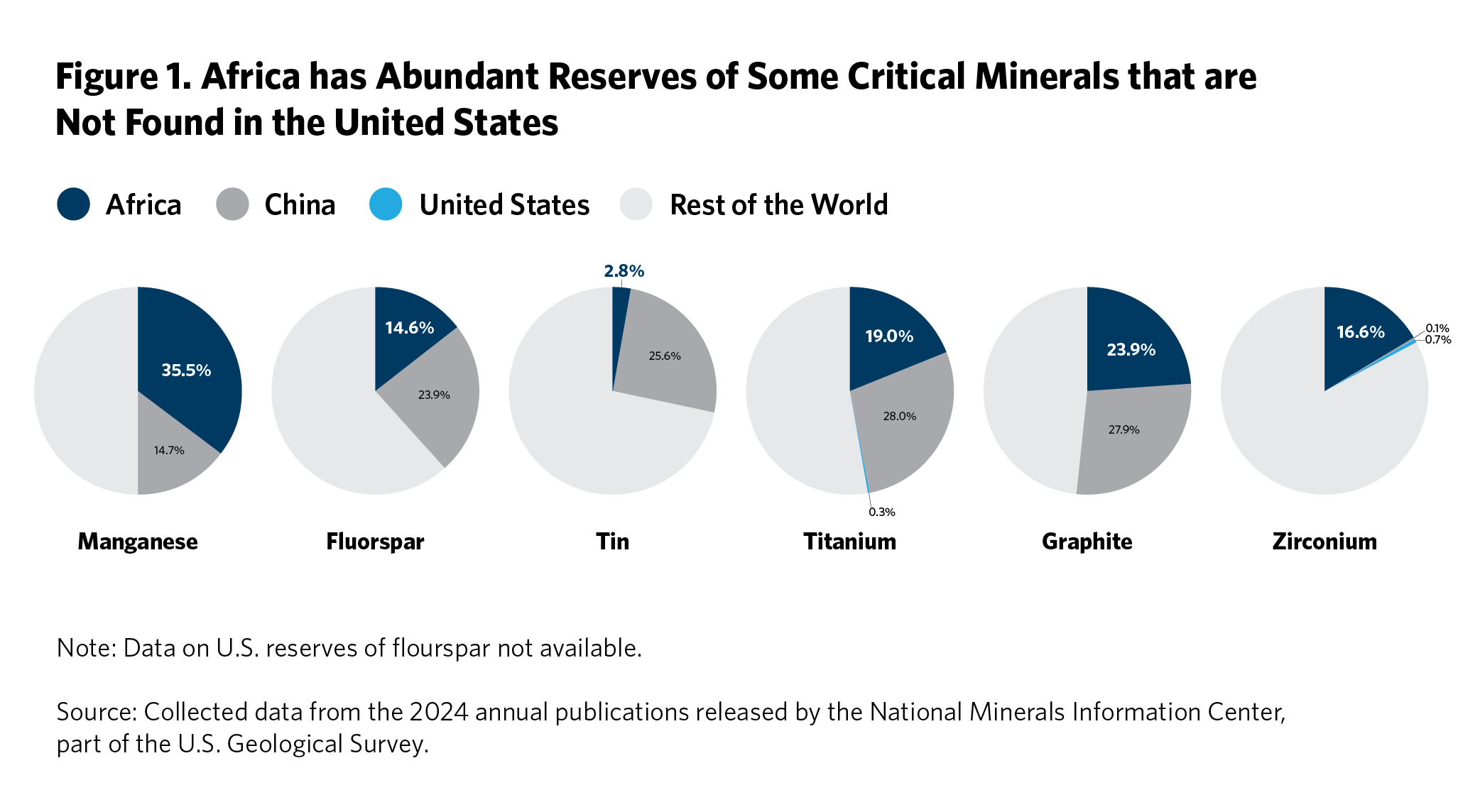
Similar potential exists for many other critical minerals, particularly those with which the United States is not endowed (see figure 1). Manganese, found in both South Africa and Gabon, the first- and second-largest producers in the world respectively,15 is a particularly compelling example: refined products like high carbon ferromanganese and silicomanganese are used in steelmaking, an industry identified by the current administration as critical for national security.16
From the perspective of African countries, U.S. engagement in mineral supply chain development would be welcome, provided it does not replicate the historical pattern of extraction of raw ore for export. Adopted by the African Union in 2009, the African Mining Vision (AMV) aims to achieve optimal growth and broad-based socioeconomic development from mineral resources by focusing on ensuring value addition and ultimately industrialization on the back of the mining sector.17 Additionally, the recently released African Green Minerals Strategy contains among its organizing structure a focus on industrialization through mineral beneficiation and mineral-based economic transformation.18 Similar language around the importance of value addition from minerals is contained in the relevant strategy documents of many mineral rich countries, including Zambia,19 Zimbabwe,20 and Tanzania.21
Among the constraints to African development of mineral beneficiation and manufacturing cited by the AMV is a lack of requisite energy infrastructure. The new U.S. energy secretary, Chris Wright, has spoken about the importance of energy in the lives of people not just in the United States but also around the world and the potential for U.S. energy technology to be adopted globally.22 In his remarks at the tenth annual Powering Africa Summit on March 7, 2025, Wright explicitly committed U.S. support for African energy.23 U.S. energy technology exports have the potential, therefore, to address the energy bottleneck and unlock the industrial activity African partners aspire to achieve, while augmenting the mineral supply chains necessary for downstream industry in the United States.
Another constraint to African countries fully exploiting their mineral resources is with respect to geological technology—from exploration to processing—and human capital. On both fronts, the United States is uniquely positioned to be an effective partner. The technical and training expertise contained within government entities, academic institutions, and private companies can be leveraged to help unlock the development of world-class mineral supply chains in African countries—to the benefit of all parties.
It is within this context that the Africa Program at the Carnegie Endowment for International Peace convened around forty high-level African and U.S. policymakers and leading members of the private sector in February 2025 during the Investing in African Mining Indaba Conference in Cape Town, South Africa. The roundtable had a clear mission: to brainstorm proposals for developing collaborations between the United States and African countries premised on scientific and technical exchanges in the critical minerals and mining sectors. The discussion produced ten core sets of ideas. Five outline the strategic case for leveraging U.S. technical and scientific expertise and the other five outline specific areas to consider in expanding this collaboration.

Former Director, Africa Program
Zainab Usman was a senior fellow and the inaugural director of the Africa Program at the Carnegie Endowment for International Peace.
Alexander Csanadi
Former Research Analyst, Africa Program
Alexander Csanadi was a research assistant in the Carnegie Africa Program.
Carnegie does not take institutional positions on public policy issues; the views represented herein are those of the author(s) and do not necessarily reflect the views of Carnegie, its staff, or its trustees.

While the EU and European governments are embracing the much-lauded middle-power moment, this entails three difficult conundrums.

Richard Youngs

Europe is facing rising populism internally as well as external pressures from Russia, China, Turkey, and the United States.

Dimitar Bechev

Much has been said of the changes Brussels is trying to make to the EU enlargement process. Here’s why gradual integration might—or might not—be the answer.
Dimitar Bechev

The European Commissioner for Trade is headed to China. But after President Xi’s bridge-building visit to Washington, can a more isolated EU overcome Beijing’s stranglehold on critical raw materials? Who will blink first?

Rym Momtaz, ed.

European NATO countries are wrestling with the possibility of U.S. disengagement from the alliance. With the continent’s security increasingly uncertain, governments must restore the credibility of their collective defense.



Hans-Dieter Lucas, Adam Thomson, Pierre Vimont