

Paper
The U.S.-Iran war has crossed a dangerous threshold: water infrastructure in the Gulf is now a target. Ecological statecraft is no longer peripheral to security, it's part of its foundations.
Olivia Lazard, Ali Bin Shahid
Source: Getty
China’s economic growth remains high in spite of the global recession. The Chinese government has already spent a great deal of stimulus money, but should strengthen its social safety net to protect manufacturing workers who lose their jobs as exports collapse.
Getting a clear view of where China’s economy is heading is not easy at the moment. Exports have been doing badly, amid subdued global demand prospects. On the other hand, investment has picked up speed, boosted by a very large policy stimulus that has raised both activity and spirits. How has the Chinese economy been doing on balance, what are the prospects, and what does this mean for economic policy?
Recent Developments—On Balance Relatively Good
In a still weak and uncertain global setting, China’s economy continued to slow down in the first quarter of 2009. However, expansionary fiscal and monetary policy since November 2008 has boosted growth. Much of the fiscal stimulus is centered on the government’s investment and infrastructure oriented “RMB 4 trillion” stimulus plan.
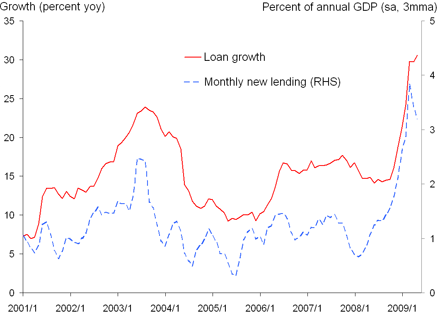
Bank lending to stimulus projects has been a key part of the impressive expansion of bank credit in the first five months of 2009. In the first quarter, monthly new lending averaged 4 percent of annual GDP (Figure 1). Notwithstanding a slowdown in lending in the second quarter, which is likely to continue, this massive monetary injection will fuel economic growth in the coming quarters.
Figure 1. A massive monetary injection

Looking at individual sources of demand reveals a diverse picture. Government-influenced investment, notably in infrastructure, has soared, boosted by the stimulus package (Figure 2). Market based investment has continued to decelerate, particularly in export-oriented manufacturing (textiles, clothes, furniture, computers, and IT), reflecting subdued and uncertain prospects for exports, profits, and spare capacity.
Figure 2. Market based investment lags government influenced investment

Housing sales have recovered in early 2009, but in the face of a significant stock of buildings that are almost or fully finished, new real estate activity has remained subdued. Consumption has so far held up well, growing an estimated 11 percent in real terms in the first quarter (y/y), as sharply lower inflation buoyed real incomes even though nominal income growth declined. Finally, after the plunge in late 2008, export volumes have so far remained weak (Figure 3). They were still down an estimated 20 percent on a year ago in April/May. Meanwhile, China’s import volumes have picked up swiftly after January, in large part because of stimulus package-induced demand for raw materials.
Overall, economic growth remained significant in the first 4–5 months of 2009 in a very difficult global environment.
Downward pressure on inflation has continued. Large declines in the prices of raw materials have driven PPI (factory gate) and CPI prices down from a year ago. However, in addition to these benign price pressures, substantial spare capacity in China and abroad is putting downward pressure on prices of manufacturing products, depressing profits in manufacturing.
Economic growth remained significant in the first months of 2009 in a very difficult global environment.
China’s foreign exchange reserve accumulation has slowed, but the underlying basic balance remains large. In the first part of 2009, the trade surplus rose again, on a year ago, as large declines in commodity prices offset robust import volume growth. Net FDI inflows saw a moderate decline. The pace of reserve accumulation declined because of valuation losses (due to appreciation of the U.S. dollar against other major currencies) and a sizable apparent net financial outflow.
Figure 3. Export weakness has continued

The Outlook—Respectable Growth, Although a Swift Return to Rapid Growth is Not Likely
The policy stimulus has allowed China to continue to grow in a still weak global setting. Nonetheless, there is a limit to how much China’s growth can diverge from global growth, given that China’s real economy is relatively integrated in the world economy. Government influenced spending only makes up one-third of domestic demand, and the surge in government influenced investment is unlikely to lead to a rapid, broad-based recovery in China in the current global environment, given the subdued short-term prospects for manufacturing growth and market based investment. Indeed, while likely robust, China’s economic growth is unlikely to rebound to its former, almost double-digit pace until the world economy experiences a sustained recovery.
Strong government influenced investment will support growth in 2009, but market-based investment is likely to continue to lag this year. Global economic growth prospects remain uncertain, and large spare capacity in China and the rest of the world is putting serious downward pressure on output prices (the PPI) and profits. In real estate, though, prospects have improved as sales have recovered.
There is a limit to how much China’s growth can diverge from global growth, given that China’s real economy is relatively integrated in the world economy.
Consumption is likely to slow further, but should continue to grow. While growth of nominal wages and employment is likely to decline further, real income should continue to be supported by very low inflation and support from fiscal policy. Rural income prospects are more subdued, due to weak agricultural output prices and migrant wages and employment. Fiscal support will help, but keeping up rural income and consumption growth will remain a challenge.
In the medium term, exports in the coming decade are likely to grow significantly less than in the previous decade. This may shave off at least 2 percentage points of GDP growth. This is significant although not catastrophic. Medium-term growth could be higher if the government is able to change the pattern of growth, with more demand, especially consumption, coming from the domestic economy.
Policy
Given current projections, it is not necessary, and probably not appropriate, to add more general fiscal stimulus in 2009. Growth this year is on course to be respectable, given the global setting, and China is likely to avoid malign deflation or other major downturn-induced problems. Moreover, it would be good to retain room for fiscal policy stimulus in 2010, if required. Addressing the adverse consequences of the downturn for households can most effectively be done by using the social safety net.
China can now emphasize forward looking policies and structural reforms. The economic setting is likely to look different in the coming decade from what it had been in the previous decade. With global demand more subdued, China needs to get more growth from domestic demand—consumption in particular. Also, the government’s rebalancing objectives call for changes in relative prices—notably higher prices for energy, land, water, resources, and the environment. The pattern of growth emerging in this setting would be driven more by the service, and less by industry (especially heavy industry).
Addressing the adverse consequences of the downturn for households can most effectively be done by using the social safety net.
While such a change in the pattern of growth would help raise overall growth, it does not come automatically. This requires policy adjustments that do three things. First, they must help channel resources to sectors that should grow in the new setting, instead of to sectors that have traditionally been favored and done well. Second, they should support thriving domestic markets and successful, permanent urbanization, with rapid growth of labor intensive, service sector oriented activity. With an adjustment along those lines, wage and household income would rise as a share of the economy. Finally, such reforms could be pursued all the more boldly and successfully if they are flanked by a well-functioning public finance system.
Louis Kuijs
World Bank
Carnegie does not take institutional positions on public policy issues; the views represented herein are those of the author(s) and do not necessarily reflect the views of Carnegie, its staff, or its trustees.
The U.S.-Iran war has crossed a dangerous threshold: water infrastructure in the Gulf is now a target. Ecological statecraft is no longer peripheral to security, it's part of its foundations.


Olivia Lazard, Ali Bin Shahid
The closure of the Strait of Hormuz has triggered a global energy crisis, but Europe is stuck in reaction mode. Without more strategic foresight, the EU will remain dependent on fossil fuels and will never be truly secure.


Milo McBride, Pauline Gerard

Montenegro and Albania are frontrunners for EU enlargement in the Western Balkans, but they can’t just sit back and wait. To meet their 2030 accession ambitions, they must make a strong positive case.


Dimitar Bechev, Iliriana Gjoni

The U.S.-sponsored TRIPP deal is driving the Armenia-Azerbaijan peace process forward. But foreign and domestic hurdles remain before connectivity and economic interdependence can open up the South Caucasus.



Thomas de Waal, Areg Kochinyan, Zaur Shiriyev

Economic growth is at the heart of a dilemma between planetary and international security.
Olivia Lazard