

Commentary
The EU can impose sanctions but struggles to enforce them without the United States. With Washington increasingly disinterested in backing European interests, the bloc must now fend for itself.
Nicu Popescu, Tiago Antunes
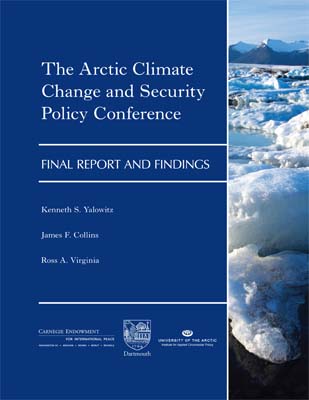
Minimizing the environmental impact of climate change and resource development in the Arctic must be a top priority, if environmental disaster is to be avoided.
The accelerating pace of climate change, increasing competition over resources, and new territorial claims demand that greater attention be paid to the Arctic. As the most immediate and serious threat to the region, minimizing the environmental impact of climate change and resource development must be the top priority, according to a report from the Carnegie Endowment, the University of the Arctic, and Dartmouth College.
Key points:
As a major Arctic power, the United States has environmental, political, and security interests and responsibilities and should play a key role in preserving the Arctic ecosystem.
Recommendations for U.S. policy makers:
The report concludes:
“The environment and the management of natural resources are the most pressing security issues in the North. States are committed to addressing boundary and access issues through existing institutions, principally UNCLOS. Large-scale damage to the Arctic from transportation accidents, energy development, fishing, and pollutants from the South pose greater immediate threats than classic security issues. Existing emergency response systems and contingency plans are not up to the task.”
Kenneth S. Yalowitz
Dartmouth College
Nonresident Senior Fellow, Russia and Eurasia Program; Diplomat in Residence
Ambassador Collins was the U.S. ambassador to the Russian Federation from 1997 to 2001 and is an expert on the former Soviet Union, its successor states, and the Middle East.
Ross A. Virginia
Dartmouth College
Carnegie does not take institutional positions on public policy issues; the views represented herein are those of the author(s) and do not necessarily reflect the views of Carnegie, its staff, or its trustees.

The EU can impose sanctions but struggles to enforce them without the United States. With Washington increasingly disinterested in backing European interests, the bloc must now fend for itself.


Nicu Popescu, Tiago Antunes

Russia is testing the waters of NATO’s mutual defense clause. What do strikes in Romanian territorial waters mean for the alliance’s posture toward Moscow?

Dimitar Bechev

Ahead of a tough winter for Ukraine, Donald Trump’s swing back toward Russia bodes ill. But instead of panicking, Kyiv’s European allies are focusing on action.

Rym Momtaz

While the EU and European governments are embracing the much-lauded middle-power moment, this entails three difficult conundrums.

Richard Youngs

Europe is facing rising populism internally as well as external pressures from Russia, China, Turkey, and the United States.
Dimitar Bechev