• Research
  • Strategic Europe
  • About
  • Experts
Carnegie Europe logoCarnegie lettermark logo
EUUkraine
  • Donate
Obama and the Moscow Summit: A Job Well Done

Source: Getty

Article

Obama and the Moscow Summit: A Job Well Done

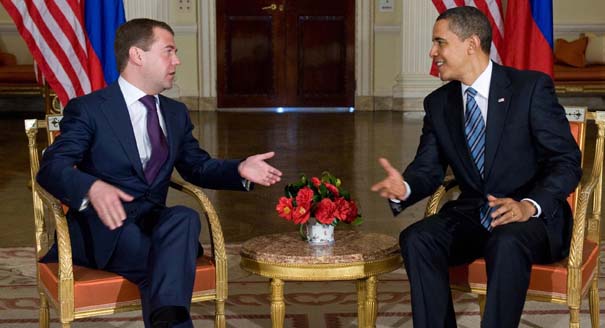
U.S. President Barack Obama made a good start at resetting the relationship with Russia in his first visit to Moscow. He now has to ensure that the American side follows-up on his openings and insist that his colleague in Moscow does the same.

Link Copied
By James F. Collins
Published on Jul 9, 2009

U.S. President Barack Obama made a good start at resetting the relationship with Russia in his first visit to Moscow.  

He made concrete progress on important agenda items. The agreement on strategic arms, measures to prevent proliferation of weapons of mass destruction, broadening cooperation on Afghanistan, and reestablishing a substantive exchange between the U.S. and Russian military take the agenda he and Russian President Dmitri Medvedev agreed upon in London a significant step forward. No less important is that the presidents agreed to a structure to oversee the future relations and took personal responsibility for the work of that institution.
 
Obama also carried his "vision of the possible" to the Russian people more broadly. The speech at the New Economic School was addressed to the coming generation and spoke to exactly the right points. We shall have to see whether the Russian people, particularly a quite cynical younger generation, listened. But Obama’s points about the young taking responsibility for a 21st century agenda and making the decisions that will shape it was on target. He effectively combined the sense of America committed to certain principles in a new era with a challenge to new Russia's emerging leaders to join us in tackling an agenda of the future. 
Obama was not drawn into the games and shenanigans that occupy observers trying to figure out who really has power in Russia.
Finally, Obama also managed the complex Russian leadership effectively and appropriately. He avoided any hint of playing to one of the leaders in Moscow and spoke effectively to the totality of the Russian leadership. He was, in short, not drawn into the games and shenanigans that occupy observers trying to figure out who really has power in Russia. 
 
The outcome of the visit will now turn on how well it is followed-up. The two presidents set down a number of principles to guide key negotiations between Russia and the United States. They opened significant opportunities to be exploited to advance their ambitious agenda and strengthen the cooperation between the two countries. If these opportunities are successfully and effectively followed-up, even those areas where there clearly was no meeting of the minds and where significant differences remain will be easier to manage over time.  
The structure created to manage relations offers an institutional venue to address problems.
In this regard, negotiations over the follow-on to START have a solid foundation but will continue to face difficult issues. The development of greater cooperation on Afghanistan appears promising. Differences over Iran, missile defense, European security systems, etc. remain, but it is constructive that these issues were discussed, some agreement to joint exploration of options appears to have emerged, and the channels of communication on these issues are open.  No less significantly, the structure created to manage relations offers an institutional venue to address problems as they arise in these areas.  
 
In sum, President Obama should be satisfied that he made significant progress. He now has to ensure that the American side follows-up on his openings and insist that his colleague in Moscow does the same. 

About the Author

James F. Collins

Nonresident Senior Fellow, Russia and Eurasia Program; Diplomat in Residence

Ambassador Collins was the U.S. ambassador to the Russian Federation from 1997 to 2001 and is an expert on the former Soviet Union, its successor states, and the Middle East.

    Recent Work

  • Article
    Daunting Challenges and Glimmers of Hope in Ukraine

      James F. Collins

  • Commentary
    The Game Changer: Cooperative Missile Defense

      Dmitri Trenin, James F. Collins

James F. Collins
Nonresident Senior Fellow, Russia and Eurasia Program; Diplomat in Residence
James F. Collins
North AmericaUnited StatesCaucasusRussiaSecurityForeign Policy

Carnegie does not take institutional positions on public policy issues; the views represented herein are those of the author(s) and do not necessarily reflect the views of Carnegie, its staff, or its trustees.

More Work from Carnegie Europe

  • Commentary
    Strategic Europe
    Europe on Iran: Gone with the Wind

    Europe’s reaction to the war in Iran has been disunited and meek, a far cry from its previously leading role in diplomacy with Tehran. To avoid being condemned to the sidelines while escalation continues, Brussels needs to stand up for international law.

      Pierre Vimont

  • Commentary
    Strategic Europe
    Taking the Pulse: Can European Defense Survive the Death of FCAS?

    France and Germany’s failure to agree on the Future Combat Air System (FCAS) raises questions about European defense. Amid industrial rivalries and competing strategic cultures, what does the future of European military industrial projects look like?

      • Rym Momtaz

      Rym Momtaz, ed.

  • Commentary
    Strategic Europe
    Macron Makes France a Great Middle Power

    France has stopped clinging to notions of being a great power and is embracing the middle power moment. But Emmanuel Macron has his work cut out if he is to secure his country’s global standing before his term in office ends.

      • Rym Momtaz

      Rym Momtaz

  • Commentary
    How Can Europe Renew a Stalled Enlargement Process?

    Despite offering security benefits to candidates and the EU alike, the enlargement agenda appears stalled. Why is progress not being made, and is it time for Europe to rethink its approach?

      Sylvie Goulard, Gerald Knaus

  • Turkey Erdogan Caucasus Central Asia
    Article
    How Turkey Can Help the Economies of the South Caucasus to Diversify

    Over the past two decades, regional collaboration in the South Caucasus has intensified. Turkey and the EU should establish a cooperation framework to accelerate economic development and diversification.

      • Feride Inan
      • Güven Sak
      • Berat Yücel

      Feride İnan, Güven Sak, Berat Yücel

Get more news and analysis from
Carnegie Europe
Carnegie Europe logo, white
Rue du Congrès, 151000 Brussels, Belgium
  • Research
  • Strategic Europe
  • About
  • Experts
  • Projects
  • Events
  • Contact
  • Careers
  • Privacy
  • For Media
  • Gender Equality Plan
Get more news and analysis from
Carnegie Europe
© 2026 Carnegie Endowment for International Peace. All rights reserved.