

Paper
Alejandro Foxley, Fernando Sossdorf
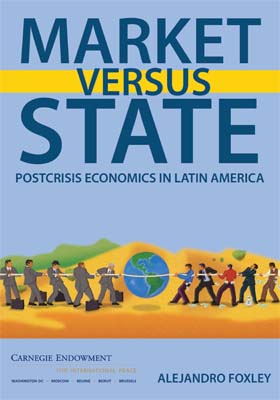
The global financial crisis was a result of failures in both the market and state—markets created financial turmoil and regulatory agencies failed to detect risks and correct imbalances. As Latin American countries emerge from the crisis, both the market and state are needed to ensure sustainable growth.
The global financial crisis was a result of failures in both the market and state—markets created financial turmoil and regulatory agencies failed to detect risks and correct imbalances. As Latin American countries emerge from the crisis, both the market and state are needed to ensure sustainable growth.
Analyzing the successes and mistakes of economic policies over the past twenty years, Foxley makes recommendations for Latin America to achieve development that creates fewer inequalities and increases the capacity for innovation.
Recommendations
“As they emerge from the most recent crisis, Latin American economies need both—more market and more state. More market will enable them to exploit new opportunities through bilateral or multilateral trade agreements, and expand public-private partnerships,” writes Foxley. “A more intelligent state, acting as a catalyst for development, could encourage creativity and foster entrepreneurship.”
Former Senior Associate, International Economics Program
Foxley was previously minister of foreign affairs, senator, and minister of finance of the Republic of Chile. While minister of finance he concurrently served as a governor of the Inter-American Development Bank and the World Bank.
Recent Work
Alejandro Foxley, Fernando Sossdorf
Alejandro Foxley
Carnegie does not take institutional positions on public policy issues; the views represented herein are those of the author(s) and do not necessarily reflect the views of Carnegie, its staff, or its trustees.

With its public finances in shambles, the far right polling at 35 percent ahead of the 2027 presidential election, and a growing protest movement, is France’s crisis a threat to the EU’s geopolitical awakening?

Rym Momtaz, ed.

The European Commissioner for Trade is headed to China. But after President Xi’s bridge-building visit to Washington, can a more isolated EU overcome Beijing’s stranglehold on critical raw materials? Who will blink first?
Rym Momtaz, ed.

The domestic impacts of how long it is taking to end the war in Ukraine have pushed the French electorate to the political extremes and compromised the country’s diplomatic capacity.
Rym Momtaz

A summer of escalation in the Black Sea has hurt Ukraine economically and is exacerbating world food security. A truce is needed—as is a broader reframing of Europe’s Ukraine strategy.

Thomas de Waal
As geopolitical rivalry weaponizes global supply chains, the EU’s true vulnerability lies in emerging-risk imports. For these goods, suppliers are growing more concentrated, substitution more difficult, and political risk is looming.

Sinan Ülgen