• Research
  • Strategic Europe
  • About
  • Experts
Carnegie Europe logoCarnegie lettermark logo
EUUkraine
  • Donate
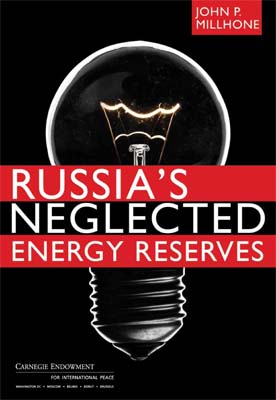
Russia's Neglected Energy Reserves
Report

Russia's Neglected Energy Reserves

Russia’s energy reserves can be conserved through available, cost-effective measures, which will lead to a more competitive economy, more jobs, and increased national income.

Link Copied
By John P. Millhone
Published on May 12, 2010

Additional Links

Full Text

Russia enjoys the world’s largest share of energy resources. While urban areas have grown more efficient in recent years, great expanses of the vast country continue to squander its valuable resources. Russia’s energy reserves can be conserved through available, cost-effective measures and this will lead to a more competitive economy, more jobs, and increased national income. 

Significant benefits are within reach if effective federal, district, and local programs are implemented. By improving energy efficiency, Russia could:

  • Lower energy costs. Better efficiency will reduce the price consumers pay for energy.
     
  • Create jobs. Transforming Russia’s energy sector will require new jobs and reliable energy services improve Russia’s long-term economic outlook.
     
  • Increase exports. By lowering the domestic consumption of natural gas and oil, exports will grow and foreign-exchange earnings will rise. 
     
  • Reduce emissions. Fewer emissions will help Russia meet its international commitments on climate change.

Five areas for Russia to improve efficiency:

  1. Electricity. Reduce losses of energy and modernize an aging power system with new and improved power plants.
     
  2. Heat. Upgrade and replace Soviet-era heating systems.
     
  3. Industry. Reduce the energy intensity of Russia’s industrial sector, which is far higher than other competing countries.
     
  4. Buildings. Introduce energy-efficient building codes and retrofit old houses and buildings.
     
  5. Transportation. Improve public transportation and increase fuel-efficiency standards.


“Russia has a unique win-win opportunity if it acts aggressively to couple its energy and climate-change policies,” writes Millhone.

About the Author

John P. Millhone

Former Visiting Scholar, Energy and Climate Program

Millhone is currently evaluating and commenting on U.S. energy policies and focusing on clean energy and economic stimulus initiatives. He is also providing analysis to the U.S.–China provincial and municipal energy efficiency management program.

    Recent Work

  • Article
    Developing a Plan B to the Kyoto Protocol

      John P. Millhone

  • Article
    Russia's Fires Breathe New Life into Climate Picture

      John P. Millhone

John P. Millhone
Former Visiting Scholar, Energy and Climate Program
John P. Millhone
CaucasusRussiaNorth AmericaEconomyClimate ChangeDomestic Politics

Carnegie does not take institutional positions on public policy issues; the views represented herein are those of the author(s) and do not necessarily reflect the views of Carnegie, its staff, or its trustees.

More Work from Carnegie Europe

  • Commentary
    Strategic Europe
    How Europe Can Survive the AI Labor Transition

    Integrating AI into the workplace will increase job insecurity, fundamentally reshaping labor markets. To anticipate and manage this transition, the EU must build public trust, provide training infrastructures, and establish social protections.

      Amanda Coakley

  • EU democracy support policies
    Paper
    European Democracy Support Annual Review 2025

    European democracy support strategy in 2025 prioritized protecting democratic norms within Europe. This signals the start of a structural recalibration of the EU’s approach to democracy support.

      • Elena-Viudes-Egea
      • +6

      Richard Youngs, ed., Elena Viudes Egea, Zselyke Csaky, …

  • Commentary
    Strategic Europe
    Taking the Pulse: Can the EU Attract Foreign Investment and Reduce Dependencies?

    EU member states clash over how to boost the union’s competitiveness: Some want to favor European industries in public procurement, while others worry this could deter foreign investment. So, can the EU simultaneously attract global capital and reduce dependencies?

      • Rym Momtaz

      Rym Momtaz, ed.

  • Commentary
    Strategic Europe
    Europe Falls Behind in the South Caucasus Connectivity Race

    The EU lacks leadership and strategic planning in the South Caucasus, while the United States is leading the charge. To secure its geopolitical interests, Brussels must invest in new connectivity for the region.

      Zaur Shiriyev

  • Commentary
    Strategic Europe
    Taking the Pulse: Is It Time for Europe to Reengage With Belarus?

    In return for a trade deal and the release of political prisoners, the United States has lifted sanctions on Belarus, breaking the previous Western policy consensus. Should Europeans follow suit, using their leverage to extract concessions from Lukashenko, or continue to isolate a key Kremlin ally?

      Thomas de Waal, ed.

Get more news and analysis from
Carnegie Europe
Carnegie Europe logo, white
Rue du Congrès, 151000 Brussels, Belgium
  • Research
  • Strategic Europe
  • About
  • Experts
  • Projects
  • Events
  • Contact
  • Careers
  • Privacy
  • For Media
  • Gender Equality Plan
Get more news and analysis from
Carnegie Europe
© 2026 Carnegie Endowment for International Peace. All rights reserved.