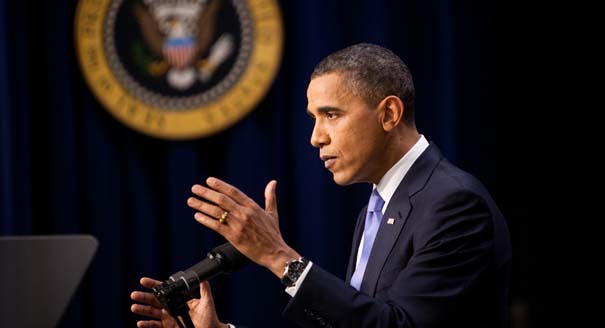
When President Obama finally visits Indonesia—as he promises to do after postponing two trips this year—he will signal that the United States is serious about reengaging Southeast Asia. Just as important, his trip will allow the United States to counteract China’s aggressive charm offensive as it attempts to become a more influential player in the region.
The relationship between the United States and Southeast Asia has traditionally been strong. Over the last few decades, U.S. presence in the region included assisting security forces in Singapore, Malaysia, Thailand, and the Philippines with training, military equipment, and joint military exercises. More recently, the United States signed a defense agreement to lift sales restrictions and a ban on military aid to Indonesia. And economic ties between the two remain healthy with the ten countries in the Association of Southeast Asian Nations (ASEAN) as a whole comprising the fifth largest U.S. trading partner and the largest destination for American investment in Asia.
Recently, however, the Bush and Obama administrations have turned their attention to other international matters—including the wars in Iraq and Afghanistan—neglecting Southeast Asia in the process. While the United States looked away, China happily stepped into the vacuum. China and ASEAN pushed to establish the world’s largest free-trade area, a market that has a combined gross domestic product of around $6 trillion. The United States has yet to finalize a free-trade area with ASEAN.
China’s leaders are also strategically and repeatedly reaching out to individual countries to bolster relations. In contrast to President Obama—who hasn’t yet made an official visit to the region—President Hu Jintao visited Malaysia earlier this year. And Chinese Premier Wen Jiabao recently concluded a trip to Burma and is expected to visit Indonesia and Brunei soon.
Although China and ASEAN’s relationship has been primarily economic, Beijing hopes to develop a military partnership as well. China is gradually expanding its naval capability in the South China Sea and recently increased arms sales, joint military joint exercises, and high-level security visits in the region, especially with the military junta in Burma.
In response, ASEAN has bounded China to a multitude of military agreements aimed at ensuring China’s cooperative behavior in the long term. The only way for the United States to prevent China from flexing its military muscles in the region is to demonstrate consistently high levels of diplomatic engagement with ASEAN.
An Obama visit would also reward President Susilo Bambang Yudhoyono’s courage in mending ties with the United States—which had been damaged by his predecessor. Yudhoyono has helped to transform Indonesia into a center for international investors amid the global financial crisis and tackled controversial issues such as terrorism, human rights, and government corruption. These initiatives have elevated Indonesia’s international profile as an emerging industrialized economy and a leading democracy in Southeast Asia.
Instead, Obama’s canceled trips—first in March as the final vote on the health care reform bill neared in Congress and again in June as the clean-up of the BP oil spill continued in the Gulf of Mexico—have the potential to weaken Yudhoyono’s standing at home and abroad. They could also be read as an invitation to China to step up its campaign to woo its southern neighbors and press nations to lean Beijing’s way.
Of course, the fact that Obama has postponed two trips to deal with pressing issues at home should not be interpreted as a sign that Washington is writing off the region. After all, the United States continues to enjoy a healthy military and economic presence in Southeast Asia and Secretary Clinton assured ASEAN that the administration plans to “focus a lot of time and energy in working with Asian partners.” This is a stronger show of support for the region than her predecessor displayed.
But Obama must make good on planning—and following through—with a trip to Jakarta soon. Otherwise, the ASEAN bloc could conclude that Obama’s rhetoric is mostly empty and that the U.S. approach has not materially changed. That could lead Southeast Asia into China’s all-too-willing arms. No matter what crisis arises when Obama schedules his next trip, postponing a third visit is simply not an option.
Nooryana Najib, a summer intern for the Asia Program, is currently pursuing a degree in International Politics in the School of Foreign Service at Georgetown University.