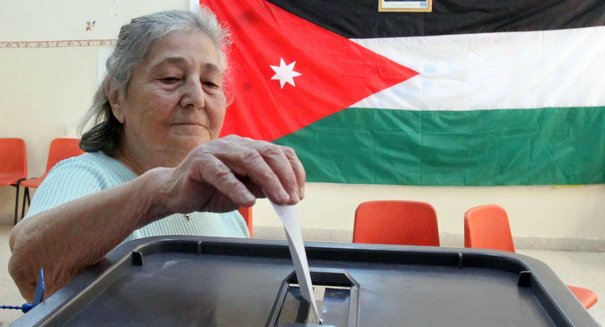
The committee supervising ballot box 31 in the Red Sea city of Aqaba arrived before dawn on November 9 to outfit the schoolroom with the necessary equipment: a plywood booth with a blue curtain mounted on the wall for voting, a clear plastic box for ballots, a computer for verifying voter registration, printed ballots, and tent cards identifying the civil servants supervising the process. After showing that the ballot box was empty and closing it with numbered seals, the chairman opened the poll promptly at 7:00 a.m. and the half-dozen women acting as poll watchers for candidates cast their votes. Then we all sat and waited for the voters to come.
As an international observer of Jordan’s parliamentary elections invited by the International Republican Institute, I find myself confronted with a paradox: although last week’s voting process can be characterized as credible, the elections unfolded within a broader political system that lacks credibility. The Jordanian government clearly put a great deal of effort into improving the mechanics of elections and deserves credit for opening up the process to scrutiny by domestic monitors and international observers. At a minimum, the government risked embarrassment, but its careful preparation prevented this from occurring.
On the other hand, the government put much less effort into crafting an electoral law that would have been broadly acceptable within Jordan, thereby alienating the country’s principal opposition party, the Islamic Action Front (IAF). And structural problems within the political system—namely the chronic underrepresentation of citizens in urban areas and the general powerlessness of the parliament—will dog the newly elected assembly, however properly elected.
Voting and Counting Process
At the micro level, Jordanian officials were impressively well prepared and organized for the elections. They seemed at pains to demonstrate meticulous compliance with procedural requirements and to maintain a high level of integrity and transparency during the actual voting and counting processes. Police officers sometimes seemed taken aback by the arrival of international observers with their large blue credential tags, but the Ministry of Interior officials to whom they turned were prepared for our arrival and welcomed us.
Candidate representatives and Jordanian civil society observers were also credentialed and stayed to witness the process from the early morning set-up until ballots were counted and the tally delivered in the evening. Still, I saw several flaws in procedure: some electoral committees failed to actually count their ballots at the beginning of the day (in order to do a full reconciliation of the vote at the end), and uniformed police officers remained in the room at the vote count I witnessed, in violation of the law, although I saw no evidence that they influenced the results in any way.
Stepping back from the micro level, however, this image of transparency begins to blur. First, no independent electoral commission exists in Jordan. Elections are run by two government ministries—the Ministry of Interior and the Ministry of Political Development—very much in that order. Second, the concept of virtual sub-districts in the electoral law raises the possibility that government officials could have stacked the deck in favor of certain candidates. While each voter could cast only one vote within a given district, candidates actually competed against each other in small groups or sub-districts (with the highest vote-getter in each group winning). In theory, candidates did not know against whom they would compete when they chose a sub-district, but it seems possible that government officials could have encouraged a favored candidate to run in a certain virtual sub-district against weaker rivals. Indeed, it is difficult to understand any other rationale for the virtual sub-district system.
Finally, while the voting and counting at each individual ballot box was open to scrutiny, the aggregation process that yielded the final results and voter turnout figures was not, and results from individual polling stations were not posted in a way that would allow outsiders to check the credibility of what was announced.
Was There Real Competition?
Aqaba on election day was noisy and festive. Large hospitality tents hosted by candidates dotted the city, cars and trucks festooned with candidate photos and blaring slogans or music were everywhere, police were working hard to keep chanting groups of young campaigners at a distance from poll entrances, and to block parties of adults sitting in plastic chairs in the street sipping coffee—and children zipping around them on bicycles—made driving increasingly hazardous as the day progressed.
At each of the 30 voting places that my observation partner and I witnessed, candidates sent representatives who stayed from the beginning of the process to the end with only the shortest bathroom breaks, keeping a parallel vote count and speaking up promptly to question anything that might constitute a violation of protocol. Candidates stopped in at voting stations, careful to avoid talking to voters but greeting poll workers and observers politely and checking in with representatives about the turnout.
Certainly it seems that there was real competition among these candidates at the local level, but at the national level this picture breaks down. Without the participation of the IAF—the country’s only political party with a broad base of support—competition and debate remained local and had a sterile quality. Electoral slogans were soporifically similar: “your candidate,” “national unity,” “reform,” “Jordan for all,” and so on. My own favorite was “no slogans,” used by Reem Badran, the only female candidate to win a seat in her own right rather than via the women’s quota (12 out of 120 seats).
Voter Turnout Doubted
Another aspect of the elections that seemed dubious, at least to Jordanians, was the officially announced voter turnout of 53 percent—not ridiculously high, but not as low as expected in light of historical trends, the unpopularity of the electoral law, and the IAF boycott. It is difficult for international observers to second-guess such results without the full data; my own extremely informal estimate suggested a turnout of some 45 percent of registered voters in Aqaba, although that is not necessarily reflective of the national average.
Jordanians, in any event, received the announced turnout figure with skepticism, viewing it as the government’s attempt to prove that it could hold meaningful elections without real opposition. A cartoon published on the back page of the independent daily al-Ghad on November 10 showed a small, pathetic figure with a blackened eye popping out of a battered box labeled “Democracy,” bearing a flag with the official turnout of 53 percent. The caption read, “The mark of success.”
Two Questions and One Precedent
However perfect or imperfect the November 9 elections, two important questions remain unanswered. First, will the incoming assembly enjoy more credibility with the public than the one elected in 2007, which was so delegitimized by election rigging and irresponsible behavior that the public applauded King Abdullah’s 2009 decision to dissolve it? Second, what steps, if any, will the Jordanian government take to address festering concerns about the electoral system and the role of the parliament?
These two questions are more closely linked than might be apparent at first. The cleaner and more transparent electoral process conducted on November 9 should mean fewer questions about whether the deputies seated in the new assembly were fairly elected. Aspects of the electoral law, however—particularly the obscure virtual sub-districts system—will still raise doubts about whether government officials created more favorable circumstances for some candidates. In addition, the underrepresentation of urban populations will continue to dog the assembly.
Moreover, it will be difficult for the parliament to be taken seriously and for deputies and political parties to gain credibility with the public if the parliament has few real opportunities to shape public policy. Thus, unless the Jordanian government is willing to allow significant amendments to the electoral law and consider giving the parliament greater powers—such as more meaningful budgetary oversight and the ability to initiate legislation without government approval—the goal of a more credible assembly is likely to remain elusive.
Whether or not the new parliament is deemed a success, Jordan’s elections established the precedent of opening much of the process to scrutiny by domestic and international monitors. It was easy enough for the Jordanian government to do that this time, with no serious competitors at the national level. Reversing precedent in future elections, however, when the IAF or other serious competitors might well participate, would be difficult. Therefore we will have to wait for another election to learn whether 2010 represented an important step forward or a brief moment of transparency in Jordanian politics.