

Commentary
Are Germany’s economic, industrial, and political struggles becoming a liability for the EU’s ability to rise to the geopolitical moment?
Rym Momtaz, ed.
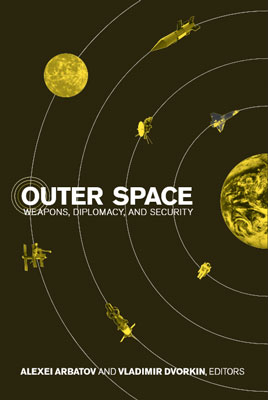
In this global era, the world faces a host of security challenges which cannot be resolved by any one nation, especially through the unilateral use of military force. One key issue that requires urgent international attention is the military use of outer space.
Source: Washington

This collection of essays by leading Russian experts analyzes how many countries are using outer space for military purposes. Adapted from the Russian version, Outer Space: Weapons, Diplomacy, and Security describes the space weapons programs of various countries. It details the history of negotiations to prevent, or at least control, the weaponization of space, including analyses of the political, military, technical, and legal problems facing negotiators trying to avoid a catastrophic new space race.
Download a free limited preview.
"As the globalization of economic, political, military, and technological development expands the realm of activity in outer space, this volume provides a compelling road map on how to avoid future conflicts in a critical arena."
—Jessica T. Mathews, President, Carnegie Endowment for International Peace

Alexey Arbatov
Alexey Arbatov is the head of the Center for International Security at the Primakov National Research Institute of World Economy and International Relations.
Vladimir Dvorkin
Major General Dvorkin (retired) is a chief researcher at the Center for International Security at the Institute of World Economy and International Relations.
Carnegie does not take institutional positions on public policy issues; the views represented herein are those of the author(s) and do not necessarily reflect the views of Carnegie, its staff, or its trustees.

Are Germany’s economic, industrial, and political struggles becoming a liability for the EU’s ability to rise to the geopolitical moment?

Rym Momtaz, ed.

European Commission President Ursula von der Leyen is about to give her annual address on the state of the EU. Here’s what she won’t—but should—say.
Rym Momtaz

The EU’s responses to two recent incidents expose the gulf between European perceptions and capabilities. Unless the union can bridge that gap, it will never become a real geostrategic power.
Rym Momtaz

European states control several Overseas Countries and Territories around the world that carry strategic, economic, and environmental weight. As great powers challenge the rules-based order, defending them is a geopolitical imperative for Europe.

Marc Pierini

In supporting Europe’s far-right, MAGA and Russia both want the same thing: a weaker EU. Europe must defend itself without abandoning the openness these forces exploit.

Armida van Rij