

Paper
James L. Schoff, Douglas E. Rake, Joshua Levy
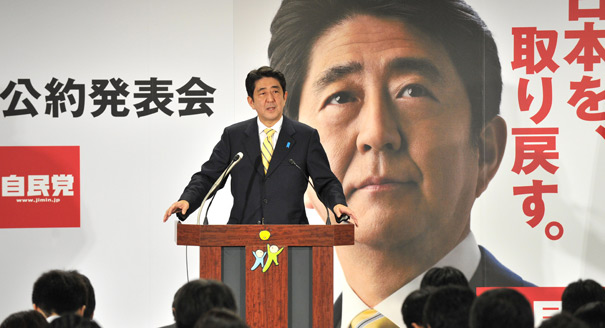
Source: Getty
Japan’s newly empowered Liberal Democratic Party needs to form a broad political coalition to repair the country’s finances, stabilize the social welfare system, and bolster Tokyo’s role in the region.
The resounding victory of the Liberal Democratic Party (LDP)—and its head, Shinzo Abe—in Japan’s lower house election is less of a redemptive win than it is simply the spectacular reversal of voter faith in the former ruling Democratic Party of Japan (DPJ). The single-seat electoral system also skewed results, giving the LDP 79 percent of those seats with just 43 percent of the votes.
This is important to keep in mind when analyzing the implications of the vote. Some LDP supporters express satisfaction that Japan can now get “back to normal” because the party governed Japan nearly uninterrupted for over fifty years. But if they want to be successful, Abe and the LDP need to look forward, not back.
The LDP has another chance to lead the country after the DPJ failed to follow through on its campaign promises in 2009, but the challenges are mighty. The economy is shrinking, public debt is growing, merchandise trade deficits are widening, and diplomatic tensions with China are high. Rebuilding after the earthquake and tsunami of March 2011 requires continued attention, and over 90 percent of Japan’s nuclear energy capacity is still offline.Japan retains several enduring strengths, however, that can be building blocks for renewed prosperity. The country still has a productive population, an adaptive and globally connected corporate sector, and a uniquely close alliance with the United States. The question now is whether or not Abe and the LDP can bring any fresh thinking for how Japan can effectively leverage the country’s strengths to directly address its systemic weaknesses. There is reason to be skeptical.
The recent campaign was notable for its lack of big ideas about Japan’s future. Abe proposed a variety of stimulus measures to revive the economy, including more government spending and looser monetary policy, but he will have limited flexibility given the government’s debt burden. Japan’s sovereign debt surpassed 200 percent of GDP, and servicing that debt consumes one in every four yen the government spends.
Abe’s idea to set an inflation target might help Japan in the short term, but debt servicing could become even more onerous if inflation pushes up interest rates over time. Japan’s large retired population could also worry about the shrinking value of its savings and cut back on consumption. Similarly, Abe’s pledge to increase defense spending is not the kind of government investment that will improve the economy’s efficiency or productivity, unless the defense industry is allowed to export more. And rebuilding roads, tunnels, and bridges beyond what is necessary to maintain safety will not help either.
Japan needs a bolder vision for administrative and economic reform that can help revive the depressed countryside and tap underutilized talent in the country—notably women and younger would-be entrepreneurs. Japan has the largest wage gap between working fathers and working mothers, for example, among OECD countries.
The new government should try to form as broad of a political coalition as possible to repair Japan’s finances, stabilize the social welfare system, and bolster Tokyo’s role in the region, including being an advocate for more open trade.
Japan’s last successful prime minister, the LDP’s Junichiro Koizumi who served from 2001 to 2006, was a strong promoter of structural reform in Japan and within his party. Not everyone agreed with Koizumi, but they knew where he stood. Koizumi fought hard to cut spending, limit borrowing, and privatize large public organizations, including Japan Post and Japan Highway Public Corporation. He did not always get his way, but Koizumi’s direction was clear.
When the LDP elected Abe as its leader in September 2012, however, it did not follow a real ideological debate about the future of the party. Instead, it was a competition of personality, and ultimately party factions among the sitting legislators outvoted LDP membership around the country to tip the contest in Abe’s favor. It was just the kind of “back to normal” selection process the LDP needs to discard.
The first time Abe served as prime minister he took the reins of power from Koizumi. Japan’s economy was growing at an annual rate of 4.8 percent and China’s economy was about half the size it is today. Abe now reclaims control with the economy shrinking at an annual rate of 3.5 percent and an increasingly confident China spending almost $80 billion more on defense annually than it did six years ago.
There is no “back to normal” option for relations with China. Abe needs to remain principled but careful as he holds firm on the Senkaku (known as Diaoyu in China) territorial dispute while he seeks opportunities to improve bilateral ties. Abe helped repair Japan-China ties during his first stint as prime minister, but the challenge is more complicated this time. Beijing will not make it easy for Abe to defuse tension, and there is added political pressure in Tokyo to stand firm on sovereignty issues.
Strengthening relations with South Korea can help Japan on the diplomatic, economic, and security fronts, but only if Abe can resist reopening old historical wounds. Establishing strong connections among the new leaders from Japan, South Korea, and China is indispensable for building trust and common purpose. And all of them should seize every opportunity to improve personal relations.
The new government’s relationship with the United States is also important. The U.S.-Japan alliance remains strong, but Washington yearns for a stable and reinvigorated Japan that can help shape the future of the region. During the recent campaign, Abe often blamed the DPJ for damaging ties with Washington, but this is an example of the small politics that the LDP should try to avoid. The truth is that the United States ended up with as good of an alliance partner under the DPJ as it enjoys with the LDP, and this emerging “bipartisan” support for the relationship in Japan should be celebrated. It is a long-term asset for the alliance.
Abe will be tempted to stay in campaign mode given the upper house election this summer, but this is not the time for the LDP to focus on narrow political tactics—the new government needs to implement policies that will get Japan back on track. Japan has overcome many challenges in the past, but this has required stable and inclusive leadership combined with forward-looking policymaking. This is the “back to normal” worth pursuing.

Former Senior Fellow, Asia Program
James L. Schoff was a senior fellow in the Carnegie Asia Program. His research focuses on U.S.-Japan relations and regional engagement, Japanese technology innovation, and regional trade and security dynamics.
Recent Work
James L. Schoff, Douglas E. Rake, Joshua Levy
James L. Schoff
Carnegie does not take institutional positions on public policy issues; the views represented herein are those of the author(s) and do not necessarily reflect the views of Carnegie, its staff, or its trustees.

As the EU confronts profound challenges, several leaders have called for fundamental reform to the union’s model—but only modest, superficial changes have resulted. What if Europe really could be reimagined from zero today: What should such a redesigned European order look like?

Richard Youngs, ed.

Preparing candidate countries for EU membership is no longer enough. As the enlargement process becomes a reality, the union must also prepare its own societies.

Iliriana Gjoni

Countries face several hurdles in joining the EU, including the final stage of ratifying their accession treaties. Procedural reforms and substantive adjustments could help move the process forward.

Stefan Lehne

Europe has an interest in supporting Armenian leader Nikol Pashinyan as he tries to make peace with neighbors and loosen ties with Russia. But it is depersonalized support in the long term, not quickfire flash, that will win the day.

Thomas de Waal

Montenegro and Albania are frontrunners for EU enlargement in the Western Balkans, but they can’t just sit back and wait. To meet their 2030 accession ambitions, they must make a strong positive case.

Dimitar Bechev, Iliriana Gjoni