

In The Media
Vikram Nehru
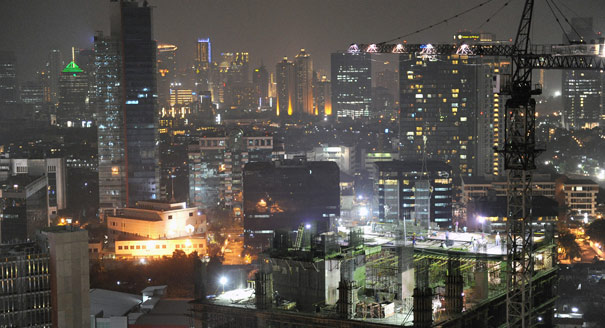
Source: Getty
The principles underpinning Indonesia’s democracy have begun to fray. It is time for a fresh round of democratic reforms.
The countdown to Indonesia’s elections has begun. In April 2014, over 190 million voters will be eligible to choose 560 members of parliament, 2,137 representatives in 34 regional parliaments, and 17,560 representatives in 510 district assemblies. And that is only the curtain-raiser for the main act two months later—the presidential election. The race is wide open.
Indonesia’s electoral system is widely considered to be fair, transparent, and efficient. Yet, while smooth and fair elections are necessary for a healthy democracy, they are not sufficient. Elections must also give voters a genuine choice between competing ideas. In Indonesia, that choice is shrinking, the distinctions between parties are blurred, and voters find it difficult to hold politicians accountable for their actions. In the short time since the country’s first election in 1999, the principles underpinning Indonesian democracy have begun to fray. The Indonesian democratic system is in need of reform.
Two seasoned Indonesia observers—Sandra Hamid of the Asia Foundation and Marcus Mietzner of Australian National University—have cataloged the slide in Indonesia’s democracy and identified three trends contributing to it. New rules have reduced the number of political parties, many of which have become vehicles to achieve the personal ambitions of a powerful political elite. The government has decreased the subsidies it provided to finance political parties, forcing them to turn to corrupt practices or powerful oligarchs to raise election funds, which has eroded the quality of political leadership and limited competition between political philosophies. And the relationship between the executive and parliament has become dysfunctional.In 1999, 48 political parties took part in the parliamentary election. By 2014, it will fall to twelve. The reason for the decline is clear. The rules that determine who is eligible to compete in national elections have been made tougher. Parties are now required to have chapters in all provinces, three-quarters of all districts in each province, and half of all subdistricts in each district. Moreover, those unable to win at least a 3.5 percent share of the national vote cannot get a seat in parliament. And only those parties or coalitions that win 20 percent of the national vote or 25 percent of national parliamentary seats can nominate presidential and vice presidential candidates.1
These stringent legal requirements have led to the dissolution of many small parties and discouraged the formation of new ones. Many remaining parties derive their identity from their leaders rather than from a common objective or ideology. Thanks to the new rules, parties must often seek coalitions to nominate a governor or president. Political alliances, therefore, tend to be formed simply to allow party leaders and their functionaries to gain access to power, with little concern for ideological compatibility. Hamid shows that in gubernatorial and presidential elections since 2004, each of the major parties has been in a coalition with every other major party at some point.
The seemingly fluid and opportunistic formation and dissolution of coalitions makes it difficult for voters to hold individual parties or their leaders accountable. And it means voters cannot always make informed choices about which candidates to back.
Reductions in budget subsidies have also chipped away at the underpinnings of Indonesian democracy. In 2005, the Ministry of Home Affairs reduced subsidies to parties by a staggering 90 percent. The ministry did so even as election costs exploded. State subsidies covered a mere 0.4 percent of election expenses in 2009, compared to 51.7 percent in 1999, as reported by Mietzner.
Several parties were forced to look for financial patrons and have turned to business oligarchs who have been only too happy to oblige. Others have sought coalitions merely to obtain ministerial positions that allow them to dispense patronage and build a war chest for the next election campaign. Perhaps this is why opinion surveys show that political parties are considered among the most corrupt institutions in Indonesia. These practices have not only damaged the reputation of the entire party system and tarnished the democratic process but also made government institutions and policy formulation increasingly vulnerable to oligarchic interests.
Finally, Indonesian democracy has been weakened by the increasingly dysfunctional relationship between the legislature and the executive. The president has found it increasingly difficult to get the cooperation of a fractious parliament in approving key laws and has even had members of his own ruling coalition of six parties vote against some of his important reform initiatives. The result was a stalled legislative program and a substantial delay in necessary reforms.
Such dysfunction is not unique to Indonesia—as the United States vividly demonstrates. But as an emerging market economy, Indonesia’s stalled legislative program can have far-reaching and long-lasting development costs that fall disproportionately on the poor.
While Indonesia’s electoral system remains robust, the democratic principles that underpin it have been weakened. Should this trend continue, the electorate will become more dissatisfied and the very cause of democracy itself may be undermined.
It has been ten years since the last set of major democratic reforms, which introduced direct presidential elections. It is time for a fresh round. As Mietzner has suggested, direct state subsidies to political parties should be reinstituted. The internal processes by which political parties choose their leaders and candidates need to be democratized. And the relative powers of parliament and the executive should be revisited.
Will this happen soon? Probably not. But Indonesia has surprised the world before. Hopefully it will do so again.
In coming months, visit CarnegieEndowment.org for more analysis of Indonesia’s upcoming 2014 general elections.
1 For direct elections of local executives, nominating parties or coalitions need 15 percent of the popular vote or control 15 percent of the seats.

Former Nonresident Senior Fellow, Asia Program
Nehru was a nonresident senior fellow in the Carnegie Asia Program. An expert on development economics, growth, poverty reduction, debt sustainability, governance, and the performance and prospects of East Asia, his research focuses on the economic, political, and strategic issues confronting Asia, particularly Southeast Asia.
Recent Work
Vikram Nehru
Vikram Nehru
Carnegie does not take institutional positions on public policy issues; the views represented herein are those of the author(s) and do not necessarily reflect the views of Carnegie, its staff, or its trustees.

The hybrid warfare landscape is evolving rapidly, leaving policymakers without clear strategies. To better inform their work in addressing emerging challenges, governments must dig deeper into the underlying dynamics at play.


Raluca Csernatoni, Alicia Wanless

As the EU confronts profound challenges, several leaders have called for fundamental reform to the union’s model—but only modest, superficial changes have resulted. What if Europe really could be reimagined from zero today: What should such a redesigned European order look like?

Richard Youngs, ed.

Far-right leader Marine Le Pen can—and will—run in France’s next presidential election. What does the outcome of her appeal against a 2025 embezzlement conviction mean for the country’s political future?

Catherine Fieschi
When Giorgia Meloni very publicly rebuked Donald Trump’s disparaging remarks about her, it surprised many who saw her as a European extension of Trumpism. Is the spat a sign of trouble in the radical right’s transatlantic axis?

Rym Momtaz, ed.
The battle over free speech has taken center stage since U.S. Vice President JD Vance accused Europe of censorship. From travel bans to social media regulation, especially around the Israel-Palestine conflict, are liberal democratic governments weaponizing free speech?
Rym Momtaz, ed.