

Commentary
Yukon Huang, Isaac B. Kardon, Matt Sheehan
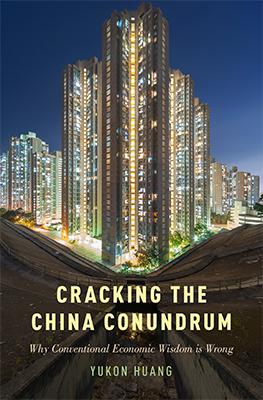
China generates widely varying views on its economic and political prospects. This book is about why there are such differences and why the conventional wisdom is so often wrong.
Source: Oxford University Press
China’s rise is altering global power relations, reshaping economic debates, and commanding tremendous public attention. Despite extensive media and academic scrutiny, the conventional wisdom about China’s economy is often wrong. Cracking the China Conundrum provides a holistic and contrarian view of China's major economic, political, and foreign policy issues.
Yukon Huang trenchantly addresses widely accepted yet misguided views in the analysis of China’s economy. He examines arguments about the causes and effects of China’s possible debt and property market bubbles, trade and investment relations with the Western world, the links between corruption and political liberalization in a growing economy and Beijing’s more assertive foreign policies. Huang explains that such misconceptions arise in part because China’s economic system is unprecedented in many ways—namely because it’s driven by both the market and state—which complicates the task of designing accurate and adaptable analysis and research. Further, China’s size, regional diversity, and uniquely decentralized administrative system poses difficulties for making generalizations and comparisons from micro to macro levels when trying to interpret China’s economic state accurately.
This book not only interprets the ideologies that experts continue building misguided theories upon, but also examines the contributing factors to this puzzle. Cracking the China Conundrum provides an enlightening and corrective viewpoint on several major economic and political foreign policy concerns currently shaping China’s economic environment.

Senior Fellow, Asia Program
Huang is a senior fellow in the Carnegie Asia Program where his research focuses on China’s economy and its regional and global impact.
Recent Work


Yukon Huang, Isaac B. Kardon, Matt Sheehan
Yukon Huang, Genevieve Slosberg

Europe’s industrial supply chains leave it vulnerable to global shocks. The EU needs a pragmatic green industrial strategy that balances durable partnerships and bolsters homegrown clean tech without sacrificing low-carbon ambition.


Milo McBride, Pauline Gerard

As geopolitical rivalry weaponizes global supply chains, the EU’s true vulnerability lies in emerging-risk imports. For these goods, suppliers are growing more concentrated, substitution more difficult, and political risk is looming.

Sinan Ülgen

The EU is putting together a new security strategy to meet today’s myriad challenges. But for any proposal to be effective, the union needs to grapple with its identity and ambitions.

Pierre Vimont

Amid uncertainty caused by the Iran war, the global drive for nonproliferation has stalled. With Europe diplomatically marginalized and countries reassessing their nuclear options, efforts to curb the spread of nuclear weapons risk becoming irrelevant.

Jane Darby Menton
Between the United States’ market-driven approach and China's state-led industrial strategy, Europe is reckoning with how it can remain competitive in the global economy. But is Europe in danger of becoming a U.S. or China colony?


Noah Barkin, Anu Bradford