• Research
  • Strategic Europe
  • About
  • Experts
Carnegie Europe logoCarnegie lettermark logo
EUUkraine
  • Donate
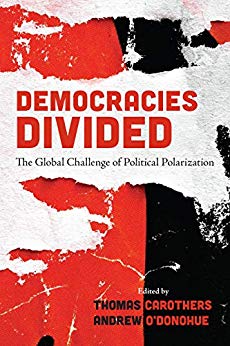
Democracies Divided: The Global Challenge of Political Polarization
Book

Democracies Divided: The Global Challenge of Political Polarization

Why divisions have deepened and what can be done to heal them.

Link Copied
By Thomas Carothers and Andrew O’Donohue
Published on Sep 24, 2019

Additional Links

Paperback - $34.99

Source: Brookings Institution

As one part of the global democratic recession, severe political polarization is increasingly afflicting old and new democracies alike, producing the erosion of democratic norms and rising societal anger. This volume is the first book-length comparative analysis of this troubling global phenomenon, offering in-depth case studies of countries as wide-ranging and important as Brazil, India, Kenya, Poland, Turkey, and the United States. The case study authors are a diverse group of country and regional experts, each with deep local knowledge and experience.

Democracies Divided identifies and examines the fissures that are dividing societies and the factors bringing polarization to a boil. In nearly every case under study, political entrepreneurs have exploited and exacerbated long-simmering divisions for their own purposes—in the process undermining the prospects for democratic consensus and productive governance.

But this book is not simply a diagnosis of what has gone wrong. Each case study discusses actions that concerned citizens and organizations are taking to counter polarizing forces, whether through reforms to political parties, institutions, or the media.

The book’s editors distill from the case studies a range of possible ways for restoring consensus and defeating polarization in the world’s democracies. Timely, rigorous, and accessible, this book is of compelling interest to civic activists, political actors, scholars, and ordinary citizens in societies beset by increasingly rancorous partisanship.

Advance Praise

“A must-read for anyone concerned about the fate of contemporary democracies. Democracies Divided offers new insights into the causes of polarization, illuminates the ways polarization can harm democracy, and explores a range of real-world efforts to overcome polarization.”
—Steven Levitsky, Harvard University, co-author of How Democracies Die

“At a moment when American society is being divided by profound polarization, Carothers and O’Donohue provide new and necessary perspective by focusing on polarization as an international problem. Their insights will help Americans, Europeans, and citizens around the world identify why polarization is worsening and what can be done to counter it.”
—Anne Applebaum, The Washington Post

“An exceptionally rich, insightful, and timely analysis of one of the most serious challenges to democracy. The lucid and incisive case studies vividly demonstrate the danger posed by intense polarization, and Carothers and O’Donohue urge creative initiatives to bridge political gulfs. This is a must-read for scholars and practitioners of democracy.”
—Larry Diamond, Stanford University, author of Ill Winds

Authors

Thomas Carothers
Harvey V. Fineberg Chair for Democracy Studies; Director, Democracy, Conflict, and Governance Program
Thomas Carothers
Andrew O’Donohue
Nonresident Scholar, Democracy, Conflict, and Governance Program
Andrew O’Donohue
North AmericaUnited StatesSouth AmericaSouthern, Eastern, and Western AfricaSouth AsiaIndiaEastern EuropePolitical ReformDemocracy

Carnegie does not take institutional positions on public policy issues; the views represented herein are those of the author(s) and do not necessarily reflect the views of Carnegie, its staff, or its trustees.

More Work from Carnegie Europe

  • Commentary
    Strategic Europe
    Europe Falls Behind in the South Caucasus Connectivity Race

    The EU lacks leadership and strategic planning in the South Caucasus, while the United States is leading the charge. To secure its geopolitical interests, Brussels must invest in new connectivity for the region.

      Zaur Shiriyev

  • Commentary
    Strategic Europe
    Taking the Pulse: Is It Time for Europe to Reengage With Belarus?

    In return for a trade deal and the release of political prisoners, the United States has lifted sanctions on Belarus, breaking the previous Western policy consensus. Should Europeans follow suit, using their leverage to extract concessions from Lukashenko, or continue to isolate a key Kremlin ally?

      Thomas de Waal, ed.

  • Commentary
    Strategic Europe
    New Tricks and AI Tools in Hungary’s High-Stakes Election

    Hungarian Prime Minister Viktor Orbán faces his most serious challenge yet in the April 2026 parliamentary elections. All of Europe should monitor the Fidesz campaign: It will use unprecedented methods of electoral manipulation to secure victory and maintain power.

      Zsuzsanna Szelényi

  • Commentary
    Strategic Europe
    The EU and India in Tandem

    As European leadership prepares for the sixteenth EU-India Summit, both sides must reckon with trade-offs in order to secure a mutually beneficial Free Trade Agreement.

      Dinakar Peri

  • Trump speaking to a room of reporters
    Commentary
    Emissary
    Unpacking Trump’s National Security Strategy

    Carnegie scholars examine the crucial elements of a document that’s radically different than its predecessors.

      • Cecily Brewer
      • +18

      James M. Acton, Saskia Brechenmacher, Cecily Brewer, …

Get more news and analysis from
Carnegie Europe
Carnegie Europe logo, white
Rue du Congrès, 151000 Brussels, Belgium
  • Research
  • Strategic Europe
  • About
  • Experts
  • Projects
  • Events
  • Contact
  • Careers
  • Privacy
  • For Media
  • Gender Equality Plan
Get more news and analysis from
Carnegie Europe
© 2026 Carnegie Endowment for International Peace. All rights reserved.