Attributing a role for Syrian refugees in fostering a positive chapter in the beleaguered Türkiye-U.S. relationship may seem like a stretch, but the Türkiye Compact proposed by the United Nations Development Program (UNDP) leads one to think otherwise.
The UNDP’s policy proposal combines humanitarian and sustainable development considerations regarding refugees in Türkiye, of which Syrians constitute the vast majority. It advocates a trade arrangement that would contribute to refugees’ self-reliance and host communities’ resilience and benefit both countries’ private businesses. The potential win-win scenario it depicts between Türkiye and the United States could spur much-needed momentum into an otherwise steadily deteriorating relationship.
The Türkiye-U.S. relationship has never been immune to challenges but is arguably going through its roughest patch. Numerous disagreements, including over U.S. policy in Syria and Türkiye’s unsavory engagement with Russia, have long been weighing on the partnership. The countries have grown further apart due to diverging priorities in an evolving and more complex international landscape. Alongside this estrangement, successive geopolitical disruptions, like the U.S. decision to withdraw from Afghanistan and Russia’s paradigm-changing war against Ukraine, have added a premium to their cooperation, pulling them closer together, if only begrudgingly.
Türkiye-U.S. relations are currently at the mercy of such circumstantial oscillations mainly because of shared negligence driven by deep frustration toward one another. This is a self-defeating mistake that needs to be reversed. While there is no silver bullet to resolve deep-seated disagreements, building positive momentum by reaching for low-hanging fruit could be a starting point. The mutually beneficial Türkiye Compact provides such an opportunity.
Syrian Refugees in Türkiye
With 3.6 million refugees, Türkiye is the country hosting the most refugees in the world, according to the UN Refugee Agency (UNHCR). The presence of 3.3 million Syrians among these refugees has become protracted, as durable solutions in the form of voluntary returns, resettlements, or local integration remain unrealized.
Despite the Turkish government pushing hard for the repatriation of Syrian refugees, the prospect of such returns remains especially dim in the short, medium, and long term, given the destruction and ongoing instability in their home country and the unlikely resolution of what has become a “frozen conflict.” The Turkish government puts the number of returns at about half a million, while the figure offered by the UNHCR is just under 172,000. Separately, only around 65,000 refugees have been resettled in other countries since 2014, a figure corresponding to only about 2 percent of the current Syrian refugee population in Türkiye.
Finally, local integration in the form of granting Syrian refugees citizenship has happened only in a very limited manner; as of November 2023, around 237,000 Syrians had been granted Turkish citizenship. Generally, the granting of citizenship to refugees is a sensitive, politicized, and procedurally difficult issue in Türkiye.
Within this context, most refugees are likely to remain in Türkiye for the foreseeable future. In 2014, the Turkish government granted refugees temporary protection, enabling free access to public services such as healthcare and education. Provision of these services has brought a significant additional burden on the Turkish treasury, with Turkish President Recep Tayyip Erdoğan putting the cumulative cost of hosting Syrian refugees at $40 billion in October 2019. Since then, the Turkish government has refrained from publicly sharing information on the costs. Officially, the stay of the refugees is based on the premise that they are in Türkiye temporarily and will eventually return home.
International actors have therefore primarily focused on providing humanitarian assistance. The EU, through its Facility for Refugees in Turkey and other programs, has provided almost $11 billion since 2016. This amount has been supplemented by additional support from the United States and several other countries. The disbursement of this assistance has been managed primarily by UN agencies in coordination with the Turkish government under the umbrella of the Regional Refugee and Resilience Plan.
However, current levels of humanitarian assistance meet only half of the needs of refugees in Türkiye. Hence, an estimated 800,000 to 1 million refugees, including women and children, participate in the informal labor market under particularly precarious conditions, as documented by the International Labour Organization and Syrians Barometer reports. The COVID-19 pandemic hurt these employment opportunities, which had already worsened since at least 2018 due to Türkiye’s deteriorating overall economic situation. According to a World Bank study, an estimated 1.5 million people in Türkiye, many of them refugees, fell into poverty as a result. The economic situation further aggravated stress on social cohesion, as competition between refugees and locals for scarce resources and employment increased. The destruction caused by twin earthquakes in February 2023, in a region of Türkiye where more than half of the country’s Syrian refugees live, brought an additional layer of stress and complexity.
How the Türkiye Compact Could Help
These developments have made all the more urgent the need to transition from an aid-driven approach to a self-sustaining developmental one, in line with the 2030 Sustainable Development Goals and the commitment to “leave no one behind.” Large donors, such as the EU, had already been calling for programs “with a focus on providing sustainable socio-economic support and livelihood opportunities within Turkey.”
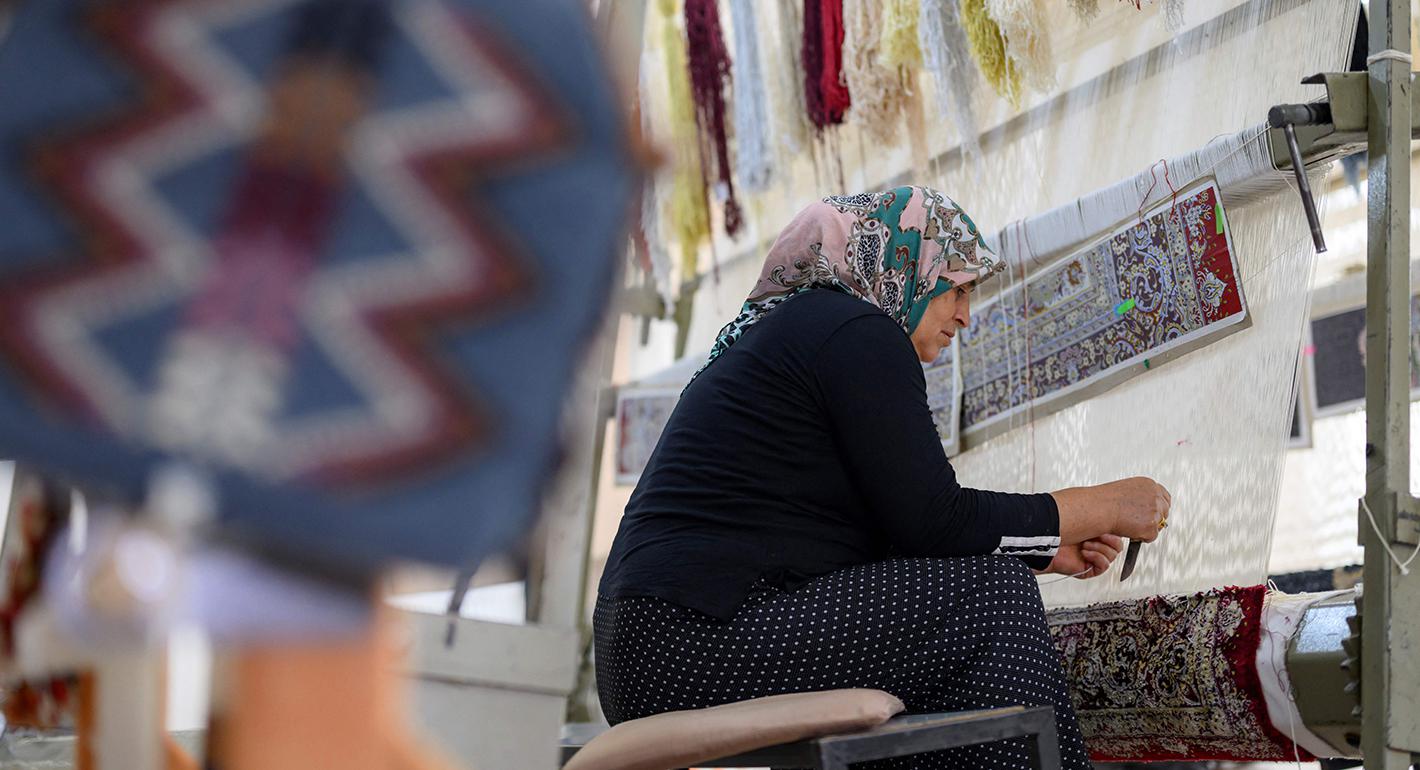
Some funding has been channeled into projects to support refugees’ access to livelihood opportunities, emphasizing the acquisition of vocational and language skills. However, despite an ever-growing number of such projects, there has not been a sizeable and sustainable increase in formal jobs for refugees. According to the “Türkiye: 3RP Country Chapter - 2023/2025,” the 2021–2022 livelihood projects put only about “20,000 individuals into employment through job placement and job creation activities.” Another source put the number of jobs to be created through such projects from 2017 to 2024 at 66,000.
With this in mind, the UNDP advanced the idea of a Türkiye Compact, which advocates for Canada, the EU, and the United States to extend trade preferences to Türkiye to incentivize businesses in the agricultural, processed food, and textile sectors to provide sustainable employment for both Syrian refugees and locals. If implemented, this policy would, according to the compact, help expand Turkish exports by an estimated $7.8 billion in 2025, create directly and indirectly more than 330,000 jobs, and add close to 1 percent of value to Türkiye’s overall GDP. This latter figure is especially significant as it approximates the cost of the destruction caused by the February earthquakes, according to the Turkish government’s calculation.
If implemented, the Türkiye Compact would create a mutually beneficial and business-worthy framework for all parties involved. It would boost trade and enhance employment opportunities. This, in turn, could reduce the dependence of the 3.6 million refugees in Türkiye on state subsidies and humanitarian assistance, help alleviate public resentment toward them, bolster their immunity against involvement in illegal activities, and diminish the prospects of secondary migration, especially to Europe. The compact’s vision could also be incorporated into post-earthquake reconstruction efforts. In the longer run, it could even constitute a template for other countries, particularly in the Global South, that host many refugees by promoting agreements that take a developmental approach instead of solely focusing on migration control.
The United States will be critical to the Türkiye Compact’s success; its adoption alone would create up to 190,000 new jobs in Türkiye, of which some 20 percent would go to refugees. This move would also be in line with the United States’ endorsement of the Global Compact on Refugees, as well as its commitment to assist post-earthquake reconstruction in Türkiye. The compact would also be a win-win in terms of business because it would increase exports of U.S. cotton to Türkiye to be processed with local and refugee labor before being reexported to the United States and elsewhere. Increased demand for American cotton could lead to job creation in the United States as well. Moreover, the implementation of the Türkiye Compact would strengthen best practices in social responsibility among participating businesses and advance the protection of labor rights.
Conclusion
As Türkiye struggles with the associated challenges of hosting a record number of refugees, it needs better support. The Türkiye Compact fits this description by aiming to provide sustainable solutions. It also carries the added benefit of potentially rekindling Türkiye-U.S. relations at a critical juncture.
Therefore, Ankara and Washington should seriously consider the idea of urgently endorsing the Türkiye Compact. Timing is critical for two reasons: First, there’s a real risk of a more structural break in Türkiye-U.S. relations in the long term that cannot be taken lightly. The current negative trajectory must be stopped and reversed immediately. Second, the United States is currently reviving its defunct Generalized System of Preferences (GSP), which aims to spur economic growth in developing countries through appropriate trade policies. Introducing provisions into the prospective GSP that allow trade facilities to countries that host large numbers of refugees or are dealing with the consequences of major natural disasters could pave the way for the U.S. endorsement and implementation of the Türkiye Compact.
The fixation on challenges to the Türkiye-U.S. partnership, such as sharp disagreements over Syria or Türkiye’s acquisition of Russian weapons, has obscured areas of low political importance where advances could be made more easily. The Türkiye Compact bears the potential to support this end. It could constitute a building block toward improving relations between Türkiye and the United States, and, as such, it deserves to be given a chance.