

Commentary
Richard Youngs
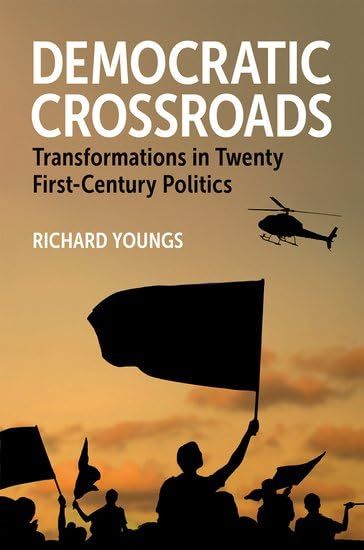
After more than a decade of democratic regression, three major crises have acted to reshape global politics in recent years: climate change, the Covid-19 pandemic and its economic legacy, and geopolitical conflict.
After more than a decade of democratic regression, three major crises have acted to reshape global politics in recent years: climate change, the Covid-19 pandemic and its economic legacy, and geopolitical conflict. In Democratic Crossroads, Richard Youngs argues these crises are altering the balance between democratic and authoritarian dynamics around the world. While they add to the strains on democracy, they are also awakening a momentum of democratic resilience and renewal.
He argues that to deal with the era's momentous challenges, democratic politics need a major boost and reboot. Without stronger commitments to uphold and improve democratic norms and practices, democracy may not weather these challenges. As Youngs shows, far-reaching democratic innovation that gives citizens effective influence over epoch-defining matters will help ensure that democratic values are more vigorously defended. In a moment of pivotal change, this book explains how democracies can become more resilient and highlights the key factors that will determine democracy's fortunes in the future.
"Amidst the breathless headlines about the global state of democracy, Richard Youngs has given us the rarest of goods--a work of nuance and qualified optimism. While the book dissects the unprecedented global challenges buffeting democracy, including climate change and the return of geopolitical conflict, it keenly explores the opportunities that they have opened for democratic renewal. Here is a timely call to rethink the role of the state and the parameters of liberalism if the democratic project is to emerge reenergized for a new era."
-- Kevin Casas-Zamora, Secretary General International Institute for Democracy and Electoral Assistance (International IDEA), former Vice President of Costa Rica
"In this original and challenging book, Youngs teases out the ways in which crises are not automatically bad for democracy and can even open up opportunities for its renewal. He invites us to view our age of turmoil as one of relentless change that threatens incumbent governments, ideas, and structures of all varieties, democratic and authoritarian alike."
-- Mark Malloch-Brown, President of Open Society Foundations
"The challenges to democracy are constantly evolving, and so are the possibilities for democracy to innovate and adapt. In this fascinating and timely study, democracy scholar Richard Youngs probes the impact of three global crises: climate change, COVID-19, and the new geopolitics of authoritarian aggression. He shows how these challenges are stimulating both stronger and more resolute action by democratic states and 'a new spirit of civic micropolitics' at the local level. In tracing state and societal responses across the globe, Youngs provides a refreshing counter to the current mood of pessimism about democratic decline."
-- Larry Diamond, Hoover Institution
"A trumpet blast against resignation and pessimism: a spirited defence of a new democratic politics of curbing ecological destruction, social injustice, and disastrous wars."
-- John Keane, University of Sydney, author of The Life and Death of Democracy

Senior Fellow, Democracy, Conflict, and Governance Program
Richard Youngs is a senior fellow in the Democracy, Conflict, and Governance Program, based at Carnegie Europe. He works on EU foreign policy and on issues of international democracy.
Recent Work
Richard Youngs
Richard Youngs
Carnegie does not take institutional positions on public policy issues; the views represented herein are those of the author(s) and do not necessarily reflect the views of Carnegie, its staff, or its trustees.

A notable degree of participative democracy has firmly arrived in Europe. But to have more far-reaching impact, democratic deliberation needs to move into a radically new phase.
Richard Youngs

The domestic impacts of how long it is taking to end the war in Ukraine have pushed the French electorate to the political extremes and compromised the country’s diplomatic capacity.

Rym Momtaz

Before the next wave of EU enlargement takes place, the union needs to grapple with thorny questions of how power is distributed among its members.


Emil Sondaj Hansen, Ditte Brasso Sørensen

Radical-right parties are expected to do well in upcoming elections in four of the EU's biggest member states. If successful, they could prevent the union from addressing key challenges ahead.

Stefan Lehne

An overwhelming victory by a far-right-wing party in a small state in eastern Germany will have major repercussions for Chancellor Friedrich Merz’s coalition.

Judy Dempsey