

Commentary
Judy Dempsey
{
  "authors": [
    "Judy Dempsey"
  ],
  "type": "commentary",
  "blog": "Strategic Europe",
  "centerAffiliationAll": "",
  "centers": [
    "Carnegie Endowment for International Peace",
    "Carnegie Europe"
  ],
  "collections": [],
  "englishNewsletterAll": "",
  "nonEnglishNewsletterAll": "",
  "primaryCenter": "Carnegie Europe",
  "programAffiliation": "",
  "programs": [],
  "projects": [],
  "regions": [
    "Europe",
    "Russia"
  ],
  "topics": [
    "EU"
  ]
}
Source: Getty
With sanctions allowing Russia to increase its influence in Belarus, the EU may need to adopt a more sophisticated, step-by-step approach to this small European country.
The Riko Group is one of Slovenia’s most successful construction companies and is well known throughout the region. But fame, it seems, has a price.
Last year, the company won a tender to build a luxury residential and shopping complex in Minsk, the capital of Belarus. The showcase will be a Kempinski Hotel.
The problem is that several other European Union countries now accuse the Slovene government of putting interests before values when it comes to Belarus.
Last month, EU foreign ministers agreed new sanctions against President Alexander Lukashenko’s authoritarian regime to get him to release political prisoners.
They extended the EU’s travel ban to a number of high officials in the Belarusian police and judiciary involved in suppressing the opposition.
But Slovenia prevented Yuri Chizh, a leading businessman, oligarch, and close friend of Mr Lukashenko, from being included on the EU’s travel ban list.
Mr. Chizh is the owner of Elite estate JLCC that has a wide range of interests, including hotels. He is also the main investor in the new Kempinski complex in Minsk.
The suspicion, at least by some EU foreign ministers, is that Slovenia was protecting the Riko Group.
Radek Sikorski, Poland’s foreign minister, who has been one of the most outspoken critics of Mr. Lukashenko’s regime, lashed out at Slovenia’s decision.
“It is sad for the EU that economic interests of one member are more important than the need to influence the Belarusian authorities to release political prisoners,” Mr. Sikorski said.
The Slovene government has vehemently denied the charges.
In reply to questions sent by Carnegie Europe, the foreign ministry replied: “Slovenia supported the extended list of sanctions with the names of judges and officials responsible for human rights violations in Belarus.”
Furthermore, it added, all the foreign ministers agreed to “prepare a more comprehensive proposal of restrictive measures…including several persons and entities supporting the authorities.”
More sanctions will be imposed in the coming days on Belarus.
Slovenia says it is being singled out unfairly. Other countries, government officials in Ljubljana claim, have been just as hesitant about measures that could hurt business.
They have a point.
In discreet negotiations over the past few days, France and Britain had been holding out against certain names of businessmen being added to the EU’s blacklist.
The majority of the EU countries have economic ties with Belarus, with Germany, the Netherlands, and France doing good business there.
According to the German Federal Statistics office, trade between Germany and Belarus increased by 11.5 percent in 2011 compared to the previous year. Total trade amounted to € 2.8 billion. In contrast, Slovenia’s total trade was around € 69 million.
Apart from the wish to protect economic interests, there are also more fundamental doubts about the efficacy of sanctions.
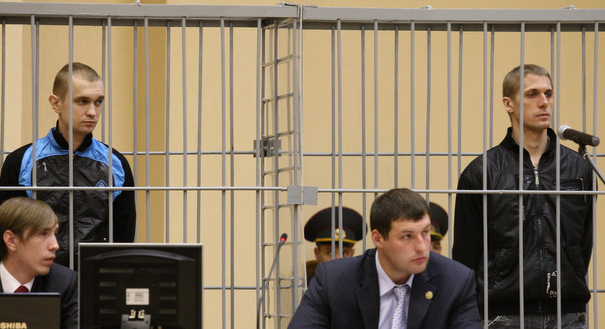
Look at what happened last weekend when, defying pleas by the EU, Belarus executed two men who were accused of the bombing of a metro station last November in Minsk in which over 15 people were killed and 300 injured.
The two men, Vladislav Kovalyov and Dmitry Konovalov, both aged 26, were shot in the back of the neck, a killing method exercised by Stalin’s executioners.
Some see this as a dreadful symbol of Russia’s growing influence over this small European country—a development that is actually accelerated by the EU’s sanctions.
Russian companies are buying up construction, cement, and oil companies. That’s in addition to Russia last year finally gaining control of Belarus’s gas transport pipeline, which sends gas from Russia to EU countries.
“We are in such a bind,” said a EU diplomat. “The more we squeeze Belarus, the more we give Russia an advantage in the country.”
What can be done?
Some EU foreign ministers want a more sophisticated, step-by-step approach to Belarus to draw it back from Moscow’s sphere. “We have to have carrots, not just sticks. That means offering to resume dialogue. But of course Lukashenko has to deliver too, for instance with releasing political prisoners,” said another EU diplomat.
So far, Mr. Lukashenko had not budged. But then, does he really want Belarus to be swallowed up by Russia? Does the EU want that too?

Nonresident Senior Fellow, Carnegie Europe
Judy Dempsey is a nonresident senior fellow at Carnegie Europe
Recent Work
Judy Dempsey
Judy Dempsey

Before the next wave of EU enlargement takes place, the union needs to grapple with thorny questions of how power is distributed among its members.


Emil Sondaj Hansen, Ditte Brasso Sørensen

A summer of escalation in the Black Sea has hurt Ukraine economically and is exacerbating world food security. A truce is needed—as is a broader reframing of Europe’s Ukraine strategy.

Thomas de Waal

Are Germany’s economic, industrial, and political struggles becoming a liability for the EU’s ability to rise to the geopolitical moment?

Rym Momtaz, ed.

European Commission President Ursula von der Leyen is about to give her annual address on the state of the EU. Here’s what she won’t—but should—say.
Rym Momtaz

The aftermath of the Ceuta crisis shows Europe has drawn the wrong lessons. Rather than doubling down on failed migration policies, the EU needs to address the underlying roots of such episodes.

Richard Youngs