

Commentary
Judy Dempsey
{
  "authors": [
    "Judy Dempsey"
  ],
  "type": "commentary",
  "blog": "Strategic Europe",
  "centerAffiliationAll": "",
  "centers": [
    "Carnegie Endowment for International Peace",
    "Carnegie Europe"
  ],
  "collections": [],
  "englishNewsletterAll": "",
  "nonEnglishNewsletterAll": "",
  "primaryCenter": "Carnegie Europe",
  "programAffiliation": "",
  "programs": [],
  "projects": [],
  "regions": [
    "Europe"
  ],
  "topics": [
    "EU"
  ]
}
Source: Getty
Every week leading experts answer a new question from Judy Dempsey on the international challenges shaping Europe’s role in the world.
Every week leading experts answer a new question from Judy Dempsey on the international challenges shaping Europe’s role in the world.
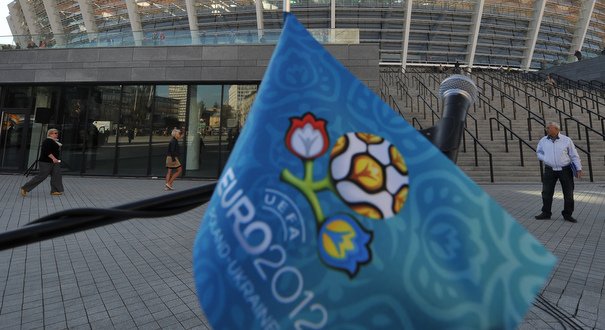
EU leaders should boycott any ceremonies or games in Ukraine while allowing the matches to go ahead. This would send a clear message to Yanukovych and everyone in Europe about what the EU thinks of the current political situation in Ukraine.
Sport and politics have always been inter-twined. Think of the Nazis use of the 1936 Olympics. Think of the German Democratic Republic doping their kids to become champion athletes. Think of the respective US and Soviet boycotts of the Olympics over the invasion of Afghanistan. Think of Putin buying the Olympics and Soccer World Cup.
Yanukovych is no communist dictator but the current drift towards a more authoritarian state in Ukraine is unmistakable. Governments cannot and should not tell sports bodies where they can and cannot perform. But by not showing up themselves they can send the right message. Angela Merkel has taken a principled stance. Other European leaders should follow her.
Let the games go on! After all, they provide a unique opportunity for international political protest. Whereas individual political leaders might want to think twice about attending the UEFA Championships, conscientious players and fans should engage in a coordinated effort to protest the Yanukovych government’s general assault on political opposition and the ongoing cruel and inhumane treatment of Yuliya Tymoshenko. Think about it. Democracy loving fans and players could agree to wear orange, the color of the Ukrainian revolution: orange armbands, orange t-shirts, orange hats! A show of solidarity with Ukrainian democrats, this non-violent means of protest would be captured by the media—a sea of orange broadcast around the world.
What do you mean by boycotting? Should the teams of EU member states not participate in the European Championship? Should the fans stay at home? Should the TV and online channels not broadcast the match between the Spanish and Italian national sides on June 10, a date that has been engraved into my diary?
All such measures would be counterproductive. But world leaders respecting human rights and following the deterioration of the Ukrainian situation should not hesitate to boycott the regime. It is a great idea not to meet the representatives of the ruling political force, at least not on the territory of the country, whilst shaking the hands of the Polish prime minister again and again during the many photo opportunities. Until then, political pressure should be increased for better treatment and even the release of Tymoshenko and other politicians and activists in prison.
As usual, Hungary is not present at the Games. Where has the glory of our Golden Team of the 1950s evaporated? Maybe better so. Looking at the deterioration of Hungarian democracy, someone might even boycott us…
Yes, by all politicians in the EU, including the Polish co-hosts. The championship will still go ahead and thousands of European fans will flock to Ukraine, including to Kharkiv where opposition leader Yulia Tymoshenko is currently jailed and on hunger strike. Her imprisonment and subsequent violent treatment is unacceptable for a potential EU member (even if Ukrainian accession is a distant prospect). Tymoshenko herself has said that she wants the tournament to proceed, as a symbol of the European integration of Ukraine. Credit to German Chancellor Angela Merkel—an avid soccer fan, especially of Die Mannschaft, the German national team—for indicating that she may boycott games held in Ukraine (Germany will play historical rivals Oranje from the Netherlands in Kharkiv). Non-Ukrainian politicians across Europe should make a collective statement of abhorrence at the political oppression of Tymoshenko by staying far away from Ukraine this summer.
Yes. European politicians should heed the call from German leaders Merkel and Gauck and decline attendance to the UEFA European Football Championship closing ceremony hosted in Ukraine. European Football fans should, of course, go to all the games they want to.
Yet with Tymoshenko’s imprisonment and maltreatment, there is no reason to gratify the Ukrainian political top with political presence from the EU. Some would counter-argue that Europeans flocked to the Olympics in China in 2008. That is a country with worse human rights and rule of law standards than Ukraine. Yet the situation is different since Ukraine has a European vocation, is a member of the Council of Europe, and could potentially join the EU in the future. It is on that stringent yardstick that Ukraine should be assessed.
The next step ought to be for Germany to try and galvanize a joint European approach to this so there are no cracks in the European position, especially with Poland who is in the delicate position of hosting the championship with Ukraine. Again the worst-case scenario remains the 2008 Olympics, where Sarkozy toyed with staying away because of Tibet, yet never coordinated properly in the EU. Finally, the whole of the EU deciding to stay away could also get the Ukrainian authorities to rethink, hopefully also on allowing Tymoshenko medical treatment abroad. In a similar situation, it seemed to have had an effect when the EU called for cancellation of the 2014 International Ice Hockey Federation World Championship in Belarus, a favorite project of strongman, Lukashenko.
In 1976, Italy reached the Davis Cup’s tennis final, scheduled to be played in Santiago against Chile. Calls for a boycott against the Pinochet junta were strong, but eventually Italian captain and ace Panatta convinced the team and the nation to participate. The players would go, but they would play wearing a scarlet red polo shirt in solidarity with the Chilean opposition. It worked beautifully—Italy won and Pinochet was livid. I have asked my followers on Twitter @riotta what they would suggest for the "Europei”. Rabid football fans that they are, they split evenly, for and against boycotting Ukraine. My position is let's play ball, but UEFA and Mr. Platini should take an official position against the Yanukovych administration’s abuses and send a delegation to visit Ms. Tymoshenko. Ukraine is not in a position to balk and this will also respect Poland’s rights.

Nonresident Senior Fellow, Carnegie Europe
Judy Dempsey is a nonresident senior fellow at Carnegie Europe
Recent Work
Judy Dempsey
Judy Dempsey

The aftermath of the Ceuta crisis shows Europe has drawn the wrong lessons. Rather than doubling down on failed migration policies, the EU needs to address the underlying roots of such episodes.

Richard Youngs

An overwhelming victory by a far-right-wing party in a small state in eastern Germany will have major repercussions for Chancellor Friedrich Merz’s coalition.
Judy Dempsey

Canadian Prime Minister Mark Carney has twice inspired praise for standing up to U.S. President Donald Trump: at the 2026 World Economic Forum in Davos and on Canada-U.S. trade negotiations. Is Carney showing a third way better than the EU has in dealing with the Trump administration?

Rym Momtaz, ed.

The EU’s responses to two recent incidents expose the gulf between European perceptions and capabilities. Unless the union can bridge that gap, it will never become a real geostrategic power.
Rym Momtaz

In supporting Europe’s far-right, MAGA and Russia both want the same thing: a weaker EU. Europe must defend itself without abandoning the openness these forces exploit.

Armida van Rij