

Commentary
Nathalie Tocci, Jan Techau
{
  "authors": [
    "Jan Techau"
  ],
  "type": "commentary",
  "blog": "Strategic Europe",
  "centerAffiliationAll": "",
  "centers": [
    "Carnegie Endowment for International Peace",
    "Carnegie Europe"
  ],
  "collections": [],
  "englishNewsletterAll": "",
  "nonEnglishNewsletterAll": "",
  "primaryCenter": "Carnegie Europe",
  "programAffiliation": "",
  "programs": [],
  "projects": [],
  "regions": [
    "Europe"
  ],
  "topics": [
    "Climate Change"
  ]
}
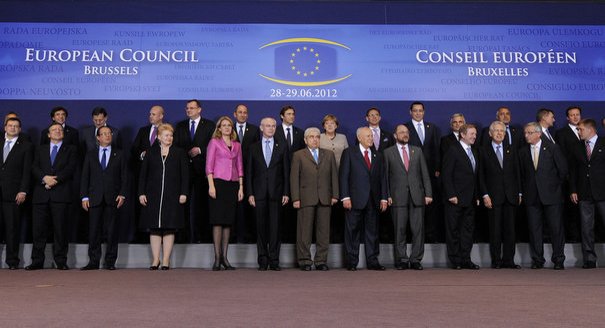
Source: Getty
One of the big mistakes made by Europeans and outside observers alike is to hope that the mess that is the European Union could be resolved by leadership, Churchill-style.
One of the big mistakes made by Europeans and outside observers alike is to hope that the mess that is the European Union could be resolved by leadership, Churchill-style. Leadership, in general, has become one of the great mysteries of the political discourse in Europe and around the world. But the word leadership is now what Uwe Poerksen has famously called a "plastic word": a term so sufficiently imprecise and meaningless it can mean everything, designed to obfuscate our cluelessness about what's going on, and to make us sound sophisticated when we are too lazy to think hard.
We say "structure" when we don't know what something is, and "process" when we don't know how something works. Similarly, "leadership", or the lack thereof, is now the across-the-board explanation for all that is wrong with the political "system" (another beautiful plastic word). It is the secret human ingredient to successful politics (and business), and the mysterious, wizardly, all-potent remedy to any dysfunctionality anywhere. The ultimate examples for great political leadership in times of crisis are, of course, Winston Churchill and Franklin Roosevelt. And so the question has arisen countless times: does the EU need Churchillian leadership to get out of this crisis? The answer is no.
There are a number of reasons for this. Most importantly, the European Union, as a political entity, is not conducive to leadership by one dominant actor. It was, in fact, built to avoid exactly that. The EU is, for the most part, an intricate and steady collective law-making exercise, not a one-off project that needs to get off the ramp through sheer will-power. It is true that its bigger member states are more powerful than smaller ones, but transferring this into accepted leadership is a very subtle affair, built on the ability to silently convince rather than on the capacity to openly dominate. True, Churchill was good at that, too, but that's not what people mean when they invoke his example in the EU context.
Secondly, in the EU, as in most political contexts, Churchillian leadership will only be accepted in a situation of mortal threat. And no matter how foolish this might be, most people (both politicians and regular folks) do not perceive the current crisis as being a mortal one. Severe, yes. Mortal, no. Therefore they are not willing to hand over the steering wheel to a strong-man (or strong-woman) and bestow that person with the emergency powers to guide us all through times of danger like a dictator pro tempore. Which is what Churchill was at the time. Britain, during the Second World War, was willing to give such powers to him. As soon as the threat was over, however, the great man was quickly stripped of his powers and voted out of office. Europe, by and large, still believes that the crisis can be resolved within the established system and with regular politics. Those hoping for a Churchill are disappointed, not least because Churchillian drama makes for a lot more interesting politics than night sessions in the council building in Brussels.
Thirdly, leadership is largely a construct of history. Only with hindsight are we really able to identify what was and wasn't leadership. Both Churchill and Roosevelt faced strong opposition when in power. Only now do they seem the universally admired knights in shining armor who came to the rescue of the free world. Back then, they were often disputed, dismissed, battled, hated, even despised, by their contemporaries. Their critics were, for the most part, wrong, but that was not clear at the time. For us today that means that we could very well live in a time of leadership, but be utterly unaware of it.
Maybe the firmness of Angela Merkel, the alternatives proposed by Francois Hollande, or the skillful guidance of Herman van Rompuy, as disputed (and ridiculed) as they are today, will be seen as heroic, steadfast and principled in the not-so distant future. Hard to imagine? So was Roosevelt’s enduring greatness in 1937.
So we should all be a bit more careful when attributing most of the EU's shortcomings to a lack of leadership. European integration is a much too complex creature to be saved by some short-term period of charismatic guidance. As a construction of 27 sovereign nations, it abhors dominance, and as a project it is the ultimate exercise in long-termism. Leadership will surely play a role in its development, but it will be only one ingredient among many. Most importantly, it can't come from one person alone. There is no such thing as the European political redeemer. Leadership in the EU must come from many sides, coordinated, synchronized, and exercised with humility. Which is why, in the EU, leadership is so hard to get—and so difficult to detect when it's actually there.
Director, Europe Team, Eurasia Group
Techau is director with Eurasia Group's Europe team, covering Germany and European security from Berlin. Previously, he was director of Carnegie Europe.
Recent Work

Nathalie Tocci, Jan Techau
Jan Techau
Carnegie does not take institutional positions on public policy issues; the views represented herein are those of the author(s) and do not necessarily reflect the views of Carnegie, its staff, or its trustees.

Are Germany’s economic, industrial, and political struggles becoming a liability for the EU’s ability to rise to the geopolitical moment?

Rym Momtaz, ed.

European Commission President Ursula von der Leyen is about to give her annual address on the state of the EU. Here’s what she won’t—but should—say.
Rym Momtaz

The aftermath of the Ceuta crisis shows Europe has drawn the wrong lessons. Rather than doubling down on failed migration policies, the EU needs to address the underlying roots of such episodes.

Richard Youngs

An overwhelming victory by a far-right-wing party in a small state in eastern Germany will have major repercussions for Chancellor Friedrich Merz’s coalition.

Judy Dempsey

Canadian Prime Minister Mark Carney has twice inspired praise for standing up to U.S. President Donald Trump: at the 2026 World Economic Forum in Davos and on Canada-U.S. trade negotiations. Is Carney showing a third way better than the EU has in dealing with the Trump administration?
Rym Momtaz, ed.