

Commentary
Marc Pierini
{
  "authors": [
    "Marc Pierini"
  ],
  "type": "commentary",
  "blog": "Strategic Europe",
  "centerAffiliationAll": "",
  "centers": [
    "Carnegie Endowment for International Peace",
    "Carnegie Europe"
  ],
  "collections": [],
  "englishNewsletterAll": "",
  "nonEnglishNewsletterAll": "",
  "primaryCenter": "Carnegie Endowment for International Peace",
  "programAffiliation": "",
  "programs": [],
  "projects": [],
  "regions": [
    "Europe"
  ],
  "topics": []
}
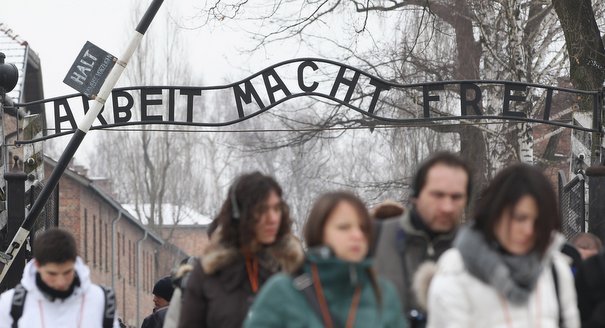
Source: Getty
Having just ended a 35-year career as a European Union official, I decided to go to Auschwitz and Birkenau for the first time. Why would I devote time in the middle of the summer to such a painful pilgrimage?
Having just ended a 35-year career as a European Union official, I decided to go to Auschwitz and Birkenau for the first time. Why would I devote time in the middle of the summer to such a painful pilgrimage?
The first answer is that I worked an entire lifetime for the European project, based on the words of Robert Schuman on May 9, 1950, words which were themselves based on the lessons drawn from the horrors of World War Two.
As a child of the immediate post-war period, as a “baby-boomer”, I was raised in the memory of the war and the remembrance of the Holocaust. This was taught in my “lycée”, I have read books and watched countless movies and film footage. More importantly, I remember my father’s best friend, Antoine, who had been a prisoner of war in Germany, visiting us almost every Friday night for years on end and sharing with my parents stories about the defeat, deportation, friends and freedom fighters who were hidden or helped in a number of ways, friends who never came back, deprivations, the liberation of 1945.
So, in many ways, Auschwitz was part of my childhood, upbringing, and professional career. Going there was therefore the natural end of an unfinished journey.
My first impression was the crowd, huge and not as elderly as I had expected. Many young and mature couples, many young single adults, all extremely attentive to what our guide had to say, all silent during the nearly 6-hour journey from Krakow, all impressed by the meticulous nature of the explanations, the “how-it-worked” side of it.
My second impression was the familiar nature of the places, this feeling of “I-have-been-here-before” which, of course, came from the fact that the Auschwitz tragedy is probably the most documented part of the Holocaust. The gate of Auschwitz KL1 with the sign “Arbeit Macht Frei”, the towering entrance to Auschwitz Birkenau KL2 and the railway line ending up next to the gas chambers, the piled-up bunk beds in men’s barracks, all these images were sort of imprinted in my memory.
The third impression was the size of the whole thing, especially at Birkenau where no less than 80 hectares were purpose-built and devoted to extermination.
Then came the emotion of walking under searing heat, barely 500 meters from where the railway carriages stopped inside Birkenau and the gas chambers, starting with the very place where the “selection” was performed, most often just upon arrival.
At which point came to mind a sentence in Primo Levi’s first book, a quote from his friend Giuliana Tedeschi with whom he visited Birkenau. She remembered, during her detention there, seeing from her window, smoke coming out of the chimneys at the end of camp. She asked an older woman about it and the reply came: “It’s us burning”. Being there oneself, in the very same women’s barracks, gives an altogether different meaning to Levi’s words.
Then came the recollection of the numbers, 1.5 million dead in the three main Auschwitz lagers, of whom 1.1 Jews, most of them women, children, and the elderly. This means 1,000 a day for four years.
Back to today’s world, reading everyday news about the rise of xenophobia, racism, white supremacists, or just simply intolerance (by people or by governments) brings a question: can Europe produce such horrors another time round?
On my way back from Krakow, I suddenly realized that the other day on the way to pick up new business cards at a printer in Brussels, which I found in the Yellow Pages, the man, an otherwise good printer, was wearing the Iron Cross over his T-shirt…
Maybe our chief educators should reflect upon a new activity for the 15-17 years old in secondary education: take them to Auschwitz and Birkenau for two days, as a routine part of the year’s curriculum. We can probably find enough corporate and public funding to bring millions, literally, of our European youth to that place.
So that they do not forget. So that they measure the real dangers behind the words of the populist, xenophobic, and racist politicians that they may be tempted, one day, to follow.
Marc Pierini, a former EU career diplomat, has served as the EU Ambassador to Turkey, Tunisia, Libya, Syria, and Morocco.

Senior Fellow, Carnegie Europe
Marc Pierini is a senior fellow at Carnegie Europe, where his research focuses on developments in the Middle East and Turkey from a European perspective.
Recent Work
Marc Pierini
Marc Pierini
Carnegie does not take institutional positions on public policy issues; the views represented herein are those of the author(s) and do not necessarily reflect the views of Carnegie, its staff, or its trustees.

Before the next wave of EU enlargement takes place, the union needs to grapple with thorny questions of how power is distributed among its members.


Emil Sondaj Hansen, Ditte Brasso Sørensen

Are Germany’s economic, industrial, and political struggles becoming a liability for the EU’s ability to rise to the geopolitical moment?

Rym Momtaz, ed.

European Commission President Ursula von der Leyen is about to give her annual address on the state of the EU. Here’s what she won’t—but should—say.
Rym Momtaz

The aftermath of the Ceuta crisis shows Europe has drawn the wrong lessons. Rather than doubling down on failed migration policies, the EU needs to address the underlying roots of such episodes.

Richard Youngs

An overwhelming victory by a far-right-wing party in a small state in eastern Germany will have major repercussions for Chancellor Friedrich Merz’s coalition.

Judy Dempsey