

Commentary
Judy Dempsey
{
  "authors": [
    "Judy Dempsey"
  ],
  "type": "commentary",
  "blog": "Strategic Europe",
  "centerAffiliationAll": "",
  "centers": [
    "Carnegie Endowment for International Peace",
    "Carnegie Europe"
  ],
  "collections": [],
  "englishNewsletterAll": "",
  "nonEnglishNewsletterAll": "",
  "primaryCenter": "Carnegie Europe",
  "programAffiliation": "",
  "programs": [],
  "projects": [],
  "regions": [
    "Europe"
  ],
  "topics": [
    "EU"
  ]
}
Source: Getty
A bitter debate over the circumcision of baby boys prompts members of Germany’s Jewish community to question whether Jews are still welcome in the country.
When German Jews who survived the Holocaust decided to remain in Germany they were ostracized. The few thousand who lived in Germany were called traitors by the Jewish majority which vowed never to set foot in this country of murderers.
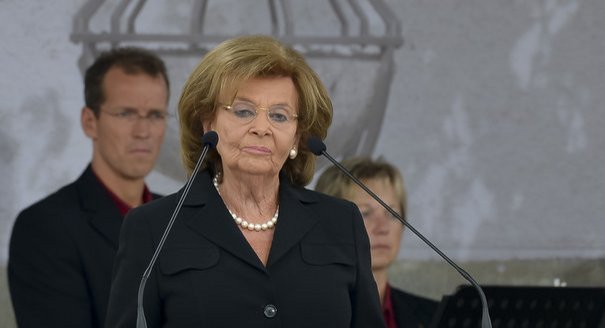
One of those who stayed was Charlotte Knobloch. Now 79, Knobloch has spent much of her life involved in Germany’s Jewish community. She was head of the Central Council of Jews in Germany, the umbrella organization for the Jewish community until her retirement in 2010.
Over the decades, Knobloch has seen a remarkable revival of Jewish life in Germany. The small community of between 10,000 and 15,000 Jews that lived in Germany after 1945, swelled to over 220,000 after the collapse of the former Soviet Union in 1991. It’s still a far cry from the 550,000 who lived here before 1938. But Germany can claim to have one of one of the fastest growing Jewish communities in Europe if not world-wide.
Jewish life is flourishing. There are new synagogues, new seminaries and new Jewish studies departments in the universities.
Successive German governments have felt proud and relieved that Jews want to live in Germany, that Jews can feel safe and comfortable, that they are welcome.
Yet now, Jews like Knobloch question whether they are still welcome. The reason is a bitter debate over whether circumcision of baby boys, mandatory for observant Jews, constitutes a bodily injury that the state should forbid.
According to Jewish tradition, male infants are circumcised on the eighth day after birth. Circumcision (brit milah) is given great importance in Judaism as this ritual reminds of the covenant made by God with Abraham.
For the longest time, this practice did not draw any attention in Germany, though many Christian and non-believing families here, in contrast to the U.S., do not have their children circumcised. Jewish and Muslim families had no problems getting their boys circumcised.
Then, last June, a district court in Cologne was confronted with a case where a small boy suffered serious medical complications following a circumcision. The judges decided that the circumcision amounted to bodily injury. “The fundamental right of the child to bodily integrity outweighed the fundamental rights of the parents”, the court judged.
It based its decision on Article 2 of the German Constitution that stipulates: “Every person shall have the right to life and physical integrity.”
The court’s ruling did not mean an outright ban on circumcisions throughout Germany. In fact, male circumcision is not illegal. Nevertheless, the ruling sowed confusion among the medical profession and concern that other courts could follow suit.
The ruling was strongly condemned by Jewish and Muslim leaders as well as Catholic and Protestant leaders. They argued it was a grave intrusion on religious freedom. Yesterday, Sunday, thousands of Jews, Muslims, and Christians demonstrated in Berlin in favor of circumcision in the name of religious freedom.
The President of the Central Council of Jews in Germany, Dieter Graumann, said: "This court decision is an outrageous and insensitive act. Circumcision of newborn boys is an inherent part of the Jewish religion and has been practiced worldwide for centuries. This religious right is respected in every country in the world."
And Charlotte Knobloch, having endured much criticism in her life for having stayed in Germany, wrote a poignantly sad commentary in Suddeutsche Zeitung, the liberal daily newspaper.
“For six decades I have had to justify myself because I stayed in Germany, as a remnant of a destroyed world, as a sheep among wolves,” Knobloch wrote.
“I always readily carried this burden because I was firmly convinced that this country and these people deserved it. Now, for the first time my basic convictions are starting to shake. For the first time I feel resignation. I seriously ask if the country still wants us.”
You could feel the stunned shock from the political establishment and the media. Rarely has any Jew publicly asked if Germany wanted Jews to leave. And in this day and age, few Germans would want that to happen.
Yet the dilemma for Germany is real: how does a modern Western secular society, with an emphasis on the protection of the individual, reconcile that principle with religious rituals, such as male circumcision?
And what does separation of church and state mean under those circumstances? Should the state stay out of religious rites, or is it obliged to protect individuals against any kind of bodily injury no matter the background of the act?
The German government has no leeway in this regard.
Politically, it cannot ban circumcisions because Germany owes it to the Jews to ensure that Germany remains a country that allows the Jews to practice their religions and to live in security. Germany also needs to remain a welcoming and tolerant country to the four million Muslims living here.
Desperate to reassure these communities, the German parliament in July passed a resolution to protect religious circumcision. A new law is now being drawn up designed to protect doctors and families against prosecution if they circumcise their children.
Female circumcision, being a far more brutal operation, will not be covered by this law. Yet this differentiation, lawyers say, cannot easily be couched in watertight legal terms.
To make matters worse, over the past weeks, Germany has seen a rise of anti-semitic incidents. Last month, a Rabbi was attacked and seriously injured and his young daughter threatened with death by a group of teenagers of Middle Eastern origin. Arab youths also threatened a group of Jewish schoolgirls.
Who knows how widespread anti-semitism is in Germany. That aside, Jews in Germany (and other European countries) are increasingly being identified with Israel and the conflict with the Palestinians. It is a very worrying trend.
I personally was shocked to hear a former colleague justifying why the Rabbi was attacked. The Rabbi, the colleague said, was clearly a supporter of Israel and therefore one of the perpetrators of the conflict.
The timing of these events with the controversy over circumcision is a coincidence. But it drives home some very uncomfortable questions about how Jews can live in today’s Germany, some 70 years after the Holocaust.

Nonresident Senior Fellow, Carnegie Europe
Judy Dempsey is a nonresident senior fellow at Carnegie Europe
Recent Work
Judy Dempsey
Judy Dempsey

Are Germany’s economic, industrial, and political struggles becoming a liability for the EU’s ability to rise to the geopolitical moment?

Rym Momtaz, ed.

European Commission President Ursula von der Leyen is about to give her annual address on the state of the EU. Here’s what she won’t—but should—say.
Rym Momtaz

The aftermath of the Ceuta crisis shows Europe has drawn the wrong lessons. Rather than doubling down on failed migration policies, the EU needs to address the underlying roots of such episodes.

Richard Youngs

An overwhelming victory by a far-right-wing party in a small state in eastern Germany will have major repercussions for Chancellor Friedrich Merz’s coalition.
Judy Dempsey

Canadian Prime Minister Mark Carney has twice inspired praise for standing up to U.S. President Donald Trump: at the 2026 World Economic Forum in Davos and on Canada-U.S. trade negotiations. Is Carney showing a third way better than the EU has in dealing with the Trump administration?
Rym Momtaz, ed.