

Commentary
Judy Dempsey
{
  "authors": [
    "Judy Dempsey"
  ],
  "type": "commentary",
  "blog": "Strategic Europe",
  "centerAffiliationAll": "",
  "centers": [
    "Carnegie Endowment for International Peace",
    "Carnegie Europe"
  ],
  "collections": [],
  "englishNewsletterAll": "",
  "nonEnglishNewsletterAll": "",
  "primaryCenter": "Carnegie Europe",
  "programAffiliation": "",
  "programs": [],
  "projects": [],
  "regions": [
    "Europe",
    "Russia"
  ],
  "topics": [
    "Security"
  ]
}
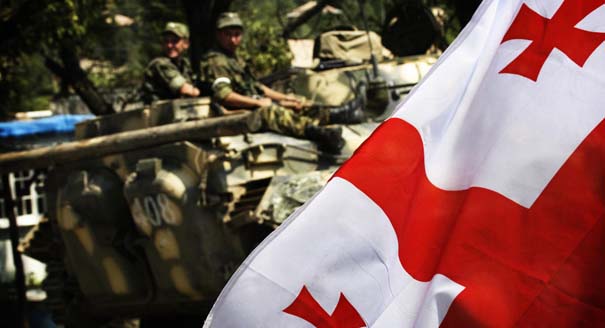
Source: Getty
Every week leading experts answer a new question from Judy Dempsey on the international challenges shaping Europe’s role in the world.
Every week leading experts answer a new question from Judy Dempsey on the international challenges shaping Europe’s role in the world.
Georgia is news today. The champion of the Rose Revolution has now suffered democratic defeat at the polls and Georgia will have to demonstrate its stamina and determination for multi-party democracy over the coming years.
If you don’t know the answer, ask for advice. I know little about Georgia. Thus, I asked my seasoned European Council on Foreign Relations colleague, Jana Kobzova, for her take on Georgia. My own gut feeling was that we should look at Georgian accession to NATO in the larger context of relations with Russia. I’m intellectually tempted by the Zbigniew Brzezinski argument that we should aim to enlarge the West, including NATO, with Russia. However, looking at arguments over Syria, Russia is certainly pulling in a different direction than the Western camp. Therefore, the Brzezinski argument might not be taking share anytime soon.
Jana suggested to approach the question in a different manner, rather a more technical and step-by-step approach to this: “Perhaps rather than arguing for or against Georgia's NATO accession (this is a polarised debate, those supporting Georgia are seen as neocons, those against it are often seen as giving in to Russia) it will be useful to say that ultimately, it will also depend on Georgia's own military reforms. The country provides 2nd largest per capita contribution to Afghanistan, which is not a small thing, these guys mostly fight rather than build roads/train Afghan soldiers as many Europeans do. On the other hand, military reforms still need to be implemented. To put it simply: there's no point arguing whether to "let" Georgia to NATO or not - we promised already (twice) that we will eventually let them in. The key is obviously when: and here, we should not slip into geopoliticising but rather focus on making sure that Georgia's army is actually modernised, ready and compatible with ours. This in itself will take years.”
Not now. It would simply irritate Putin and would add ammunition to his already swollen propaganda war chest. From a defense point of view, it would not add much, if anything, to Georgia's security and would give the Kremlin ample room for provocation. It is better to wait, or at most, slowly open a process for the Turkey in Europe issue.
Georgia is not ready for NATO membership. It remains a work in progress regarding fulfilling democratic criteria. However, the perspective of future membership should be kept open and signals reassuring Georgians that they are part of the West and will not be left to face Russian pressure alone need to continue. The country has come a long way but NATO has to avoid the EU’s mistake in moving too fast in admitting members who were not ready and thus losing leverage to promote democratic reforms.

Nonresident Senior Fellow, Carnegie Europe
Judy Dempsey is a nonresident senior fellow at Carnegie Europe
Recent Work
Judy Dempsey
Judy Dempsey

The aftermath of the Ceuta crisis shows Europe has drawn the wrong lessons. Rather than doubling down on failed migration policies, the EU needs to address the underlying roots of such episodes.

Richard Youngs

An overwhelming victory by a far-right-wing party in a small state in eastern Germany will have major repercussions for Chancellor Friedrich Merz’s coalition.
Judy Dempsey

Canadian Prime Minister Mark Carney has twice inspired praise for standing up to U.S. President Donald Trump: at the 2026 World Economic Forum in Davos and on Canada-U.S. trade negotiations. Is Carney showing a third way better than the EU has in dealing with the Trump administration?

Rym Momtaz, ed.

The EU’s responses to two recent incidents expose the gulf between European perceptions and capabilities. Unless the union can bridge that gap, it will never become a real geostrategic power.
Rym Momtaz

In supporting Europe’s far-right, MAGA and Russia both want the same thing: a weaker EU. Europe must defend itself without abandoning the openness these forces exploit.

Armida van Rij