

Commentary
Nathalie Tocci, Jan Techau
{
  "authors": [
    "Jan Techau"
  ],
  "type": "commentary",
  "blog": "Strategic Europe",
  "centerAffiliationAll": "",
  "centers": [
    "Carnegie Endowment for International Peace",
    "Carnegie Europe"
  ],
  "collections": [],
  "englishNewsletterAll": "",
  "nonEnglishNewsletterAll": "",
  "primaryCenter": "Carnegie Europe",
  "programAffiliation": "",
  "programs": [],
  "projects": [],
  "regions": [
    "Europe"
  ],
  "topics": [
    "EU"
  ]
}
Source: Getty
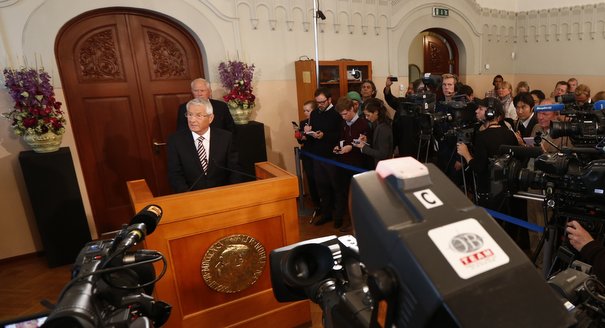
The EU has been awarded the Nobel Peace Prize today. It is the right prize for the right organization at the right time.
The EU has been awarded the Nobel Peace Prize today. It is the right prize for the right organization at the right time.
There are clearly two reasons for the Nobel Committee's decision. One is the acknowledgement of the EU's unique contribution to peace, stability, and reconciliation on the European continent following the Second World War. Alongside NATO, which kept the western part of the continent free from Soviet aggression, it was the EU that delivered internal consolidation and new ways of cooperation between erstwhile and traditional enemies in Europe.
At the end of the cold war, the EU's enlargement policy offered new chances to Central and Eastern European states after their long ordeal behind the iron curtain. The EU peace project can't be praised enough for these accomplishments.
The second reason is clearly political. The Peace Prize has always been a political one. It gives the EU a morale boost at a time when it has been shaken to its core. The prize is an encouragement to the EU to continue its peace-generating integration work. It is a reminder to eurosceptics to consider the real merits of the union they so despise, and it is an appeal to Europe to finally become a serious strategic player in the world.
In that sense, the award is also an aide-memoir to Europeans that they carry a responsibility few others must shoulder: to pacify their own, historically unstable continent, and to be a force for good in the world.
Director, Europe Team, Eurasia Group
Techau is director with Eurasia Group's Europe team, covering Germany and European security from Berlin. Previously, he was director of Carnegie Europe.
Recent Work
Nathalie Tocci, Jan Techau
Jan Techau

While the EU and European governments are embracing the much-lauded middle-power moment, this entails three difficult conundrums.

Richard Youngs

Much has been said of the changes Brussels is trying to make to the EU enlargement process. Here’s why gradual integration might—or might not—be the answer.

Dimitar Bechev

The European Commissioner for Trade is headed to China. But after President Xi’s bridge-building visit to Washington, can a more isolated EU overcome Beijing’s stranglehold on critical raw materials? Who will blink first?

Rym Momtaz, ed.

The domestic impacts of how long it is taking to end the war in Ukraine have pushed the French electorate to the political extremes and compromised the country’s diplomatic capacity.
Rym Momtaz

Before the next wave of EU enlargement takes place, the union needs to grapple with thorny questions of how power is distributed among its members.


Emil Sondaj Hansen, Ditte Brasso Sørensen