

Commentary
Judy Dempsey
{
  "authors": [
    "Judy Dempsey"
  ],
  "type": "commentary",
  "blog": "Strategic Europe",
  "centerAffiliationAll": "",
  "centers": [
    "Carnegie Endowment for International Peace",
    "Carnegie Europe"
  ],
  "collections": [],
  "englishNewsletterAll": "",
  "nonEnglishNewsletterAll": "",
  "primaryCenter": "Carnegie Europe",
  "programAffiliation": "",
  "programs": [],
  "projects": [],
  "regions": [
    "Europe"
  ],
  "topics": []
}
Source: Getty
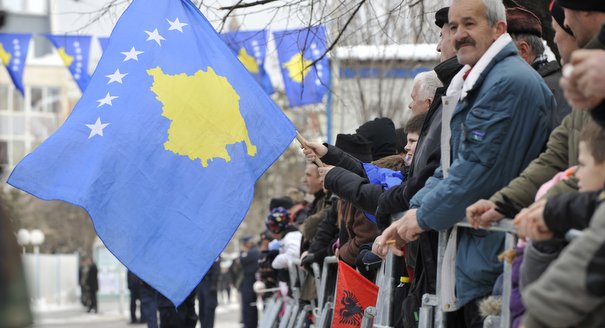
Any doubts you might have harbored about the effectiveness of the EU’s soft power have been confirmed by a devastating report by the European Court of Auditors on Kosovo.
Any doubts you might have harbored about the effectiveness of the EU’s soft power have been confirmed by a devastating report by the European Court of Auditors.
The detailed report, published last week, gives a blow-by-blow account of the EU’s failure in Kosovo.
It shows how the EU mission staff is poorly selected and poorly trained. It explains how the EU has failed to monitor and improve Kosovo’s institutions—police, courts, judiciary, and local administration.
As a result, corruption is still rampant and human trafficking continues unabated. This is despite the fact that these two issues increasingly preoccupy the EU’s member states because they spill over into crime at home. The member states seem indifferent to the EU’s incompetence and to the lack of political will that Kosovo’s government and presidency have demonstrated to tackle corruption and organized crime.
Yet Kosovo has ambitions to join the EU, which is all the more reason for Brussels to be extremely worried about what is happening on Europe’s southern flanks. Haven’t the member states learned anything from Bulgaria and Romania, who joined the EU in 2007? Five years later, both have still to tackle corruption or build strong and accountable democratic institutions.
In the case of Kosovo, a more robust judiciary system would clearly improve matters, and quickly. In its report, the Court of Auditors describes a cobweb of official bodies that duplicate but do not coordinate, with the result that there is no coherent judicial or prosecution system.
Then there is the constant interference by the government, and especially the president’s office, which has been abusing its power to pardon criminals, even those who have committed very serious crimes.
The report states that the European Commission was aware that many of these pardons were handed out for dubious reasons. “The European Commission has expressed concern about the extensive use of presidential pardons without appropriate justification,” states the report. Why, then, did it make no effort to stop them?
Of course, it was never going to be easy to build a country in Kosovo, a former Serb province disputed for centuries between Serbs and ethnic Albanians and mired in poverty, corruption, and ethnic hatred.
It doesn’t help, either, that not all of the EU’s 27 member states have recognized Kosovo’s independence. Because of that, Europol, the EU’s police body, cannot fully operate in Kosovo.
There is also the fact that the United States is a big player in Kosovo as well, and that Brussels and Washington have not, according to the Court of Auditors, coordinated their help for the country.
But one factor is clearly not to blame: money.
In this small country in the Balkans, the European Union Rule of Law Mission in Kosovo, or EULEX, has spent €614 million over the last five years. This makes EULEX the largest crisis management operation ever launched by the EU. Moreover, according to the report, “Kosovo is the biggest recipient per capita of EU assistance in the whole world”.
Even before EULEX started, the sums of EU money invested in Kosovo were staggering. Between 1999 and 2007, Kosovo received €3.5 billion, with the European Commission and the member states accounting for two-thirds.
The problem is that the EU may have a goal in mind when it embarks on a soft power mission, but it lacks the political and intellectual will and competent personnel to implement that mission.
Kosovo is not an isolated case.
In Bosnia, after even more years of European involvement, the EU has still not been able to introduce the robust kind of rule of law that would end corruption. The local and central administrations are weak and susceptible to political interference, and the state structures barely function.
In Afghanistan, the EU has struggled to establish a police-training mission for years. The mission was understaffed from the outset, not to speak of low morale and leadership issues.
Apart from the police mission, which operates on a tight budget, the EU has poured billions into infrastructure projects and non-governmental organizations because it believes it should. For the EU, money is an essential tool of soft power.
Perhaps. But the problem is that too much money, without establishing conditionality or strict and clear means to attain a goal, is counter-productive.
Kosovo has received so much money, with almost no conditionality, that it has created a dependency culture. What motivation is there for locals to build strong, independent, and democratic institutions if they know that once that is achieved, the money will stop flowing?
Moreover, money has not created stability. The Mitrovica region in the north of Kosovo, which is dominated by the Serb minority, is now a safe haven for organized crime due to the lack of a strong police force and any kind of judicial system.
EULEX should have established a presence much earlier on the ground to show that the EU was responsible for overseeing a system of law and order throughout the whole country. But it didn’t because it had neither the political will nor the means.
Instead, preserving the peace has been left up to NATO’s Kosovo Force (KFOR) mission, which was supposed to be reduced even further last year. That had to be postponed. So much for the EU’s soft power credentials.
Few countries are good at soft power. The United States knows that from bitter experiences in Iraq.
The EU, however, professes to make soft power its guiding principle for dealing with conflicts, both because it likes the image that this philosophy confers, and because it is shy of using hard, or military power.
Yet it has made a hash of most of its soft power missions. Will next time work better? This is the question the EU needs to ask as it prepares for a new mission in Mali.

Nonresident Senior Fellow, Carnegie Europe
Judy Dempsey is a nonresident senior fellow at Carnegie Europe
Recent Work
Judy Dempsey
Judy Dempsey
Carnegie does not take institutional positions on public policy issues; the views represented herein are those of the author(s) and do not necessarily reflect the views of Carnegie, its staff, or its trustees.

The aftermath of the Ceuta crisis shows Europe has drawn the wrong lessons. Rather than doubling down on failed migration policies, the EU needs to address the underlying roots of such episodes.

Richard Youngs

An overwhelming victory by a far-right-wing party in a small state in eastern Germany will have major repercussions for Chancellor Friedrich Merz’s coalition.
Judy Dempsey

Canadian Prime Minister Mark Carney has twice inspired praise for standing up to U.S. President Donald Trump: at the 2026 World Economic Forum in Davos and on Canada-U.S. trade negotiations. Is Carney showing a third way better than the EU has in dealing with the Trump administration?

Rym Momtaz, ed.

The EU’s responses to two recent incidents expose the gulf between European perceptions and capabilities. Unless the union can bridge that gap, it will never become a real geostrategic power.
Rym Momtaz

In supporting Europe’s far-right, MAGA and Russia both want the same thing: a weaker EU. Europe must defend itself without abandoning the openness these forces exploit.

Armida van Rij