

Commentary
Nathalie Tocci, Jan Techau
{
  "authors": [
    "Jan Techau"
  ],
  "type": "commentary",
  "blog": "Strategic Europe",
  "centerAffiliationAll": "",
  "centers": [
    "Carnegie Endowment for International Peace",
    "Carnegie Europe"
  ],
  "collections": [],
  "englishNewsletterAll": "",
  "nonEnglishNewsletterAll": "",
  "primaryCenter": "Carnegie Europe",
  "programAffiliation": "",
  "programs": [],
  "projects": [],
  "regions": [
    "Europe",
    "North America"
  ],
  "topics": [
    "EU"
  ]
}
Source: Getty
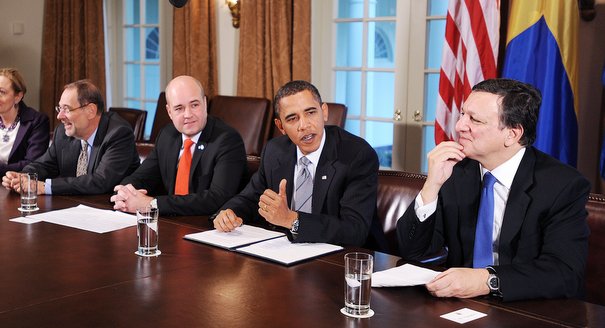
If Europeans want to be taken seriously as partners, have a modicum of influence on U.S. foreign policy decisions, and keep the United States interested in Europe, the homework is theirs to do, not America’s.
Now that the U.S. election is over, Europeans have a unique chance to get back to real life again. Their obsessive attention to this election was never really backed up by any kind of rational analysis. In reality, very little was at stake for transatlantic relations in the Obama vs. Romney contest. Interests don’t change overnight, and even a President Romney would not have fundamentally altered the transatlantic agenda. Getting emotionally engaged in the U.S. election was an easy and exciting escape from the malaise Europeans face at home. Not only can you forget about the crisis for a while, you can also feel good about being engaged and supporting the morally preferable candidate. Knowing what’s right for America is a lot more comfortable, less charged with issues of responsibility, and a lot cheaper than talking about what Europe can do to make a difference in the world.
Europeans often overlook that the quality of transatlantic relations depends a lot more on themselves than on who occupies the White House. If Europeans want to be taken seriously as partners, have a modicum of influence on U.S. foreign policy decisions, and keep the United States interested in Europe, the homework is theirs to do, not America’s.
Contrary to common belief, this has only partly to do with military assets. Naturally, the Americans look with concern at the dwindling military capabilities in Europe, which undermine NATO’s credibility and raison d’etre. Being relatively weaker themselves, Americans hope that, in the future, Europeans can provide more and more of the services required to keep the Balkans, Eastern Europe, and North Africa stable, peaceful, and democratic. What they see is a Europe that spends €180 billion on defense but plays no role in global strategic affairs. That’s not viable, and it is weakening transatlantic relations.
But beyond the well-discussed military issue, there is also a wider concern about EU foreign policy in general. It is about the fact that Europe, even in fields where it already has all the instruments and all the leverage, is not acting decisively as a foreign policy power. As I have written before, it’s the lack of ambition that bothers Europeans, Americans, and other observers alike. Just imagine the reputation and standing Europe could have, not only in the transatlantic relationship, but across the board, if it just tackled some of the obvious and urgent issues at hand.
Here is my priority action list for “Operation Renewed Hope”, the European program to regain credibility as a foreign policy player, impress the Americans, and feel better about themselves:
Everyone knows that membership is not a viable option anymore. Which means we can finally continue the accession negotiations in all seriousness. Sound paradoxical? It isn’t. Neither the Europeans nor the Turks want full Turkish membership anymore. But what both sides want is a reformed Turkey. For the Europeans, the negotiations are the only real tool they have to bring about reforms and to influence Turkey at home. For Erdogan, the negotiations are a tool to push through reforms that he otherwise couldn’t. Yes, Erdogan is a more difficult player now, with worrisome ambitions and positions. But he is a realist first and foremost. He wants Turkey to be strong. So do we. So let’s keep silent about the end goal, and continue in the negotiations with full zest.
After the fraudulent elections, Europeans are dumbfounded about what to do with Ukraine. But they already own the perfect tool for dealing with the regime in Kiev, the Association Agreement, which is waiting to get signed but has been put on hold. The EU should sign the agreement because it gives them real leverage with Ukraine. Here, conditionality, if played right, could work. Use the human rights clauses in the document, and apply them. Play hardball in return for preferred access to EU markets. This would have a very positive geopolitical impact on Russia as well.
Use the European Commission’s anti-trust case against Gazprom as the starting point for a really unified European energy policy vis-à-vis Moscow. For too long Europeans refrained from using their leverage in the buyer-seller relationship with Russia, and for too long they allowed Russia to play them against each other. It is now time to create a European unity using a strategic issue of the utmost geopolitical importance.
Three words: Pooling and sharing. The case has been made so often, it’s tiresome to repeat it, but it must be done: Europeans must start spending their huge overall defense budgets in smarter ways. It makes sense militarily, it makes sense financially, and it makes sense within the transatlantic framework. There is no convincing reason why it should not make sense politically. And yes, some European countries should stop using their military spending as social programs aimed at subsidizing government jobs.
Creating a zone of free trade across the Atlantic is the second big geopolitical project that needs to become a reality. What better gesture in the emerging Pacific Century than to eliminate trade barriers between Europe and America? It would create countless jobs, stimulate investment, boost trade, increase tax revenue, and increase the West’s influence in multilateral organizations such as the WTO, the IMF, and the G20.
None of these things would cost a lot of money, would require new treaties or instruments, or even fundamentally new thinking. All it requires is some ambition to make your own life, and that of others, better, and some unity. The fact that despite their relative easiness, they are still deemed revolutionary, is a sign of our real weakness in the world. It does not come from demographics, or lack of military capabilities, or even the euro crisis. It comes from a lack of daring, ambition, and resolve. Do I sound naïve here? If so, that’s a good thing, because that means I am on to something.

Director, Europe Team, Eurasia Group
Techau is director with Eurasia Group's Europe team, covering Germany and European security from Berlin. Previously, he was director of Carnegie Europe.
Recent Work

Nathalie Tocci, Jan Techau
Jan Techau
Carnegie does not take institutional positions on public policy issues; the views represented herein are those of the author(s) and do not necessarily reflect the views of Carnegie, its staff, or its trustees.

European Commission President Ursula von der Leyen is about to give her annual address on the state of the EU. Here’s what she won’t—but should—say.

Rym Momtaz

The aftermath of the Ceuta crisis shows Europe has drawn the wrong lessons. Rather than doubling down on failed migration policies, the EU needs to address the underlying roots of such episodes.

Richard Youngs

An overwhelming victory by a far-right-wing party in a small state in eastern Germany will have major repercussions for Chancellor Friedrich Merz’s coalition.

Judy Dempsey

Canadian Prime Minister Mark Carney has twice inspired praise for standing up to U.S. President Donald Trump: at the 2026 World Economic Forum in Davos and on Canada-U.S. trade negotiations. Is Carney showing a third way better than the EU has in dealing with the Trump administration?
Rym Momtaz, ed.

The EU’s responses to two recent incidents expose the gulf between European perceptions and capabilities. Unless the union can bridge that gap, it will never become a real geostrategic power.
Rym Momtaz