
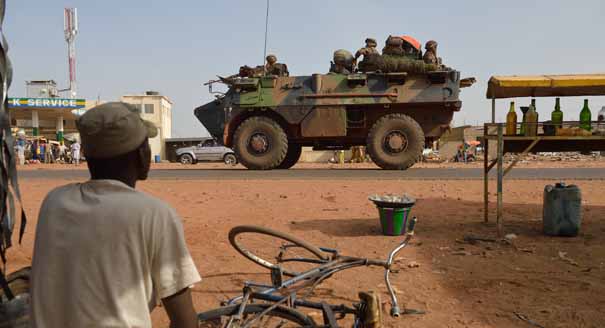
This should have been Europe’s little war.
It should have been a matter of days. Shortly after Paris decided to intervene to prevent Mali from falling into the hands of radical Islamists, European powers—London, Berlin, Rome, Madrid, Warsaw, among others—should have stepped in to turn the intervention into a common European operation.
That would have sent a strong signal: Europeans are ready to act in a concerted manner for their interests. With military muscle if necessary.
European powers have a strong interest in the region. In 2011, the EU agreed on a common strategy for the Sahel region, to fight lawlessness, poverty, and insecurity. “Countering violent extremism and radicalization” is an explicit goal of the strategy. When events in Mali forced Paris to start an emergency operation, Europeans were in the middle of preparing a training mission for Mali’s army. The attack on the oil field in Algeria only serves to highlight the fact that Europeans cannot ignore the very region which borders their immediate neighborhood. Extremists must be denied territory.
But even if the intervention ticked all the right boxes, including international legitimacy with the support of the United Nations and Mali’s African neighbors, all that France got from its European partners was some lukewarm words of support, and a bit of logistical help. The message from other European capitals was crystal clear: this is not our business. Good luck.
There was something missing in the picture: the United States. Last year Washington already signaled that it was not on the same page with France with regard to Mali. And the Obama administration, now more than ever, is doing everything it can to stay out of anything that might look like another serious military engagement that could turn messy. Americans are tired of foreign entanglements and feel overstretched.
The hard truth is that only the United States has enough influence to convince reluctant Europeans to participate in a military mission. Europeans still see the United States as the ultimate protector and the power that guarantees order. Every European country has some kind of privileged relationship with the United States, and only it has sufficient power to build a military coalition. And of course if it is on board, partners know that they will not have to bear full responsibility, nor get the blame in case of failure.
But the United States urgently wants to phase out its role as the global policeman. A burden which is perceived as too big for a country which has strengths but is not, as a nation-state, made to run the world. European powers therefore must step up their game and weave order into their neighborhood. The Sahel is a primary concern, it has turned into an arc of insecurity stretching from Somalia to Mali and threatening to destabilize Europe’s southern neighborhood.
The United States’ disengagement is not only leading to an absence of American hard power. It is also leading to a lack of American leadership which is still necessary to bring diverging European actors together. The French are, to a certain extent and in a very specific region—West Africa—able to step up their game and replace the United States as a policeman. But they cannot replace the United States, the dealmaker: the power that unites reluctant Europeans.
Neither can London, as it moves further away from the continent, infusing new insecurity into intra-European relations and making an EU Common Foreign and Security Policy look ever more utopian. And Germany, the rising power, has not changed its inward-looking political culture. It continues to abhor military power, therefore limiting its foreign policy toolbox to the soft power side.
Mali has unveiled all these uncomfortable truths. The United States won’t lead in Europe and its neighborhood anymore, and European powers are not ready to act in concert to take collective responsibility. Europeans have a choice to make: either accept that they have little or no influence on developments in their neighborhood or find new ways to deal with the hard side of power.


