

Commentary
With its public finances in shambles, the far right polling at 35 percent ahead of the 2027 presidential election, and a growing protest movement, is France’s crisis a threat to the EU’s geopolitical awakening?
Rym Momtaz, ed.
{
  "authors": [
    "Jan Techau",
    "Hugo Brady"
  ],
  "type": "commentary",
  "blog": "Strategic Europe",
  "centerAffiliationAll": "",
  "centers": [
    "Carnegie Endowment for International Peace",
    "Carnegie Europe"
  ],
  "collections": [],
  "englishNewsletterAll": "",
  "nonEnglishNewsletterAll": "",
  "primaryCenter": "Carnegie Europe",
  "programAffiliation": "",
  "programs": [],
  "projects": [],
  "regions": [
    "Europe"
  ],
  "topics": [
    "EU"
  ]
}
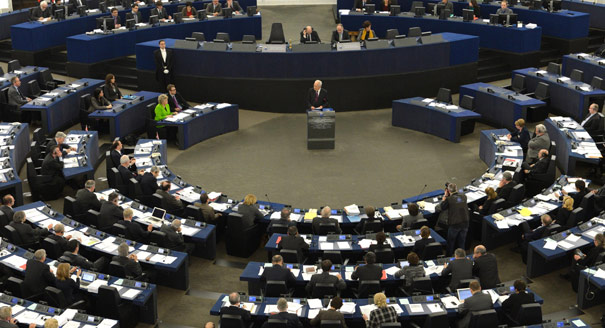
Source: Getty
The decision to establish a third official seat of the European Parliament in Dresden, quietly announced on Friday afternoon preceding the holiday weekend, is a classic example of EU horse-trading.
Did you spot our April Fools’ joke?
The European Parliament is, of course, not establishing a third official seat in Dresden. At least not for now... The blog piece below, published Monday, April 1, 2013, was our contribution to the occasionally light-hearted debate on the future of Europe. Thanks for playing along!
The decision to establish a third official seat of the European Parliament (EP) in Dresden, quietly announced on Friday afternoon, when most observers and journalists had already left Brussels to head home for Easter, is a classic example of EU horse-trading. It is also epitomizes everything that is wrong with Brussels.
When in crisis, do what you are best at. This seems to have been the guiding principle of EU decisionmakers with this latest piece of backroom maneuvering that will live in infamy as one of the most stupid and self-defeating EU deals ever struck.
Often, when faced with painful political realities–say the rejection of an EU treaty in a referendum, the Union's worrisome legitimacy issues, or the eurozone crisis entering a new diabolic phase–Eurocrats tend to “go institutional.” That is, they come up with a distracting bureaucratic “innovation” that blatantly ignores the issues at hand, leaves no one satisfied, and creates a “pig-with-lipstick” compromise so painfully concluded that it cannot then be reopened or rolled back. But this time, Brussels' best and brightest have truly outdone themselves.
Apparently, the decision to move the EP to Dresden is part of a secret deal stitched together to ensure that MEPs approve the heavily disputed EU budget. According to the decision, the EP will start holding plenary sessions in the famous East German metropolis soon after the next European Parliamentary elections in May 2014. From then on, MEPs will alternate between Strasbourg and Dresden for their infamous monthly away-sessions. The Brussels EP calendar remains unchanged, and the EU's budget will quietly increase after a midterm review in 2017.
Naturally, France opposed the first bit of the deal until the bitter end as it has with all other attempts to end the madness of the EP's monthly commute from Brussels to Strasbourg via planes, trains, and automobiles. It will now lose half the parliament's plenary sessions. French President François Hollande had to give in to considerable pressure from Berlin in the latest illustration of how the balance of power in the EU has shifted eastwards. But, according to EP spokesman Jaume Duch, hotel, bar, and nightclub owners in Strasbourg will be partially compensated for their losses by diverting around € 250 million in leftover EU cohesion money into a slush fund.
Questions about the legality of the decision were quickly brushed away in Brussels over the weekend. The Council's legal service, known for its nearly magical capacity to “flexibilize” EU treaty law whenever needed, issued a short assessment on Sunday. It states that no treaty change will be required to make the decision binding. The head of the Council's legal service, Hubert Legal, is quoted, rather cheekily, as saying: “We are absolutely certain that this decision can withstand any challenge in the European Court of Justice (ECJ). It is not only legal, it's über-legal.”
In a written statement, German EP President Martin Schulz, who recently lost a case in the ECJ over the reduction of parliamentary sessions held in Strasbourg, said he was “proud and delighted that the representational function of the EP will now be brought to a much wider audience, and much closer to EU citizens.” Note that he did say citizens, not voters, even though tactical considerations about voter turnout in Europe's most populous country must have been a key factor in the decision. It is an election year in Germany, after all.
Anti-European populism is becoming an increasingly widespread phenomenon in the EU's erstwhile “Musterland.” The Dresden EP seat is clearly, however bizarrely, intended to arrest that trend with a hefty slice of political symbolism, thickly buttered with a permanent tax-money-financed boost to the economy of the Free State of Saxony.
The EP decision is, of course, a scandal and an example par excellence of the EU giving in to its worst demons. The political fallout is accumulating. Bild, the rambunctious German tabloid, elated by the EU's decision to “give something back to Deutschland,” has started a smear campaign against Nigel Farage, the slightly notorious leader of the nationalist, pro-Brexit UK Independence Party. Farage, when interviewed on the UK's Newsnight program, thundered “you couldn't make it up!!!”
Bild now refers to him as “Bomber Farage”. This thinly veiled reference to British Air Marshal Arthur Harris, mastermind of the 1945 allied bombing campaign that almost totally destroyed Dresden, ensures that the jingoistic tit for tat is guaranteed to continue, creating large amounts of collateral damage to the European cause along the way.
Admittedly, the decision to host the EP in a city which is symbolic of both the grand humanistic tradition of Europe and the murderous consequences of Nazi rule in Germany has a certain appeal. Dresden will be the first city to host a major institution outside the EU's traditional Carolingian heartland that still dominates the bloc. It is a place in Germany's East, appropriately reflecting the shift of political gravity towards “Mitteleuropa.”
Leaving aside the insanity of the decision: had the EU really wanted to make a statement, it should have picked Coventry as host to the EP. After all, the city was turned to rubble in a massive air raid by the German Luftwaffe on November 14, 1940, making the city a symbol of German aggression and British resilience. The country that really needs some populist pro-European bribery is Britain, not Germany. A decision for Coventry, today a twin city of Dresden, would have sent a strong message to the British people that Europe wants them to stay in. It just might have caused the super-slick Farage to fluster.
So, another chance wasted to make the best of a bad EU deal. In any case, no clever act of political symbolism could have reclaimed the damage done to the EU's reputation by last week's decision. Most tellingly, Jacques Delors, the iconic former President of the European Commission and darling of European federalists everywhere, was amongst the sharpest critics of the decision to create a third EP seat. Shortly after midnight on Saturday morning, Delors tweeted: “Speechless at the new EP seat in Dresden; thought it must be a joke at first. Time to storm the Berlaymont, people!”

Director, Europe Team, Eurasia Group
Techau is director with Eurasia Group's Europe team, covering Germany and European security from Berlin. Previously, he was director of Carnegie Europe.
Hugo Brady
Centre for Europe Reform

With its public finances in shambles, the far right polling at 35 percent ahead of the 2027 presidential election, and a growing protest movement, is France’s crisis a threat to the EU’s geopolitical awakening?

Rym Momtaz, ed.

Ahead of a tough winter for Ukraine, Donald Trump’s swing back toward Russia bodes ill. But instead of panicking, Kyiv’s European allies are focusing on action.
Rym Momtaz

While the EU and European governments are embracing the much-lauded middle-power moment, this entails three difficult conundrums.

Richard Youngs

Much has been said of the changes Brussels is trying to make to the EU enlargement process. Here’s why gradual integration might—or might not—be the answer.

Dimitar Bechev

The European Commissioner for Trade is headed to China. But after President Xi’s bridge-building visit to Washington, can a more isolated EU overcome Beijing’s stranglehold on critical raw materials? Who will blink first?
Rym Momtaz, ed.