

Commentary
Rym Momtaz, ed.
{
  "authors": [
    "Rym Momtaz"
  ],
  "type": "commentary",
  "blog": "Strategic Europe",
  "centerAffiliationAll": "",
  "centers": [
    "Carnegie Endowment for International Peace",
    "Carnegie Europe"
  ],
  "englishNewsletterAll": "",
  "nonEnglishNewsletterAll": "",
  "primaryCenter": "Carnegie Europe",
  "programAffiliation": "",
  "regions": [
    "Europe",
    "Ukraine",
    "United States"
  ],
  "topics": [
    "EU",
    "Foreign Policy",
    "NATO",
    "Military"
  ]
}

Source: Getty
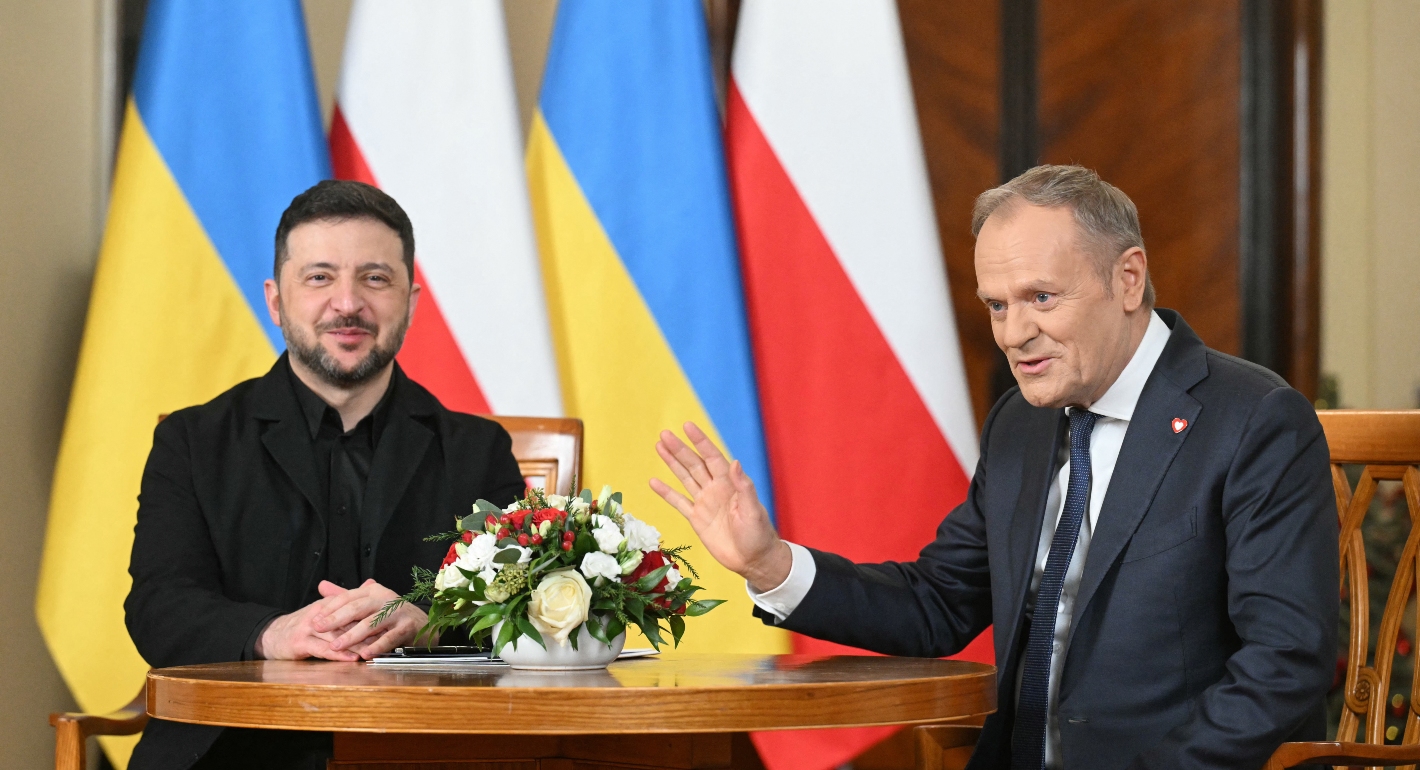
Ahead of a tough winter for Ukraine, Donald Trump’s swing back toward Russia bodes ill. But instead of panicking, Kyiv’s European allies are focusing on action.
It was a fortunate coincidence of the calendar, but one that projected more resolve and steadfastness than was probably intended.
Less than forty-eight hours after U.S. President Donald Trump announced a waiver for purchases of Russian diesel and a so-called energy ceasefire between Russia and Ukraine, one that was news to Kyiv and ignored by Moscow, the EU approved the largest expansion of its Russia sanctions list since the start of the war. Amid the international reaction, Trump renewed his call for Ukrainian President Volodymyr Zelensky to be replaced.
At the same time, at the Warsaw Security Forum, the highest ranking U.S. military official in Europe, the Supreme Allied Commander Europe General Alexus Grynkewich, attempted in a rare speech to reinforce the NATO’s deterrence by laying out his, and the alliance’s, theory of victory against Putin.
“My Theory of Victory is simple. We will block the initial attack. If the attack persists, we will blunt it and prevent enemy advance. And if required, we will break the enemy’s forces and the operational warfighting system that is arrayed against us,” he said.
And by the end of the day, French President Emmanuel Macron published video of his naval forces boarding and searching a ship in the Russian ghost fleet, used to smuggle oil products and circumvent sanctions.
The juxtaposition painted an interesting reality. Perhaps even a new normal for the alliance.
European leaders did not go into a public tailspin after a decision by a U.S. president that could potentially harm their security. With the timeline and applicability of Trump’s decision up in the air because of U.S. laws, Europeans stayed their course.
It was a stark difference with the last time Trump called for Zelensky to be removed that his administration threatened to cut off the supply of vital weapons and intelligence and that Starlink boss Elon Musk threatened to withhold access to his service.
It is perhaps a quiet signal of how things are changing in the transatlantic alliance. There was no publicly discernable urgent panic, no careful staging of videoconferences, or announcements of billion-euro acquisitions of U.S. weapons to try to placate Trump and contain the fallout.
It’s not that the potential consequences of the United States blocking further arms sales to Ukraine or cutting off the intelligence it has been providing aren’t dramatic.
Ukraine is staring at a very challenging winter ahead, and Russia’s bombing campaign over recent weeks has been ferocious and exacting, especially against the country’s energy and critical infrastructure. Kyiv is facing a critical shortage of American Patriot air defense munitions, which are the most capable system for intercepting Russian ballistic missiles—and the United States, and European firms looking to start production in 2027, cannot build fast enough.
But European leaders, including Zelensky, have learned from the many previous rounds of rollercoaster diplomacy with Trump. Their statements welcoming an energy ceasefire are meant to show that they are not obstructing the president’s desire to end this war that has stubbornly withstood his art of the deal. They have also learned that the best way to give themselves cards with the White House, and more importantly in the theater of war, is by accelerating their sanctions, producing more weapons, and increasing their readiness and resilience.
More than half of the sanctions the EU agreed at the September 12, 2026, Foreign Affairs Council are connected to the production chain of ballistic missiles, according to the bloc’s top diplomat Kaja Kallas.
Sanctions don’t replace Ukrainian air defense batteries and interceptors, but they can disrupt Russia’s ability to produce its own at speed.
Europeans are working on concretely assisting Ukraine, despite the slowness of their production lines and the limits of their fiscal space, and despite consensus over the seizing of Russian frozen assets continuing to elude them.
In mid-September, Germany got U.S. approval to transfer ten of its Patriot batteries to Ukraine, even though the notification to Congress was not accompanied by a concurrent announcement of backfill-replacement missiles being shipped to Germany.
France and Italy are meant to deliver Aster 30 missiles by the end of October, 2026, and their own air defense system, the SAMP/T batteries, by 2027.
And Europeans have massively stepped up their supply of intelligence and targeting support for Ukraine since the last time the U.S. cut off intelligence sharing.
Time is of the essence for Ukraine, as the next three months look to be the hardest when, according to Zelensky, the country has received only about one-third as many anti-aircraft missiles so far this year as it did in 2025.
It shows how much more the Europeans need to do to be able to handle a war like the one in Ukraine, with or without very minimal U.S. support.
Intra-European defense industrial cooperation is still, at best, a work in progress, where narrow local industrial and employment considerations, as well as disagreement over the desirable amount of American involvement, continue to hinder transformational leaps.
The recent failures of Franco-German cooperation on a next generation aircraft and tank, as well as their inability to come together on air-defense industrial projects are major setbacks.
Division and disunity also cast a shadow. With the EU in the last phases of ending its energy purchases from Russia, while energy prices continue to rise, mainly because of the Iran war, and as constituencies grow more disgruntled, support for resuming those Russian energy purchases could increase in certain European quarters—especially now Trump has broken the taboo. Moreover, the upcoming review of the United States’ force posture in Europe has highlighted the disparate ways various European allies prefer dealing with how America is rethinking its role in the continent’s security.
Despite these serious challenges, the past few days have shown that Europeans are maturing as geopolitical actors, even with regard to their historic American protector. In the grand scheme of things, this is a much better state of affairs for the alliance and its longevity.
Subscribe to Strategic Europe, delivered every Tuesday and Thursday!

Editor in Chief, Strategic Europe
Rym Momtaz is the editor in chief of Carnegie Europe’s blog Strategic Europe. A multiple Emmy award-winning journalist-turned-analyst, she specializes in Europe and the Middle East and the interplay between those two spaces.
Recent Work
Rym Momtaz, ed.
Rym Momtaz
Carnegie does not take institutional positions on public policy issues; the views represented herein are those of the author(s) and do not necessarily reflect the views of Carnegie, its staff, or its trustees.
While the EU and European governments are embracing the much-lauded middle-power moment, this entails three difficult conundrums.

Richard Youngs
Much has been said of the changes Brussels is trying to make to the EU enlargement process. Here’s why gradual integration might—or might not—be the answer.

Dimitar Bechev
The European Commissioner for Trade is headed to China. But after President Xi’s bridge-building visit to Washington, can a more isolated EU overcome Beijing’s stranglehold on critical raw materials? Who will blink first?
Rym Momtaz, ed.
The domestic impacts of how long it is taking to end the war in Ukraine have pushed the French electorate to the political extremes and compromised the country’s diplomatic capacity.
Rym Momtaz
Before the next wave of EU enlargement takes place, the union needs to grapple with thorny questions of how power is distributed among its members.

Emil Sondaj Hansen, Ditte Brasso Sørensen