

Commentary
Nathalie Tocci, Jan Techau
{
  "authors": [
    "Jan Techau"
  ],
  "type": "commentary",
  "blog": "Strategic Europe",
  "centerAffiliationAll": "",
  "centers": [
    "Carnegie Endowment for International Peace",
    "Carnegie Europe"
  ],
  "collections": [],
  "englishNewsletterAll": "",
  "nonEnglishNewsletterAll": "",
  "primaryCenter": "Carnegie Europe",
  "programAffiliation": "",
  "programs": [],
  "projects": [],
  "regions": [
    "Europe",
    "Russia",
    "Asia",
    "North America"
  ],
  "topics": [
    "Climate Change"
  ]
}
Source: Getty
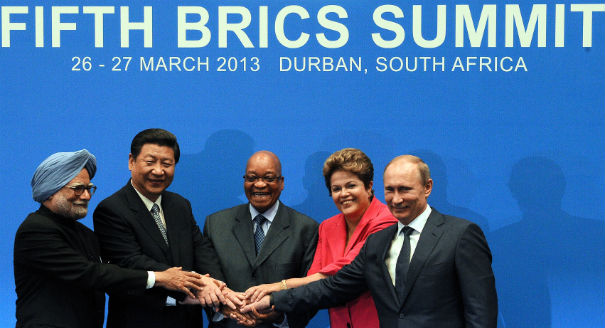
Brazil, Russia, India, China, and South Africa are setting up a development bank. That is good news, as it increases their stake in a rules-based liberal world order.
At the end of March, the five BRICS countries—Brazil, Russia, India, China, and South Africa—announced that they would establish their own development bank. Foreign Policy magazine called it the “first tangible outcome” these countries have produced since they officially started their club in 2008.
Reactions from around the world, whether welcoming or critical of the step, all pointed in the same direction: here is further proof of the West’s decline in the world. The new bank, observers said, would be the embodiment—and enabling instrument—of an alternative model of global governance. For some in the West, the announcement by the BRICS was nothing short of a declaration of war. Others stressed that little was known about the new institution, including how much money it would be able to loan and under what conditions.
There is clearly not enough information out there to judge the project on its own merits. But if the new bank ever becomes operational, the rest of the planet will finally know what model for global governance the BRICS have in mind—just as everyone dealing with the IMF and the World Bank knows that its operations are broadly based on the economically liberal Washington Consensus.
Western observers have long wondered when the emerging powers would transform from new players into full-fledged global stakeholders. Little in these countries’ behavior indicated that they felt a sense of responsibility for global stability and the rules-based liberal world order that they had relied on for their own remarkable rise.
The new BRICS development bank could be an answer to that question. Admittedly, this is a rather optimistic assessment. But the establishment of an institution of this kind will trigger all kinds of mechanisms that may have unintended consequences for the nations involved.
In essence, the new BRICS bank—if it follows the example of the World Bank and the IMF—will turn the five member countries into global taxpayers. In domestic politics, making people pay taxes is an essential step toward turning them into citizens with a share in the system. That is why in successful immigration societies, such as the United States, the tax regime is such an important instrument for the integration of the newly arrived.
In the international system, turning the BRICS into taxpayers could work similarly. By establishing a multilateral bank, as opposed to financing development ad hoc through national budgets, the BRICS will be forced to make the conditions of their lending transparent. They will also need to publicly agree on the goals and intentions governing their credit policy. Furthermore, they will be obliged to make each other accountable for the money they contribute to their common cause. In short, they will have to create a system of governance, rules, and transparency.
This is good, although the chances are that it will be difficult to square the geopolitical goals of a country like China, which is a single-party dictatorship, with those of Brazil or India, which are democracies and, for the most part, open societies where voters demand accountability from their leaders.
Even if the BRICS find enough common ground to pull it off, the new system will hardly be the rogue institution that many in the West fear. As the BRICS countries depend on free markets, the unhindered flow of goods, and basic accountability, it would be surprising if the principles behind their bank were grossly different from the ones governing the established financial institutions.
More likely, the new bank will pursue the same kind of policies as Western institutions. Remember that, in reality, all BRICS nations unequivocally embrace Western-style capitalism. After all, it has lifted tens of millions of their people out of poverty.
In the end, the BRICS will not be able to offer an alternative model of global governance. The very forces that have made these countries great in the first place will limit their potential to offer an alternative to Western principles. And a bank broadly built on norms of sound economic governance and multilateral transparency cannot, in the long run, function as a political tool to build alliances against the liberal world order. That is a fact, no matter how much money gets pumped into it, and no matter how much this might be desired by rulers in Beijing, Moscow, Caracas, or Havana.
The West should not fear the new institution. In the end, the new bank will have to look a lot like the West’s own financial instruments, even though it might take a while for the BRICS to realize it. In the meantime, the West should be confident that it still has the better offer to make. In terms of global governance, no credible alternative model has yet emerged that serves the needs and interests of billions of people better than the West’s.

Director, Europe Team, Eurasia Group
Techau is director with Eurasia Group's Europe team, covering Germany and European security from Berlin. Previously, he was director of Carnegie Europe.
Recent Work

Nathalie Tocci, Jan Techau
Jan Techau
Carnegie does not take institutional positions on public policy issues; the views represented herein are those of the author(s) and do not necessarily reflect the views of Carnegie, its staff, or its trustees.
French President Emmanuel Macron has unveiled his country’s new nuclear doctrine. Are the changes he has made enough to reassure France’s European partners in the current geopolitical context?

Rym Momtaz, ed.
European reactions to the war in Iran have lost sight of wider political dynamics. The EU must position itself for the next phase of the crisis without giving up on its principles.

Richard Youngs
Europe isn’t as weak in the new geopolitics of power as many would believe. But to leverage its assets and claim a sphere of influence, Brussels must stop undercutting itself.

Dimitar Bechev
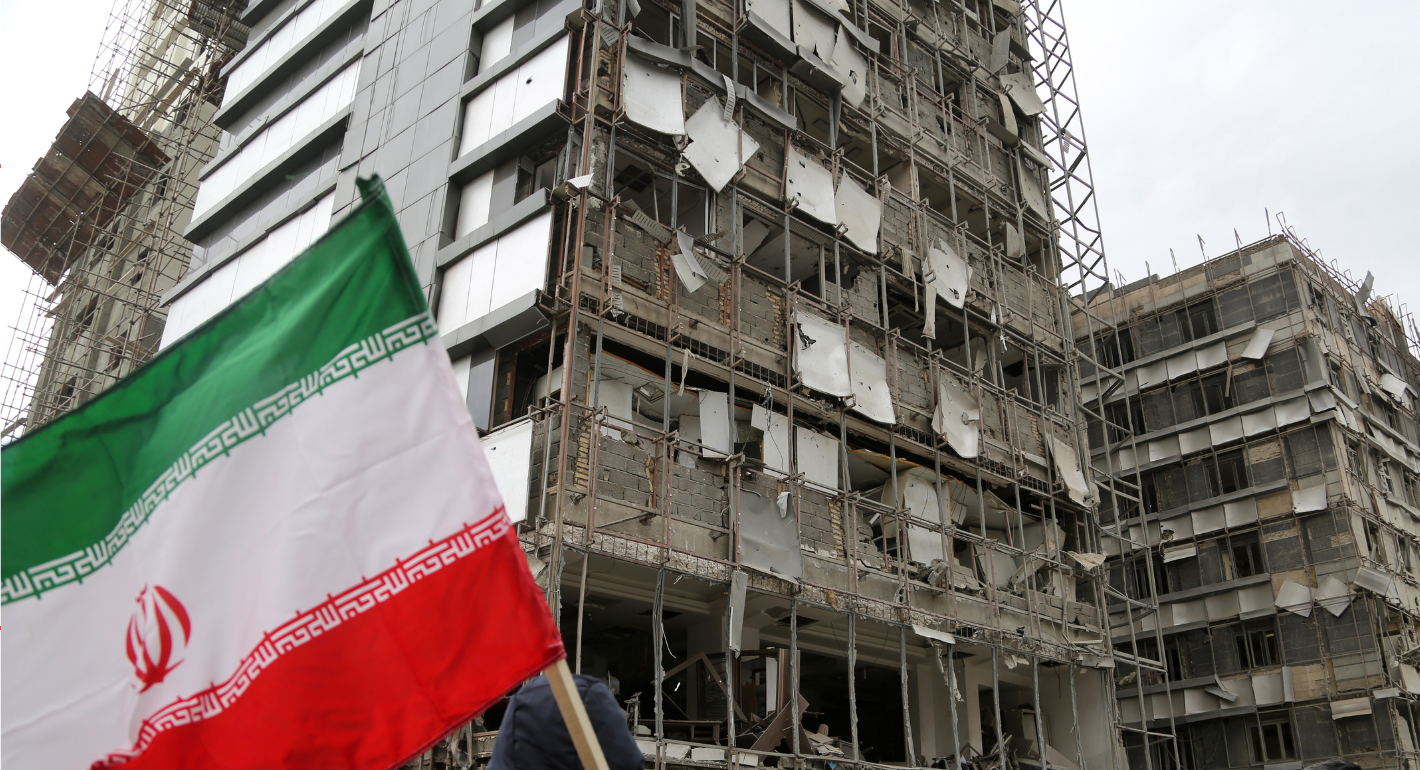
Europe’s reaction to the war in Iran has been disunited and meek, a far cry from its previously leading role in diplomacy with Tehran. To avoid being condemned to the sidelines while escalation continues, Brussels needs to stand up for international law.

Pierre Vimont
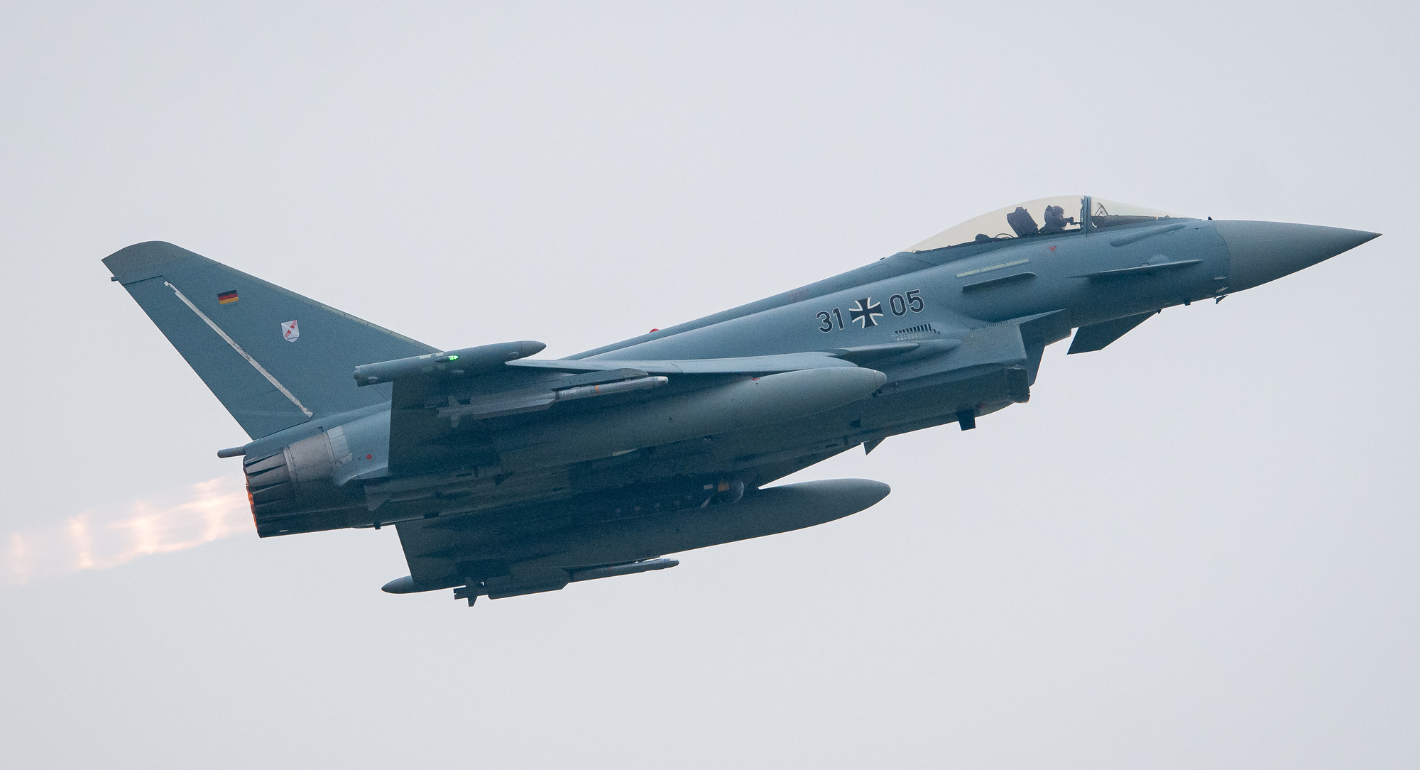
France and Germany’s failure to agree on the Future Combat Air System (FCAS) raises questions about European defense. Amid industrial rivalries and competing strategic cultures, what does the future of European military industrial projects look like?
Rym Momtaz, ed.