

Commentary
The EU can impose sanctions but struggles to enforce them without the United States. With Washington increasingly disinterested in backing European interests, the bloc must now fend for itself.
Nicu Popescu, Tiago Antunes
{
  "authors": [
    "Misha Glenny"
  ],
  "type": "commentary",
  "blog": "Strategic Europe",
  "centerAffiliationAll": "",
  "centers": [
    "Carnegie Endowment for International Peace",
    "Carnegie Europe"
  ],
  "collections": [],
  "englishNewsletterAll": "",
  "nonEnglishNewsletterAll": "",
  "primaryCenter": "Carnegie Europe",
  "programAffiliation": "",
  "programs": [],
  "projects": [],
  "regions": [
    "Europe",
    "Middle East"
  ],
  "topics": [
    "EU"
  ]
}
Source: Getty
Is the Arab Spring comparable to the 1848 revolution or the Thirty Years War in Europe? Historical analogies are close enough to induce humility and pessimism.
Even the most serious situations have aspects that verge on the absurd.
This week, as the United States was considering military strikes against Syria in response to the chemical weapons attack on a Damascus suburb, it was the know-all attitude of pundits across the world that provided this element.
They expressed three basic positions, each with various justifications:
Option B includes endless caveats and hand-wringing, but Options A and C are usually articulated with adamant resolve. That, of course, is the nature of the beast. In these situations, pundits and commentators are under enormous pressure to have a clear commitment.
Which is why I enjoyed one of Professor Dan Drezner’s tweets so much this week. The Fletcher School’s prolific blogger confessed he “does not have a firm opinion on what to do in Syria.” He also added the slightly self-deprecatory hashtag #badpundit.
Perhaps it is advancing years that lead one to become indecisive and a #badpundit. But it could also be that in the golden post-Cold War age, we have witnessed so many interventions that we can now say with some confidence that their outcome does not often bear any relation to their intended aims.
Take, for example, the intervention in Afghanistan in 2001, which was mainly launched in response to 9/11. Tony Blair, British prime minister at the time, also argued forcefully for sending in troops to rid the world of the scourge of heroin.
What happened was the opposite. In effect, overproduction became such a problem for the major producers and traffickers of heroin in Afghanistan that they periodically held back distribution of the drug in order to prop up the global market.
Idealism, as the Afghanistan war shows in many other ways, too, is not a very useful attitude to have when contemplating a military intervention. Looking at the Arab Spring and its historical antecedents, it may not serve the immediate participants all that well, either.
It was Eric Hobsbawm, the eminent Marxist historian who died in 2012, who first compared the Arab Spring to Europe’s own Spring of Nations in1848, which ended very unhappily for the idealistic revolutionaries a year later. Over the following half century, European liberals went a long way to dismantling the anciens regimes, although they often needed an intolerant nationalism to do it, culminating in the First World War.
More recently, pundits have been comparing the Arab Spring to the Thirty Years War, the horrific series of religious and great power conflicts which killed an estimated one third of the population of the territories which now make up Germany.
Despite my earlier mockery of pundits, I find it useful to ponder such analogies. Of course, a European precedent like the Thirty Years War can only act as a rough guide to what could be about to happen in the Middle East. Aside from the specific cultural and geopolitical differences between the two territories, there are numerous variables from demography to communications and, indeed, the nature of weaponry that have changed over the past 300 years.
But there are two elements of the war in Syria that may be comparable to this earlier conflict: they concern the scale of the conflict and the key to a final resolution.
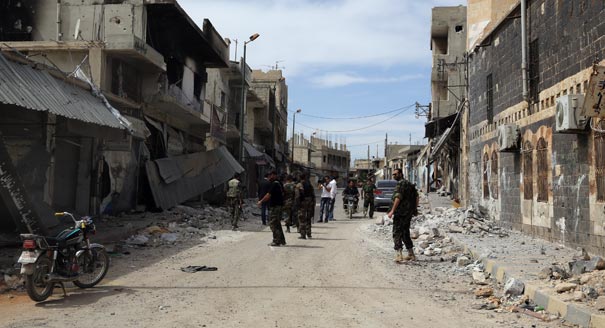
The Syrian situation is not only about the use of chemical weapons (momentous though that may be). It threatens the stability of the entire region, beginning with Lebanon, because it is making the political dynamics in all neighboring countries even more volatile.
In the years after 1618, the attempts by tiny principalities in central Europe to challenge the status quo acted as a vortex, sucking in almost every major power. The now fragmented territories of Syria can exert a similar force on the neighborhood and beyond.
The second similarity lies in the question of how you solve this. At the start of the First World War, the Balkans were referred to as a powder keg. One could have imagined the same being said about the myriad territories of the Holy Roman Empire in 1618.
In fact, the Balkans of the early twentieth century weren’t powder kegs; the various principalities, Palatinates, free cities, and Imperial concessions of the seventeenth century weren’t, either. They were merely detonators laid by the great powers.
Today’s Syrian detonator can only be disarmed if the outside parties who are indirectly engaged in the conflict are prepared to find a compromise agreement. This means the United States hammering out a deal with Russia. This agreement would then need to include the three major regional powers, Iran, Israel, and Saudi Arabia. Iran and Saudi Arabia would have to lean on their proxies to accept any deal, and Israel would have to take the peace negotiations with the Palestinians seriously.
What are the chances of that? The square root of very little. So with no viable political or diplomatic talks on track, I think we can be confident that regardless of whether the West intervenes or not, things are about to get very nasty.
Maybe Professor Drezner isn’t such a #badpundit after all.
Misha Glenny
Journalist and Broadcaster
Misha Glenny is a journalist and broadcaster whose books include The Balkans: Nationalism, War and the Great Powers: 1804-2012, McMafia: A Journey through the Global Criminal Underworld, and DarkMarket: How Hackers Became the New Mafia.
Carnegie does not take institutional positions on public policy issues; the views represented herein are those of the author(s) and do not necessarily reflect the views of Carnegie, its staff, or its trustees.

The EU can impose sanctions but struggles to enforce them without the United States. With Washington increasingly disinterested in backing European interests, the bloc must now fend for itself.


Nicu Popescu, Tiago Antunes

Russia is testing the waters of NATO’s mutual defense clause. What do strikes in Romanian territorial waters mean for the alliance’s posture toward Moscow?

Dimitar Bechev

With its public finances in shambles, the far right polling at 35 percent ahead of the 2027 presidential election, and a growing protest movement, is France’s crisis a threat to the EU’s geopolitical awakening?

Rym Momtaz, ed.

Ahead of a tough winter for Ukraine, Donald Trump’s swing back toward Russia bodes ill. But instead of panicking, Kyiv’s European allies are focusing on action.
Rym Momtaz

While the EU and European governments are embracing the much-lauded middle-power moment, this entails three difficult conundrums.

Richard Youngs