

Commentary
Dmitri Trenin
{
  "authors": [
    "Dmitri Trenin"
  ],
  "type": "commentary",
  "blog": "Strategic Europe",
  "centerAffiliationAll": "",
  "centers": [
    "Carnegie Endowment for International Peace",
    "Carnegie Europe",
    "Carnegie Russia Eurasia Center"
  ],
  "collections": [],
  "englishNewsletterAll": "",
  "nonEnglishNewsletterAll": "",
  "primaryCenter": "Carnegie Russia Eurasia Center",
  "programAffiliation": "",
  "programs": [],
  "projects": [],
  "regions": [
    "Russia"
  ],
  "topics": [
    "EU",
    "Security"
  ]
}
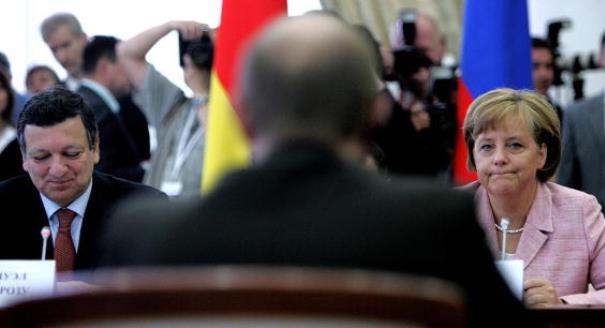
Source: Getty
The EU needs a new strategy on Russia that is informed by Europe’s values and focuses on Europe’s interests. But first, Germany needs to show more foreign policy leadership.
The forthcoming German parliamentary election is immensely important to Europe and the world, but few people outside Germany appear overly concerned. Chancellor Angela Merkel is expected to stay on, even though the composition of her governing coalition is uncertain. Once returned to power, Merkel and her colleagues will continue to face the fundamental task of providing leadership in an EU seeking to reform and reenergize itself.
Berlin also has an eminent role in helping to forge a more unified—or at least coherent—EU foreign policy, in particular toward the EU’s Eastern neighbors and Russia. On foreign policy leadership and strategizing, Berlin has been found wanting. There are growing claims that Germany’s own Ostpolitik is outdated and needs an overhaul. A debate of sorts began a few months ago, pitting those who demand a tougher public stance toward Russia, especially on values-related issues, against those who prefer a business-first approach.
Germany and the EU now need to adopt a strategy on Eastern Europe and Russia that is informed by Europe’s values and focuses on Europe’s interests. That should be a priority for whoever wins this month’s German election.
The EU’s Eastern Partnership summit in Vilnius this November could provide an opportunity for that. The initiative covers the six former Soviet republics of Armenia, Azerbaijan, Belarus, Georgia, Moldova, and Ukraine.
Of the six, two have indicated that they would lean toward Russia and the Eurasian union Moscow seeks to build. Belarus, of course, did this long ago. Yet Armenia’s recent decision in favor of economic integration with Russia, has been seen as a strategic coup for Russian President Vladimir Putin. With Russia’s economic and military integration project attracting ever more members, the question for the EU is what attitude to take toward this emerging reality. Germany’s judgment and its leadership will be crucial.
Of the remaining four countries, Azerbaijan prefers to walk alone, given its substantial energy resources. Georgia started flying EU flags years ago, and its change of government last year only reaffirmed this orientation. Moldova has been ruled for several years by a group of parties that calls itself a coalition for European integration.
The big issue is Ukraine. Viktor Yanukovych, the country’s president, has restated his intention to sign an association agreement with the EU, despite Putin’s attempts to persuade Ukrainians to switch to Moscow’s Eurasian project. How will the EU treat Kiev’s application for closer ties with Brussels, given the domestic practices of the Ukrainian elite? Again, Germany’s position will be of paramount importance.
Finally, Russia itself. Germany’s repeated attempts to help Russia modernize its economy—with the aim of also modernizing Russia’s political system—have so far failed. It was hoped that reforms would enable Russia would somehow “join with” the EU as a de facto associate. To quote former European Commission president Romano Prodi, Russia would “share everything with the union but institutions.”
Well, it has not turned out exactly that way. Two decades after the fall of Communism, Russia has a political, economic, and now an officially approved values system that is very different from the realities of today’s EU. Russia’s political elite has also opted for a great-power identity that prioritizes independence and sovereignty and seeks to minimize outside interference in its own affairs.
For Russia, the EU has long ceased to be a mentor, and it is now also being rejected as a socioeconomic model. Europeans, for their part, are becoming increasingly critical of Russia’s domestic conditions, with recent reproaches focusing on gay rights and Russian foreign policy, as symbolized by Moscow’s stance on Syria.
Berlin has stopped being Moscow’s advocate, but it has not yet taken a strategic view of its own and the EU’s relations with Russia. Europe’s strategy on Russia should maximize its soft power to build a safer neighborhood to the East. The EU needs to maximize economic opportunities, which may increase as the Russian government realizes it cannot live by oil and gas alone.
To the extent that the EU may emerge as a strategic player in the future, the EU will need to be able to partner with Russia and its Eurasian economic and security union. German leadership will be crucial for both the EU’s policy toward its Eastern neighborhood as well as the future of relations with Russia.
Former Director, Carnegie Moscow Center
Trenin was director of the Carnegie Moscow Center from 2008 to early 2022.
Recent Work
Dmitri Trenin
Dmitri Trenin
European reactions to the war in Iran have lost sight of wider political dynamics. The EU must position itself for the next phase of the crisis without giving up on its principles.

Richard Youngs
Europe isn’t as weak in the new geopolitics of power as many would believe. But to leverage its assets and claim a sphere of influence, Brussels must stop undercutting itself.

Dimitar Bechev

Europe’s reaction to the war in Iran has been disunited and meek, a far cry from its previously leading role in diplomacy with Tehran. To avoid being condemned to the sidelines while escalation continues, Brussels needs to stand up for international law.

Pierre Vimont
France and Germany’s failure to agree on the Future Combat Air System (FCAS) raises questions about European defense. Amid industrial rivalries and competing strategic cultures, what does the future of European military industrial projects look like?

Rym Momtaz, ed.
France has stopped clinging to notions of being a great power and is embracing the middle power moment. But Emmanuel Macron has his work cut out if he is to secure his country’s global standing before his term in office ends.
Rym Momtaz