

Commentary
Judy Dempsey
{
  "authors": [
    "Judy Dempsey"
  ],
  "type": "commentary",
  "blog": "Strategic Europe",
  "centerAffiliationAll": "",
  "centers": [
    "Carnegie Endowment for International Peace",
    "Carnegie Europe"
  ],
  "collections": [],
  "englishNewsletterAll": "",
  "nonEnglishNewsletterAll": "",
  "primaryCenter": "Carnegie Europe",
  "programAffiliation": "",
  "programs": [],
  "projects": [],
  "regions": [],
  "topics": [
    "EU"
  ]
}
Source: Getty
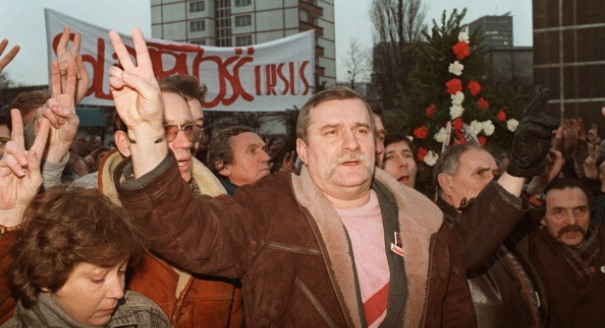
Two new movies remind Poles that they must not squander the gains of 1989. As national hero Lech Walesa turns seventy, Warsaw still has unfinished business, especially on the EU.
Polish cinema is thriving. Two of its greatest film directors, Agnieszka Holland and Andrzej Wajda, recently released new films. Both movies are about heroes, and both are hugely important for European audiences.
Holland’s Burning Bush is a powerful three-part series about Jan Palach, a Czechoslovak student who burned himself to death in Prague in protest against the Soviet-led invasion of his country in August 1968.
Wajda’s gripping film, Wałęsa, Man of Hope, is, as the title suggests, about Lech Wałęsa. This feisty and courageous shipyard worker who founded the independent trade union movement Solidarity in August 1980 shook not only Communist Poland but also the Soviet bloc and Western Europe.
Palach and Wałęsa personified the drive for freedom and democracy that would eventually reunite Europe. Yet, as Wajda himself asked, what does this past mean for the younger generation? They hardly even know who Wałęsa is.
Wajda’s film coincides with Wałęsa’s seventieth birthday this Sunday.
Wałęsa is still himself, disdainful of authority, interestingly provocative, just as he was when he was Solidarity leader or Poland’s first post-Communist president.
Many Poles mocked Wałęsa then for his gaffes, for his unpolished language and manners. They chose not to remember how this man, thanks to his charisma, his beliefs, his political instincts, and his unwillingness to be intimidated by police thugs, put the Communist regime out of business.
Of course, Mikhail Gorbachev, the Soviet Union’s last Communist president, facilitated this transformation. But ultimately, it was the Poles’ sheer doggedness that got them where they are today: part of NATO, part of the EU, part of a reunited Europe. Poland did not squander its anti-Communist revolution.
But today, this extraordinary peaceful revolution must be exploited further. With just two years until the next Polish elections, Donald Tusk’s center-right government has unfinished business to deal with. That involves Europe.
Polish officials recognize that if Poland wants a stronger say in the EU’s future direction, it needs a strong economy and it needs to adopt the euro.
Despite experiencing an economic slowdown, Poland is the only European country not to have slipped into recession during the global financial crisis or the euro crisis. That says a lot about Jacek Rostowski’s management of the economy as finance minister.
Yes, Poland has dithered over crucial reforms such as privatization and education. The Tusk government is perfectly aware of its shortcomings. It has chosen caution in the face of falling support in the polls.
But Poland could do more to set the agenda in the EU. Since the years of Wałęsa’s presidency, Warsaw has radically shifted away from an unquestioning Atlanticism. Today, it rightly believes that the administration of U.S. President Barack Obama is not particularly interested in Europe. This means that Europe must prepare to stand on its own, in particular on security and defense.
Warsaw should not wait for German Chancellor Angela Merkel and French President François Hollande to develop a modus vivendi. If Carnegie Europe’s Jan Techau is right that Merkel is skeptical of political integration, that would be against Poland’s—and Europe’s—interests.
Poland does have some clout. It is the sixth-largest country in the EU so it has the chance to make a difference. Spain and Italy, with larger populations, cannot do so at the moment because of their deep economic and political problems.
But with its increasing commitment to a European foreign, security, and defense policy, Poland could galvanize more support from its northern neighbors and the Baltic states. Warsaw could also reach out to other, smaller EU countries that have traditionally been integrationist.
Sadly, Poland cannot rely on Hungary or the Czech Republic, let alone Bulgaria and Romania, or Slovenia and Slovakia. They have become so inward-looking and corrupt that they have come close to squandering the gains of their own post-Communist revolutions.
That is why Wajda’s and Holland’s films are worth seeing. They are a special reminder about the universal courage and unquenchable thirst for freedom. The movies remind Europeans of values they must not neglect.
As ever, Wałęsa has his own views about Europe’s future. “We need to expand economic and defense cooperation and other structures to create one state from Poland and Germany in Europe,” he told Russia’s Itar-Tass news agency this week.
He has also advocated ever-closer ties between European states, even saying that he would one day, perhaps, be “president of a United States of Europe.”
Happy birthday, Lech!

Nonresident Senior Fellow, Carnegie Europe
Judy Dempsey is a nonresident senior fellow at Carnegie Europe
Recent Work
Judy Dempsey
Judy Dempsey
Carnegie does not take institutional positions on public policy issues; the views represented herein are those of the author(s) and do not necessarily reflect the views of Carnegie, its staff, or its trustees.

Are Germany’s economic, industrial, and political struggles becoming a liability for the EU’s ability to rise to the geopolitical moment?

Rym Momtaz, ed.

European Commission President Ursula von der Leyen is about to give her annual address on the state of the EU. Here’s what she won’t—but should—say.
Rym Momtaz

The aftermath of the Ceuta crisis shows Europe has drawn the wrong lessons. Rather than doubling down on failed migration policies, the EU needs to address the underlying roots of such episodes.

Richard Youngs

An overwhelming victory by a far-right-wing party in a small state in eastern Germany will have major repercussions for Chancellor Friedrich Merz’s coalition.
Judy Dempsey

Canadian Prime Minister Mark Carney has twice inspired praise for standing up to U.S. President Donald Trump: at the 2026 World Economic Forum in Davos and on Canada-U.S. trade negotiations. Is Carney showing a third way better than the EU has in dealing with the Trump administration?
Rym Momtaz, ed.