

Commentary
Richard Youngs
{
  "authors": [
    "Richard Youngs"
  ],
  "type": "commentary",
  "blog": "Strategic Europe",
  "centerAffiliationAll": "",
  "centers": [
    "Carnegie Endowment for International Peace",
    "Carnegie Europe"
  ],
  "collections": [],
  "englishNewsletterAll": "",
  "nonEnglishNewsletterAll": "",
  "primaryCenter": "Carnegie Europe",
  "programAffiliation": "",
  "programs": [],
  "projects": [],
  "regions": [
    "Middle East"
  ],
  "topics": [
    "Foreign Policy",
    "EU"
  ]
}
Source: Getty
As Europe’s humanitarian role becomes increasingly prominent, the EU must ensure that the other, more geostrategic components of its foreign policy develop in tandem.
A darkened summer witnessed death and instability on a frightening scale. Tragedy unfurled its claws in Iraq, Gaza, Libya, and eastern Ukraine; in Syria, killings have taken on a routine rhythm. In addition, record numbers of despairingly vulnerable migrants crossed the Mediterranean into southern Europe. The head of the UN Development Program notes that the current cluster of humanitarian crises is of unprecedented intensity.
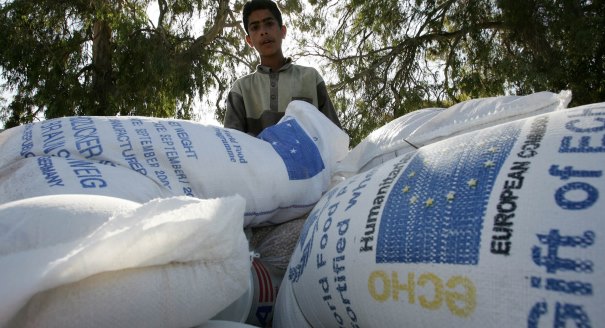
As these successive crises have deepened, Europe’s role as a lead provider of humanitarian assistance has become increasingly prominent. European emergency relief has reached new highs. This raises a crucial question: Is the EU getting the balance right between humanitarianism and other aspects of its foreign policy?
In most of the crises that currently dominate the headlines, the EU has emerged as the largest provider of humanitarian aid. This is certainly the case when the EU’s humanitarian aid body (known as ECHO) and member states are counted together, and sometimes even when ECHO is considered on its own.
The EU is rightfully proud of this status, which routinely burnishes the EU’s claim to be an ethical foreign policy actor. Member states trade competing claims to be the vanguard humanitarian. EU countries that remain agnostic over, for example, human rights and democracy promotion in contrast see humanitarian relief as an uncontestably “good” thing.To some extent, humanitarian crises have spurred new commitments in other areas of policy. In Iraq, alongside the EU activating its Emergency Response Coordination Center to pool humanitarian aid, several member states have moved to supply equipment to Kurdish forces under threat from the Islamic State.
In Gaza, the EU has proposed to lead a broader strategy of disarmament and has offered to redeploy its long-moribund border-control mission in Rafah. In Ukraine, the union has dispatched a mission to advise and train on reforming the security sector as Russian incursions have become more blatant and extensive.
Notwithstanding these moves, however, other aspects of EU foreign policy are not fully keeping pace with the “humanitarian moment.” In the crises that have menaced global order over the summer, the EU has—arguably—lent a little too heavily on humanitarianism as the main pillar of its desire to help.
From mid-2013, there was strong pressure from parts of the EU machinery for the union to prioritize impartial humanitarian access in Syria over logistical support to moderate rebel forces. Much humanitarian aid was routed through government channels, while other assistance found its way to more extreme forces. With both the government of Syrian President Bashar al-Assad and the Islamic State now entrenched, the results have hardly been neutral.
In Gaza, the EU has channeled hundreds of millions of euros in humanitarian aid into the benighted strip of land over many years. It has done so because it has excluded itself from any direct political role with Hamas, the Islamist organization that controls the territory. Unless humanitarian provisions are accompanied by measures that exert effective pressure on Israel or address the roots of political dysfunction in the Israeli-occupied territories, such provisions will fail on their own terms.
In Iraq, today’s emergency relief comes on the back of years of European disengagement. Notwithstanding a number of recent EU agreements and aid initiatives, Europe declined to trouble itself with Iraq during a period when it was already patently clear that creeping authoritarianism was seeding problems.
The EU stepped up humanitarian aid to rebel-held cities in Ukraine during the summer, even as member states declined to offer any military support to Ukrainian government forces. Yet arguably, the humanitarian situation would have improved most dramatically if those forces had been able to reestablish normal state control over all of Ukraine’s territory more quickly.
Policymakers say they are committed to “going beyond” humanitarianism through providing military training or logistical support in a range of conflict scenarios. But the key question is a far broader one: What kind of incentives can the EU offer to dampen the tensions that cause crises in the first place? If the EU is not willing to offer more to the likes of Ukraine, Iraq, and the Israeli-occupied territories, then relief operations and mediated talks will have less impact than desired.
While decisions over humanitarian aid must never be unduly warped by self-interest, neither must they unduly restrict strategic deliberation. Humanitarian assistance should not detract from longer-term political goals nor end up as a substitute for stronger, political forms of foreign policy engagement.
The EU often exhibits a conviction that it must avoid taking sides in too pronounced a manner. This is a noble sentiment that learns the right lessons from many one-sided foreign policy interventions of previous decades. But it is a sentiment that can be taken too far. Apolitical neutrality may unwittingly perpetuate the causes and cycles of violence and may actually hinder humanitarianism’s own declared goals.
While this dilemma has long been a concern over humanitarian relief, today’s tilt toward humanitarianism now makes it increasingly relevant. Diplomats do not need to be reminded that humanitarian aid targets the symptoms, not the causes, of violence and instability. The more difficult question is whether the way that humanitarian relief interlinks with other EU foreign policy instruments is making those underlying causes worse.
This is not to suggest that the EU is mistaken in offering so much humanitarian support; indeed, the union will need to keep providing emergency relief. But if the more geostrategic components of foreign policy fail to develop in tandem, today’s well-meaning humanitarianism may have profoundly undesired effects in the longer term.

Senior Fellow, Democracy, Conflict, and Governance Program
Richard Youngs is a senior fellow in the Democracy, Conflict, and Governance Program, based at Carnegie Europe. He works on EU foreign policy and on issues of international democracy.
Recent Work
Richard Youngs


Richard Youngs, Erik Jones, Dan Baer, …
Carnegie does not take institutional positions on public policy issues; the views represented herein are those of the author(s) and do not necessarily reflect the views of Carnegie, its staff, or its trustees.

Are Germany’s economic, industrial, and political struggles becoming a liability for the EU’s ability to rise to the geopolitical moment?

Rym Momtaz, ed.

European Commission President Ursula von der Leyen is about to give her annual address on the state of the EU. Here’s what she won’t—but should—say.
Rym Momtaz

The aftermath of the Ceuta crisis shows Europe has drawn the wrong lessons. Rather than doubling down on failed migration policies, the EU needs to address the underlying roots of such episodes.
Richard Youngs

An overwhelming victory by a far-right-wing party in a small state in eastern Germany will have major repercussions for Chancellor Friedrich Merz’s coalition.

Judy Dempsey

Canadian Prime Minister Mark Carney has twice inspired praise for standing up to U.S. President Donald Trump: at the 2026 World Economic Forum in Davos and on Canada-U.S. trade negotiations. Is Carney showing a third way better than the EU has in dealing with the Trump administration?
Rym Momtaz, ed.