

Commentary
Five countries staged the biggest political boycott in Eurovision history over Israel’s participation. With the FIFA World Cup and other sporting or cultural touchstones on the horizon, are boycotts effective?
Rym Momtaz, ed.
{
  "authors": [
    "Botond Feledy",
    "Andras Racz"
  ],
  "type": "commentary",
  "blog": "Strategic Europe",
  "centerAffiliationAll": "",
  "centers": [
    "Carnegie Endowment for International Peace",
    "Carnegie Europe"
  ],
  "collections": [],
  "englishNewsletterAll": "",
  "nonEnglishNewsletterAll": "",
  "primaryCenter": "Carnegie Europe",
  "programAffiliation": "",
  "programs": [],
  "projects": [],
  "regions": [
    "Europe",
    "Eastern Europe"
  ],
  "topics": [
    "Foreign Policy",
    "EU"
  ]
}
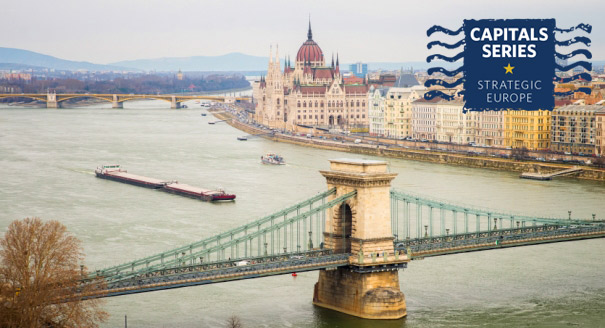
Source: Getty
Budapest’s overly close relationship to Moscow poses a strategic risk not only to Hungary’s national interests but also to the country’s EU and NATO partners.
Strategic Europe continues its series devoted to explaining the foreign and security policy ambitions of the 28 EU member states. We have asked our contributors from each capital to give a candid assessment of their country’s perception of security and strategy, with a ranking on a scale from 0 (the laggards) to 5 (the ambitious). This week, the spotlight is on Hungary.
*
Many observers perceive the Hungarian government of Prime Minister Viktor Orbán to be a Russian Trojan horse inside the EU and NATO. However, on May 5, Russian President Vladimir Putin openly threatened Hungary, saying it could seriously harm the country’s economic interests if Budapest pulled out of an agreement for the Russian energy company Rosatom to expand Hungary’s Paks nuclear power plant. This declaration indicates that Hungary’s relationship with Russia is much more complex than simply a bond between a serf and his lord.

Orbán himself might well be a Putinist. He is clearly attracted by authoritarian regimes, as he himself has declared several times, often with surprising openness. According to the recently published memoirs of Eleni Tsakopoulos Kounalakis, a former U.S. ambassador to Hungary, Orbán once told her: “All this talk about democracy is bullshit.”
However, being a Putinist is not the same as being a loyal Putin ally. In fact, Orbán has never been that. Since the beginning of his political career in the late 1980s until 2010, the Hungarian prime minister was one of Russia’s harshest critics throughout Central Europe.

In fact, the Hungarian government has been conducting a kind of multivectorial foreign policy based on maneuvering between the West and Russia. While Orbán is often critical of the EU, he is also well aware of the importance of EU funds in keeping the Hungarian economy afloat. Hence, he has never risked letting his occasional conflicts with Brussels endanger the continuous flow of EU money to Hungary. At the same time, the Orbán government has done its best to be a cooperative, reliable member of NATO to soften the criticism of Budapest coming from Washington.
As for Russia, the Orbán government has always perceived cooperation with Moscow as a project based purely on economic interests, not on any strategic commitment. Hungary’s energy dependency is crucial here: Russia is still a dominant source of Hungarian gas imports, and Hungary’s single Soviet-era nuclear power plant at Paks uses Russian fuel. By strengthening economic ties with Russia, Orbán intended to increase Budapest’s short-term political room for maneuver vis-à-vis Western partners, but without giving up Hungary’s profitable memberships in the EU and NATO.
#Orban has never been a loyal #Putin ally.Tweet This
The problem is that Moscow has different ideas about its bilateral relations. An imperial state with an imperial perspective of time, Russia focuses more on strategic interests in its ties with Hungary and is even ready to accept short-term losses to achieve its long-term goals. Budapest is important for Moscow not in and of itself but because of Hungary’s memberships in the EU and NATO: Hungary may serve as an entry point for Russia to influence decisionmaking in the two organizations and to weaken their coherence.
Russia, of course, is well aware of the foreign policy intentions of the Orbán government. Hence, by using all of its diplomatic, political, economic, and intelligence-related means, Russia has worked consistently to put Hungary in a situation in which it has to give up maneuvering and start serving Moscow’s interests. Providing support for Hungary’s openly anti-Western, far-right Jobbik party is one of Russia’s tools of influence, as Hungarian analyst Péter Krekó pointed out in a study published in March 2015.
However, the greatest success of this Russian strategy was the agreement to expand the Paks nuclear plant. In December 2013, Russia succeeded in making Hungary sign the contracts formalizing the deal, which financially and technologically ties Budapest to Moscow for decades to come.
In exchange for such a long-term, strategic commitment, the Orbán government received only benefits of a more tactical nature. Besides offering a short-term concession on the price of Hungary’s Russian gas imports, the Paks contracts prescribed that 40 percent of the construction costs would be outsourced to Hungarian subcontractors. Most probably, that will mean oligarchic groups close to the government.
It may therefore be assumed that Budapest’s decision to sign the deal was motivated by personal economic interests that overrode national ones. Another possibility is that the Hungarian foreign policy administration, which has been decimated by political cleansing, was simply unable to properly assess the risks such a commitment would pose.
Yet, the Paks power plant project has become the fork in the road for Orbán’s multivectorial foreign policy. On the one hand, Orbán made a strong commitment to Russia to build two new reactors, signed the contracts, and took the reward. On the other hand, the deal might well contradict EU regulations, as there was no request for tender and the state intends to offer a level of support that exceeds EU rules. It is therefore unlikely that Brussels would approve the proposed construction.
#Russia is becoming less patient with #Hungary.Tweet This
Hence, the moment is coming when Orbán will finally have to make an either-or choice—something he has long tried to avoid. He cannot risk a serious conflict with Brussels, but he has made too close a commitment to Moscow. Although Orbán is trying to gain some time from Moscow, Russia is becoming less and less patient, as indicated by Putin’s recent threat.
The Kremlin is therefore likely to keep up its strategy of trying to permanently link Hungary to its own camp, with the aim of weakening the EU and NATO from the inside. And if pressure needs to be used, Moscow is rarely reluctant to do so.
Before the crisis in Ukraine, Western partners might have perceived Orbán’s misguided multivectorial approach as tricky games of altogether minor significance. Now, however, Budapest’s overly close relationship to Moscow poses a strategic risk not only to Hungary’s national interests but also to the country’s EU and NATO partners. Hungary urgently needs to rebalance its foreign policy.
Botond Feledy is a foreign policy expert and founder of the Hungarian foreign policy news portal Kitekintő.
András Rácz is a senior research fellow at the Finnish Institute of International Affairs.
Botond Feledy
Kitekintő
Andras Racz
Carnegie does not take institutional positions on public policy issues; the views represented herein are those of the author(s) and do not necessarily reflect the views of Carnegie, its staff, or its trustees.
Five countries staged the biggest political boycott in Eurovision history over Israel’s participation. With the FIFA World Cup and other sporting or cultural touchstones on the horizon, are boycotts effective?

Rym Momtaz, ed.
The full list of humiliations Europe has endured since Donald Trump returned to the White House makes for grim reading. But Washington’s adversarial approach to its allies undermines its own power base.
Rym Momtaz
The closure of the Strait of Hormuz has triggered a global energy crisis, but Europe is stuck in reaction mode. Without more strategic foresight, the EU will remain dependent on fossil fuels and will never be truly secure.


Milo McBride, Pauline Gerard
After spending much of 2025 trying to placate Donald Trump, some European leaders are starting to change posture. But is even a hostile Washington still so important to Europe that the U.S. president’s outbursts are worth putting up with?
Rym Momtaz, ed.
European leaders have now not only lost faith in Donald Trump’s U.S. presidency, but also in America’s hegemony as a whole. But short-term challenges make an immediate divorce unwise.
Rym Momtaz